
In today’s highly competitive life sciences industry, brands are no longer competing only on innovation—they are competing on visibility, trust, and education. This is where biotech content marketing becomes a powerful growth engine. Unlike traditional industries, biotechnology requires a deeper level of explanation, credibility, and scientific accuracy in every piece of content.
Biotech companies operate in a space where decisions are data-driven, highly regulated, and often slow-moving. Buyers include researchers, healthcare professionals, investors, and institutions who expect clarity and authority before engaging with any brand. Because of this, content marketing is not just a marketing tactic—it is a strategic necessity.
Modern biotech companies use content to simplify complex scientific concepts, build authority in niche markets, and generate qualified leads globally. Whether it’s genomics, pharmaceuticals, medical devices, or bioinformatics, the right content strategy can transform how a brand is perceived in the industry.
At its core, biotech content marketing bridges the gap between science and communication. It translates complex innovation into understandable, valuable, and actionable insights for global audiences.
Why Biotech Content Marketing Matters in a Complex Industry
Biotechnology is one of the most sophisticated and technical industries of the world. Even the most revolutionary innovation, however, could not be a commercial success if not well communicated.
Biotech content marketing can help address this challenge by:
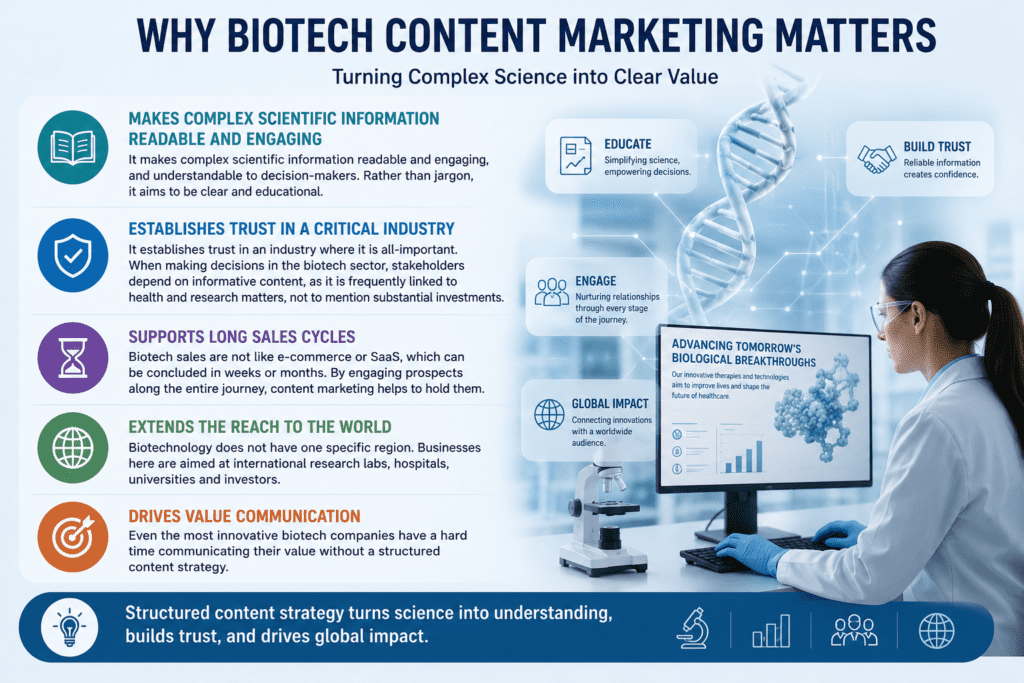
It makes complex scientific information readable and engaging, and understandable to decision-makers. Rather than jargon, it aims to be clear and educational.
It establishes trust in an industry where it is all-important. When making decisions in the biotech sector, stakeholders depend on informative content, as it is frequently linked to health and research matters, not to mention substantial investments.
Supports long sales cycles. Biotech sales are not like e-commerce or SaaS, which can be concluded in weeks or months. By engaging prospects along the entire journey, content marketing helps to hold them.
It extends the reach to the world. Biotechnology does not have one specific region. Businesses here are aimed at international research labs, hospitals, universities and investors.
Even the most innovative biotech companies have a hard time communicating their value without a structured content strategy.
Comprehensive overview of understanding the Global Audience in Biotechnology.
One of the great things about biotech content marketing is that it’s able to reach a wide range of audiences around the world. It also implies that content needs to be strategically targeted to various user groups.
The main audience is made up of researchers who need content that is data-rich, peer-reviewed and scientifically accurate. Healthcare professionals require real-life scenarios and practical application. Market potential, market scalability, and innovation impact are important to investors. Students and general audience need explanations to be simplified and educational stories to be told.
These audiences can all be balanced without compromising on the scientific accuracy of the content or its readability in a successful biotech content strategy.
One of the challenges for global brands in the biotech industry is between localization and standardization. Scientific principles are common to all countries, but regulatory frameworks, healthcare systems and the priorities of research are different in different countries. That’s why it is crucial that content is flexible and still conveys consistent brand messages.
The components of a successful biotech content strategy.
There are several components of a successful biotech content marketing campaign that helps make it cohesive, accurate and engaging.
Scientific accuracy is the most important. All content needs to be screened for technical accuracy to ensure authenticity.
Education is also a key value. Content should reflect a specific purpose – to inform, explain, or solve a problem – but not just to sell a product.
There’s a big part of discoverability that’s tied into search engine optimization. Even the best and most informative content in the realm of biotechnology can be difficult to access without SEO.
Thought leadership helps to establish a company as an expert in its field. Building trust takes time through research publications, case studies, and expert opinions.
Multi-format content = wider reach. Blogs, whitepapers, videos, webinars and infographics are all utilized to engage various audiences.
Consistency is essential. Biotech marketing isn’t about the one viral post, it’s about the ongoing education and brand presence.
In biotech content marketing, SEO and visibility play a crucial role.SEO and visibility are key factors in biotech content marketing.
One of the most crucial channels for bringing in worldwide biotech audiences is search engines. Google is where researchers and professionals typically start their research, seeking out information about disease, compounds, clinical trials or technologies.
That’s where biotech content marketing gets very close to SEO strategy. Relevant keywords, technical optimization, and backlink building can all play a role in boosting visibility for biotech companies.
But SEO in the Biotech industry is different. It requires the proper use of keywords, authoritative referencing and medically or scientifically correct explanations.
Long-form content is particularly effective, as it can delve into subjects such as gene therapy, CRISPR technology, or the steps involved in developing pharmaceuticals. Also, it is better to use a structured text with clear headings to make it easier to read and to be classified by the search engine.
Technical SEO also comes into the equation. The attributes of a fast-loading website, mobile optimization, and schema markup for medical or scientific content boosts indexing and ranking.
Content Types That Work Best in Biotech Marketing
Different content formats serve different purposes in the biotech industry.
Educational blog articles are used to explain complex topics in simple language. These are ideal for attracting organic traffic and building awareness.
Whitepapers provide in-depth research insights and are often used in B2B biotech marketing to generate leads.
Case studies demonstrate real-world applications of biotech solutions, helping build credibility with potential partners and investors.
Webinars and video content help humanize scientific topics and allow experts to explain innovations directly to audiences.
Email newsletters are used to nurture long-term relationships with researchers, institutions, and clients.
Each of these content types contributes to a comprehensive biotech content marketing ecosystem that supports both awareness and conversion.
Challenges in Biotech Content Marketing
Despite its advantages, biotech content marketing comes with several challenges.
One major challenge is maintaining scientific accuracy while keeping content engaging. Too much technical detail can overwhelm readers, while oversimplification can damage credibility.
Regulatory compliance is another important factor. Biotech content often needs to align with legal and medical regulations depending on the region.
Audience diversity also creates complexity. Writing content that appeals to both scientists and investors requires careful balance.
Additionally, long sales cycles make it difficult to measure immediate ROI from content efforts. Results often take time to materialize.
Despite these challenges, companies that invest in structured content strategies see long-term benefits in brand authority and lead generation.
The Role of Storytelling in Biotech Content
Storytelling is often underestimated in scientific industries, but it plays a crucial role in biotech content marketing.
Even in highly technical fields, people connect with stories more than data alone. Storytelling helps explain how a discovery impacts real lives, improves healthcare, or solves global challenges.
For example, instead of only explaining a new drug mechanism, content can highlight how it improves patient recovery or reduces treatment costs.
This human-centered approach makes biotech content more relatable and memorable while still maintaining scientific integrity.
Future Trends in Biotech Content Marketing
Technology-driven and data-powered communication are strongly linked to biotech content marketing’s future.
AI will be a significant part of the content creation, analysis, and personalization process. AI tools will enable biotech companies to develop more precise and effective content strategies.
More interactive content like simulations, 3D models and virtual labs will be used, enabling users to interact directly with complex scientific concepts.
As attention spans shorten around the world, video and short-form content will remain significant.
Companies will be able to provide very personalized and relevant content to investors, clinicians and researchers, based on their behaviour and interests, thanks to data-driven personalization.
Content marketing will be even more vital for education and communication in the future, as the biotech industry grows.
Conclusion
In a world where scientific innovation is accelerating rapidly, communication is just as important as discovery. Biotech content marketing has become a critical tool for companies that want to stand out in a competitive global landscape.
It enables biotech brands to educate, engage, and build trust with highly specialized audiences while improving online visibility and long-term growth.
From research-based blogs to SEO-driven strategies, content marketing helps transform complex science into meaningful communication that drives business success.
Companies that invest early in structured content strategies will continue to outperform competitors in visibility, credibility, and lead generation.
One such example in the digital marketing space is Ranking Champs, which focuses on creating SEO-driven content strategies that help businesses—including biotech brands—build authority, attract global traffic, and scale their online presence effectively.
FAQ Section
What is biotech content marketing?
Biotech content marketing is the process of creating and distributing valuable, educational, and scientific content to promote biotechnology companies, products, and services.
Why is content marketing important in biotechnology?
It helps simplify complex scientific topics, builds trust with global audiences, and supports long-term lead generation in a highly technical industry.
Who benefits from biotech content marketing?
Researchers, healthcare professionals, investors, students, and biotech companies all benefit from well-structured content strategies.
What types of content work best for biotech companies?
Blogs, whitepapers, case studies, webinars, and educational videos are the most effective content types in the biotech industry.
How does SEO impact biotech content marketing?
SEO helps biotech companies improve online visibility, attract organic traffic, and reach global audiences searching for scientific information.
Is biotech content marketing suitable for startups?
Yes, startups can use content marketing to build authority, attract investors, and educate their target audience from the beginning.

James Robert
James Robert is a seasoned Off-Page SEO expert specializing in strategic link building, digital outreach, and authority growth for businesses aiming to improve search visibility and rankings. With over five years of hands-on experience, he helps brands strengthen their online presence through high-quality backlinks, niche-relevant placements, and ethical SEO practices aligned with Google’s guidelines. James’s core specialties include guest posting, blogger outreach, niche edits, brand mentions, and backlink profile optimization. He is highly skilled at building relationships with authoritative publishers and executing scalable outreach campaigns that drive long-term organic growth. As a contributor to leading marketing platforms, James regularly shares actionable insights on off-page SEO strategies, link acquisition, and sustainable ranking improvements, helping businesses achieve consistent and measurable SEO success.