

Online market research helps businesses understand what customers want, how they make purchasing decisions, and where new opportunities exist. Instead of relying on assumptions, companies can study consumer behavior, competitors, market trends, and customer feedback using digital channels.
Surveys, interviews, search data, online communities, reviews, and website analytics can reveal valuable customer insights that support smarter decisions. The process also helps businesses validate product ideas, identify gaps in the market, improve marketing strategies, and understand changing demand.
When combined with reliable market intelligence and competitive analysis, digital research provides a clearer picture of the market and helps organizations turn research findings into practical, data-driven strategies for sustainable growth.
What Is Online Market Research?
Online market research is the process of collecting, analyzing, and interpreting information about a market, target audience, customers, competitors, and industry through digital channels.
It can involve original information collected directly from participants or existing information gathered from reliable online sources. Depending on the research objective, businesses may use qualitative, quantitative, exploratory, descriptive, or causal research.
The purpose is not simply to collect more data. Effective research answers specific business questions and converts evidence into insights that can guide product development, marketing, pricing, positioning, customer experience, and growth strategies.
Why Is Online Market Research Important?
Customers leave digital signals everywhere. Their searches, reviews, survey responses, website interactions, social conversations, and purchasing behaviors can reveal valuable information about their needs and expectations.
Businesses can use these insights to identify market opportunities, understand customer pain points, evaluate demand, monitor competitors, recognize emerging trends, and reduce the uncertainty surrounding important decisions.
Online research is also highly flexible. Companies can reach geographically dispersed audiences, conduct remote interviews, distribute surveys quickly, analyze digital behavior, and update their findings as markets change.
What Can Online Market Research Help You Discover?
A well-designed research project can answer questions about both the market and the people within it. You may want to know who your ideal customers are, what problems they experience, what solutions they currently use, or what prevents them from purchasing.
Research can also reveal how customers perceive your brand, which features they value, how much they are willing to pay, which competitors they consider, what topics they search for, and where gaps exist in the current market.
These insights create a connection between customer needs and business opportunities.
Types of Online Market Research
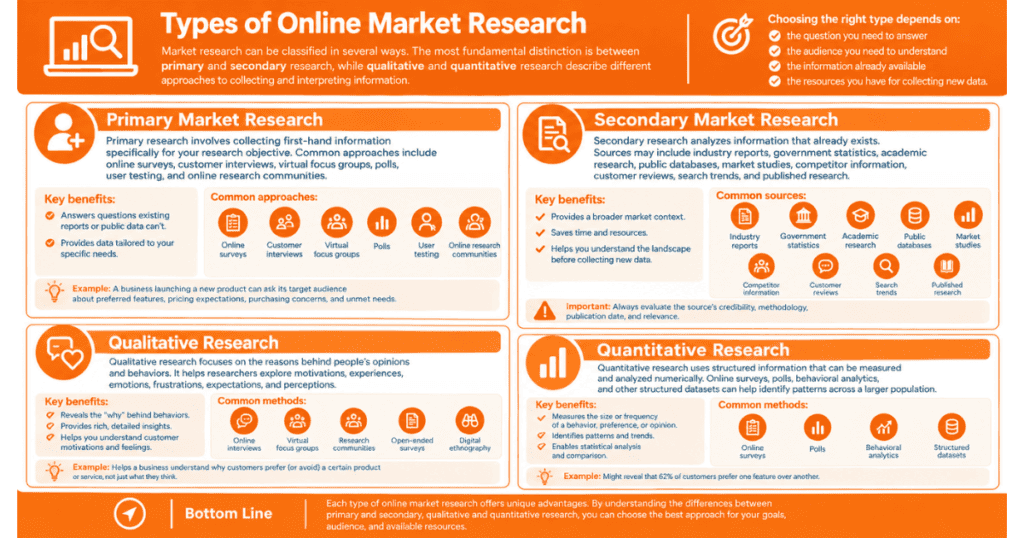
Market research can be classified in several ways. The most fundamental distinction is between primary and secondary research, while qualitative and quantitative research describe different approaches to collecting and interpreting information.
Choosing the right type depends on the question you need to answer, the audience you need to understand, the information already available, and the resources you have for collecting new data.
Primary Market Research
Primary research involves collecting first-hand information specifically for your research objective. Common approaches include online surveys, customer interviews, virtual focus groups, polls, user testing, and online research communities.
Because the information is collected for a specific purpose, primary research can address questions that existing reports or public data cannot answer. For example, a business launching a new product can ask its target audience about preferred features, pricing expectations, purchasing concerns, and unmet needs.
Secondary Market Research
Secondary research analyzes information that already exists. Sources may include industry reports, government statistics, academic research, public databases, market studies, competitor information, customer reviews, search trends, and published research.
It is often useful as a starting point because it establishes the broader market context before a company invests in original research. However, the source’s credibility, methodology, publication date, and relevance should always be evaluated.
Qualitative Research
Qualitative research focuses on the reasons behind people’s opinions and behaviors. It helps researchers explore motivations, experiences, emotions, frustrations, expectations, and perceptions.
Online interviews, virtual focus groups, research communities, open-ended surveys, and digital ethnography can provide this type of insight. Qualitative research is particularly useful when a business needs to understand why customers behave a certain way.
Quantitative Research
Quantitative research uses structured information that can be measured and analyzed numerically. Online surveys, polls, behavioral analytics, and other structured datasets can help identify patterns across a larger population.
For example, quantitative research might reveal that a particular percentage of customers prefer one feature over another. It is useful for measuring the size or frequency of a behavior, preference, or opinion.
Online Market Research Methods
No single method works for every research question. The strongest approach is usually the one that matches the type of evidence you need.
| Research objective | Method | Useful insight |
| Measure customer preferences | Online surveys | Opinions, preferences, satisfaction |
| Understand customer motivations | Online interviews | Needs, experiences, pain points |
| Test reactions to a concept | Virtual focus groups | Group reactions and perceptions |
| Monitor customer conversations | Online communities | Changing attitudes and feedback |
| Study website behavior | Analytics and heatmaps | Engagement and user journeys |
| Discover search demand | Keyword research | Search interests and market demand |
| Understand competitors | Competitive analysis | Pricing, positioning, offers |
| Track brand conversations | Social listening | Sentiment and emerging topics |
| Test user experience | Remote usability testing | Friction and usability issues |
| Analyze existing information | Secondary research | Industry and market context |
Using several complementary methods can strengthen your conclusions. For instance, search data may show increasing interest in a topic, while interviews can explain why customers are interested and what they actually expect from available solutions.
How to Conduct Online Market Research
A successful research project begins with a clear objective. Rather than starting with a tool, define the business decision you need the research to support.
Next, identify your target audience and formulate specific research questions. Determine whether you need quantitative measurements, qualitative insights, existing market information, or a combination of all three.
Select the appropriate research methods and data sources, then collect the information systematically. Once the data is available, look for patterns, differences between audience segments, recurring pain points, competitor gaps, and changes in market demand.
Finally, turn the findings into actionable recommendations. Research has limited value when the information remains in a spreadsheet or report and never influences a product, campaign, customer experience, or strategic decision.
How to Define Your Research Objective
A vague objective can produce a large amount of irrelevant information. A focused objective tells you exactly what to investigate and prevents the research process from becoming unnecessarily broad.
Instead of asking, “What does our market want?” consider a question such as, “Which features matter most to our target customers when choosing this type of product?” The second question gives you a clear direction for selecting participants, questions, data sources, and analysis methods.
How to Identify Your Target Audience
Your research participants should reflect the people whose decisions matter to the business. Define relevant characteristics such as demographics, location, industry, job role, interests, purchasing behavior, needs, or stage in the buying journey.
Audience segmentation can make findings more useful. Different customer groups may have completely different motivations, budgets, expectations, and pain points, so treating an entire market as one audience can hide important patterns.
Online Surveys, Interviews, and Focus Groups
Online surveys are effective when you need structured feedback from a broader audience. They can measure customer satisfaction, product preferences, brand awareness, purchasing behavior, and opinions in a format that is relatively easy to compare.
Interviews and focus groups provide deeper context. Virtual interviews explore individual experiences and motivations, while online focus groups allow participants to respond to ideas and interact with one another. These approaches are especially valuable when understanding the reason behind a behavior is more important than simply measuring it.
Online Communities and Digital Ethnography
Online research communities allow participants to discuss experiences, answer questions, react to concepts, and provide feedback over an extended period. This makes them useful for exploratory research and ongoing customer insight.
Digital ethnography takes a behavioral perspective by examining how people interact, communicate, and make decisions in digital environments. These methods can uncover subtle motivations that structured surveys may not capture.
Using Search Data for Market Research
Search behavior can provide clues about what people are interested in, the problems they are trying to solve, and how demand changes over time. Keyword research and search trend analysis can therefore contribute to market and audience research.
However, search volume should not automatically be treated as proof of purchasing demand. Search intent, competition, audience relevance, seasonality, and commercial context all need to be considered before drawing conclusions.
Using Customer Reviews for Research
Customer reviews are a valuable source of unsolicited feedback. Positive comments can highlight features customers appreciate, while negative reviews can expose recurring frustrations, product weaknesses, service problems, or unmet expectations.
Analyzing reviews across multiple businesses can also reveal patterns within a market. Repeated complaints may represent opportunities for product improvements or differentiation.
Social Listening and Consumer Insights
Social listening involves monitoring online conversations about brands, products, competitors, and industry topics. It can help identify sentiment, frequently discussed issues, emerging trends, and changes in public perception.
The information becomes more useful when it is compared with other evidence. Social conversations may reveal what people are saying, while surveys, interviews, and behavioral data can help establish how widespread a particular issue actually is.
Competitor Analysis as Part of Market Research
Understanding customers is only one part of understanding a market. Competitive analysis helps businesses examine how other companies approach pricing, products, positioning, content, customer experience, promotions, and audience targeting.
The goal is not to copy competitors. Instead, research should reveal patterns, strengths, weaknesses, market gaps, and opportunities for differentiation. Comparing competitor activity with customer feedback can help identify areas where existing solutions fail to meet expectations.
Online Market Research Tools
Research tools should be selected according to the question you are trying to answer. Analytics platforms can reveal website behavior, keyword tools can uncover search demand, survey software can collect structured feedback, and social listening platforms can monitor digital conversations.
Heatmaps and session recordings can help identify user experience problems, while competitor intelligence tools can provide information about traffic, visibility, content, and market positioning. Research databases can supplement these sources with broader industry information.
A tool should support a research strategy rather than become the strategy itself. More software does not necessarily mean better research.
How to Analyze Market Research Data
Data analysis involves looking beyond individual responses to identify meaningful patterns. Grouping information by customer segment, behavior, purchase stage, or demographic characteristics can reveal differences that are hidden in overall averages.
For qualitative information, look for recurring themes, motivations, objections, and language customers use to describe their problems. For quantitative data, examine frequencies, percentages, trends, relationships, and meaningful differences between groups.
The final goal is to move from data to insight. A useful insight explains what the evidence means and why it matters to the business.
How to Make Market Research More Reliable
Good research depends on reliable information and sound methodology. Poor sampling, leading questions, outdated sources, inaccurate data, and confirmation bias can all distort the results.
Use credible sources, define your audience carefully, write neutral questions, and evaluate whether your participants accurately represent the population you are studying. When an important conclusion depends on one source, validate it with additional evidence where possible.
Data privacy and research ethics are equally important. Participants should understand how their information is collected and used, and businesses should follow applicable privacy requirements when handling personal information.
Common Challenges in Online Market Research
One challenge is information overload. The internet contains enormous amounts of data, but not all of it is relevant, accurate, current, or trustworthy.
Another challenge is bias. People may give socially desirable answers in surveys, online discussions may overrepresent highly vocal users, and researchers may unintentionally interpret evidence in ways that support their existing assumptions.
Technology can also create complexity. Using too many platforms without a defined research framework can produce fragmented information instead of useful insights. Clear objectives and consistent analysis are more important than the number of tools involved.
Common Online Market Research Mistakes
Starting research without a specific question is one of the most common mistakes. It can result in excessive data collection without a clear path toward a decision.
Another mistake is relying on a single source or method. A survey may tell you what customers prefer, but an interview can explain why. Analytics may show where users leave a website, while usability testing can reveal what caused the problem.
It is also important not to confuse correlation with causation. Two trends occurring at the same time do not necessarily mean that one caused the other.
Online Market Research Examples
Imagine an ecommerce business considering a new product category. It could begin by examining search trends and industry data to understand demand, then analyze competitors to compare products, prices, positioning, and customer reviews.
The business could follow this with an online survey to measure customer preferences and interviews to explore purchasing motivations. Combining these findings would provide stronger evidence for product development, pricing, and marketing decisions.
A B2B company could use a similar process to study a new market. Industry research could establish market conditions, competitor analysis could reveal positioning gaps, and interviews with decision-makers could uncover buying criteria and objections.
Online Market Research vs. Traditional Market Research
Traditional market research can involve in-person interviews, physical surveys, face-to-face focus groups, and other offline methods. Online research moves many of these activities into digital environments.
Digital methods can make research more flexible by allowing businesses to reach remote audiences, collect responses quickly, analyze online behavior, and conduct research without requiring participants to be physically present.
However, moving research online does not remove the need for sound methodology. Sampling, question design, data quality, privacy, analysis, and interpretation remain critical regardless of the research channel.
Best Practices for Better Research
The strongest research projects stay focused on a business decision. Start with a question, choose the evidence needed to answer it, and select methods that match the audience and objective.
Use multiple reliable data sources when appropriate, separate observations from assumptions, and document how conclusions were reached. Revisit important findings as customer behavior and market conditions change.
Most importantly, communicate insights in a way decision-makers can use. A concise finding connected to a specific action is more valuable than pages of disconnected statistics.
Frequently Asked Questions
What is online market research?
Online market research is the process of collecting and analyzing information about customers, competitors, markets, and industry trends through digital channels. It can include surveys, interviews, focus groups, online communities, search data, reviews, analytics, and secondary research.
What are the main types of online market research?
The main types include primary and secondary research, as well as qualitative and quantitative research.
What are common online market research methods?
Common methods include online surveys, virtual interviews, online focus groups, research communities, competitor analysis, social listening, keyword research, website analytics, customer review analysis, usability testing, and digital ethnography.
How do you conduct online market research?
Define a research objective, identify your target audience, create focused research questions, select appropriate methods and data sources, collect information, analyze the findings, validate important conclusions, and convert the results into actionable business decisions.
What are the benefits of online market research?
It can help businesses understand customer needs, identify market trends, evaluate competitors, validate product ideas, discover opportunities, improve marketing, understand customer experience, and reduce uncertainty when making business decisions.
Conclusion
Online market research helps turn customer behavior, market trends, competitor information, and digital data into actionable business insights. By defining clear objectives, choosing suitable methods, validating information, and connecting findings to real decisions, businesses can understand their market more accurately and build strategies around evidence rather than assumptions.

James Robert
James Robert is a seasoned Off-Page SEO expert specializing in strategic link building, digital outreach, and authority growth for businesses aiming to improve search visibility and rankings. With over five years of hands-on experience, he helps brands strengthen their online presence through high-quality backlinks, niche-relevant placements, and ethical SEO practices aligned with Google’s guidelines. James’s core specialties include guest posting, blogger outreach, niche edits, brand mentions, and backlink profile optimization. He is highly skilled at building relationships with authoritative publishers and executing scalable outreach campaigns that drive long-term organic growth. As a contributor to leading marketing platforms, James regularly shares actionable insights on off-page SEO strategies, link acquisition, and sustainable ranking improvements, helping businesses achieve consistent and measurable SEO success.