
Building quality backlinks is an important part of a successful SEO strategy, but finding the right opportunities can be time-consuming. Marketers need to research competitors, evaluate websites, discover relevant prospects, and manage outreach while maintaining link quality.
The right Link Building Tools can simplify these tasks by bringing backlink research, competitor analysis, link prospecting, and outreach automation into a more organized workflow. Whether you are a beginner, freelancer, or SEO agency, the right software can help you discover valuable opportunities and monitor your backlink profile more efficiently.
This guide explores the key features, use cases, metrics, benefits, and selection factors to help you choose tools that support a practical and sustainable link-building strategy.
What Are Link Building Tools?
Link-building software is designed to help marketers research, discover, qualify, acquire, and monitor backlinks. Depending on the platform, it may include backlink databases, competitor analysis, prospecting, outreach, email discovery, link auditing, or monitoring features.
Some solutions focus on a single stage of the process, while others combine several SEO functions. The best choice depends on your campaign goals, website size, budget, and the type of backlinks you want to acquire.
Why Are Link Building Tools Important for SEO?
Manual backlink research can quickly become difficult when you need to examine hundreds of websites. Checking authority, relevance, traffic, existing links, contact details, and content quality for every prospect can consume valuable time.
SEO software helps organize this research. It can uncover referring domains, reveal competitor link opportunities, identify broken links, find potential prospects, and track the progress of outreach campaigns.
The purpose is not to collect as many backlinks as possible. A successful strategy focuses on earning relevant, trustworthy links that make sense for the audience and the content.
What Can Link Building Tools Do?
Modern SEO platforms can support almost every stage of a link-building campaign. They can help you research backlink profiles, discover potential websites, compare competitors, identify link gaps, find contact information, and organize outreach.
Advanced solutions may also support link monitoring, lost-link recovery, broken-link discovery, anchor-text analysis, link-risk evaluation, and campaign reporting.
This makes the technology useful for both small businesses and large SEO teams. However, the features you need will depend on whether your main goal is research, prospecting, outreach, auditing, or campaign management.
15 Best Link Building Tools for SEO
Different tools solve different link-building problems. Some specialize in backlink databases and competitor research, while others focus on prospecting, email discovery, outreach, auditing, or monitoring.
The following 15 platforms cover the main stages of a modern link-building workflow and can be evaluated according to your campaign requirements.
| Tool | Best For | Main Strength |
| Ahrefs | Backlink research | Backlink and competitor analysis |
| Semrush | All-in-one SEO | Backlink Gap and prospect research |
| Majestic | Link intelligence | Trust Flow and Citation Flow |
| Moz Link Explorer | Link analysis | Link metrics and discovery |
| BuzzStream | Outreach management | Prospect and relationship management |
| Pitchbox | Outreach automation | Prospecting and outreach campaigns |
| Respona | Link outreach | Prospect discovery and personalized outreach |
| Snov.io | Outreach and prospecting | Email discovery and automation |
| Hunter | Email finding | Business contact discovery |
| Skrapp | Email prospecting | Professional email discovery |
| BuzzSumo | Content research | Content and influencer discovery |
| Screaming Frog | Link auditing | Website crawling and link analysis |
| LinkResearchTools | Advanced backlink analysis | Link risk and competitive research |
| SE Ranking | SEO and backlink monitoring | Backlink tracking and analysis |
| Google Search Console | Free monitoring | Website backlink data |
1. Ahrefs
Ahrefs is widely used for backlink research, competitor analysis, and link opportunity discovery. Its backlink database allows users to investigate referring domains, anchor text, linked pages, and competitor link profiles.
Its competitor research capabilities can help identify websites that link to competing content. This makes it useful for finding potential prospects and understanding how other websites in your niche acquire backlinks.
2. Semrush
Semrush provides backlink analysis alongside broader SEO research features. Its backlink-related functions can help identify referring domains, analyze competitor profiles, and discover backlink gaps.
It is particularly useful for marketers who want to connect link-building research with keyword research, content analysis, organic visibility, and broader SEO campaign management.
3. Majestic
Majestic focuses heavily on link intelligence and backlink analysis. Its Trust Flow and Citation Flow metrics provide additional ways to evaluate the quality and influence of backlink profiles.
The platform can be useful when your primary goal is understanding the structure and quality of links pointing toward a domain or specific URL.
4. Moz Link Explorer
Moz Link Explorer provides backlink research and link analysis features that help users investigate linking domains, discovered links, and authority-related metrics.
It can be useful for SEO professionals who want a straightforward way to evaluate potential prospects and compare backlink profiles during link research.
5. BuzzStream
BuzzStream focuses on digital outreach and relationship management. It helps organize prospects, manage communication, track outreach activity, and maintain campaign information.
For teams handling many prospects, keeping outreach organized can be as important as finding the prospects themselves. A centralized workflow can reduce missed follow-ups and duplicated communication.
6. Pitchbox
Pitchbox is designed around prospecting and outreach campaign management. It can help users discover prospects, organize campaigns, personalize outreach, and track responses.
This makes it useful for agencies and SEO teams managing larger outreach campaigns where manual spreadsheet management becomes difficult.
7. Respona
Respona combines prospect discovery with outreach workflows. It can help marketers identify relevant opportunities and create personalized campaigns based on the prospect and content involved.
Its workflow is useful for campaigns involving content promotion, digital PR, guest contributions, resource opportunities, and other relationship-based link acquisition methods.
8. Snov.io
Snov.io combines lead generation, email discovery, verification, and outreach automation. These capabilities can support link-building campaigns that depend heavily on finding and contacting relevant website owners.
Its prospecting and email workflow can reduce repetitive contact research while allowing marketers to manage outreach campaigns from a central platform.
9. Hunter
Hunter specializes in finding professional email addresses and supporting email verification. It can be useful when a link-building prospect has been identified but the appropriate contact information is difficult to locate.
Accurate contact discovery can improve outreach efficiency, particularly when campaigns target editors, content managers, marketing teams, or business owners.
10. Skrapp
Skrapp is an email-finding platform designed to help users discover professional contact information. It can support link prospecting by helping identify people who may be responsible for website content or partnerships.
It is most useful when combined with a strong prospect qualification process. Finding an email address is only valuable when the underlying website is relevant and worth contacting.
11. BuzzSumo
BuzzSumo is primarily useful for content research, discovery, and identifying influential publishers and content creators. These capabilities can support link-building campaigns by revealing content that attracts attention and potential publishing opportunities.
Researching popular topics can also help you create link-worthy content before beginning outreach. This shifts the focus from simply asking for links to producing something publishers have a reason to reference.
12. Screaming Frog
Screaming Frog is a website crawler that can help identify internal and external link issues. It is particularly useful for auditing large websites and finding broken links, redirects, orphaned pages, and other technical problems.
Although it is not primarily an outreach platform, technical link auditing can uncover link reclamation opportunities and help ensure that valuable pages are accessible to users and search engines.
13. LinkResearchTools
LinkResearchTools provides advanced backlink analysis and competitive research capabilities. It can help users investigate backlink profiles, evaluate link risks, discover competitive opportunities, and analyze the overall structure of a website’s links.
This type of detailed analysis can be particularly useful for websites with large backlink profiles or complex SEO requirements.
14. SE Ranking
SE Ranking combines backlink analysis and monitoring with broader SEO functionality. Its backlink features can help users discover links, monitor changes, evaluate referring domains, and keep track of acquired or lost backlinks.
Ongoing monitoring is important because a link that exists today may later disappear, change attributes, or point to a different destination.
15. Google Search Console
Google Search Console is a free resource that provides website owners with useful search performance and backlink information. It can help you understand which websites and pages are associated with your site from Google’s perspective.
It does not replace a large commercial backlink database, but it is an important starting point for small websites and beginners who want to understand their existing link profile without paying for software.
Best Link Building Tools by Use Case
There is no single solution that is perfect for every SEO campaign. Some platforms are built around backlink databases, while others focus on prospecting, email outreach, or link monitoring.
| Tool Type | Best For | Main Purpose | Ideal User |
| Backlink Research Tool | Backlink analysis | Discover and analyze links | SEO professionals |
| Competitor Research Tool | Link gap analysis | Find competitor opportunities | Marketers |
| Link Prospecting Tool | Finding prospects | Discover relevant websites | Outreach teams |
| Email Finder | Contact discovery | Find business contacts | Outreach specialists |
| Outreach Platform | Campaign management | Manage link campaigns | Agencies |
| Link Monitoring Tool | Tracking backlinks | Monitor acquired links | SEO teams |
| Link Audit Tool | Link evaluation | Review backlink profiles | Website owners |
| Website Crawler | Technical audits | Find internal and external link issues | Technical SEOs |
| Prospect Database | Website discovery | Build outreach lists | Link builders |
| SEO Reporting Tool | Performance tracking | Measure campaign progress | Agencies |
How to Choose a Link Building Tool?
Start with your actual workflow instead of choosing software simply because it has a large feature list. A freelancer may need affordable backlink research and prospecting, while an agency may require automation, reporting, multiple projects, and team collaboration.
Consider database size, data accuracy, prospect quality, competitor research, outreach features, integrations, reporting, ease of use, and scalability. Pricing should also be compared against the amount of time the platform can save.
A useful platform should make your process more efficient without encouraging low-quality or unnatural link-building practices.
Backlink Research and Competitor Analysis
Backlink research helps you understand how websites in your industry earn links. You can examine referring domains, linked pages, anchor text, link attributes, and the overall strength of a backlink profile.
Competitor analysis takes this research further. By comparing several competing websites, you can discover common referring domains and identify websites that may also be relevant to your content.
This process can uncover opportunities that are difficult to find through ordinary search. Instead of creating a prospect list from scratch, you can use existing backlink patterns to guide your research.
Link Prospecting: Finding the Right Opportunities
Link prospecting involves finding websites that could potentially link to your content. Good prospects are usually relevant to your industry, serve a genuine audience, and publish useful content.
Search operators, backlink databases, resource-page research, competitor analysis, digital PR research, and content discovery can all help build a prospect list.
However, a website should not become a prospect simply because it has a high authority score. Relevance and editorial quality are equally important when deciding whether a link opportunity is worth pursuing.
What Makes a Backlink High Quality?
A high-quality backlink usually comes from a relevant website with useful content and a genuine audience. The link should fit naturally within the surrounding information and provide a reason for readers to visit the destination.
Look beyond surface-level metrics. Consider topical relevance, organic visibility, referring domains, content quality, link placement, outbound-link patterns, and whether the website appears to maintain meaningful editorial standards.
A relevant contextual link can be more valuable for your strategy than an unrelated backlink selected only because of a high numerical metric.
Important Backlink Metrics to Understand
SEO platforms use different measurements to help users evaluate websites and backlink profiles. Common metrics include Domain Authority, Domain Rating, Authority Score, Trust Flow, Citation Flow, referring domains, organic traffic, and backlink counts.
These metrics are useful for comparison and research, but they are not direct guarantees of search performance. Search engines use many signals, and third-party authority metrics are only estimates.
For better prospect evaluation, combine several signals rather than allowing one score to make the decision.
Domain Authority, Domain Rating, and Authority Metrics
Authority metrics estimate the strength of a website or its backlink profile. They can make prospect qualification faster because they provide a standardized way to compare domains.
However, a high authority score does not automatically mean that a website is a good link opportunity. A website can have strong metrics but little topical connection to your business.
Use authority metrics as a filtering system, then manually review relevance, content quality, organic visibility, audience, and the potential context of the backlink.
Trust Flow and Citation Flow
Trust-oriented metrics attempt to estimate the quality and trustworthiness of a site’s backlink network, while citation-oriented measurements generally focus more on the quantity or influence associated with links.
| Metric | What It Measures | Main Focus | How to Use It |
| Trust Flow | Quality of backlinks | Trust and link quality | Check whether links come from trustworthy sources |
| Citation Flow | Influence based on backlinks | Link quantity and influence | Compare the strength and volume of a link profile |
| Referring Domains | Number of unique websites linking to a site | Link diversity | Check whether backlinks come from different domains |
| Domain Authority | Estimated website authority | Overall link strength | Compare potential link prospects |
| Domain Rating | Strength of a website’s backlink profile | Backlink authority | Evaluate and compare potential prospects |
These measurements can help identify unusual backlink patterns and compare different domains. They become more useful when combined with other indicators rather than treated as standalone SEO scores.
The same principle applies to every third-party backlink metric: use it to support your judgment, not replace it.
Link Building Outreach and Prospect Management
Once you have qualified prospects, outreach becomes the next important stage. A good outreach process keeps prospects organized and makes it easier to personalize communication.
Email discovery and verification features can help identify appropriate business contacts. Outreach platforms can then organize conversations, follow-ups, campaign stages, and responses.
Personalization remains important. A message that clearly explains why the content is relevant to the recipient’s audience is more useful than a generic template sent to hundreds of unrelated websites.
Link Building Automation
Automation can reduce repetitive work such as prospect organization, contact discovery, follow-up scheduling, reporting, and backlink monitoring.
However, automation should support quality rather than replace it. Automatically generating thousands of prospects or sending identical messages can create inefficient campaigns and poor-quality relationships.
The most effective approach combines automated data collection with human review, personalization, and editorial judgment.
How Beginners Can Use Free Link Building Tools?
Beginners do not need to pay for expensive SEO software right away. Free Link Building Tools can help you learn how backlinks work, find potential link opportunities, research competitors, and check your own website’s backlink profile without a large budget.
Free resources are also useful for finding content ideas, identifying broken links, checking indexed pages, and discovering websites related to your niche. They are a good starting point for small websites and beginners who are still learning SEO.
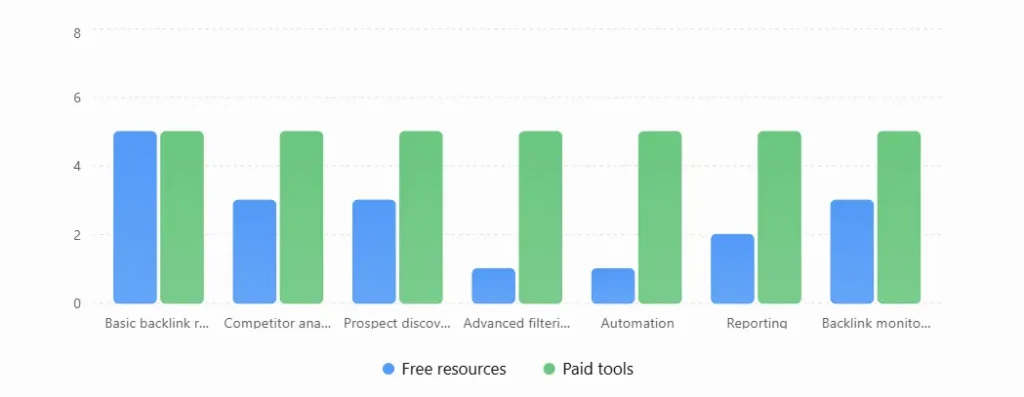
As your website grows and your campaigns become more active, paid tools can save time by providing larger backlink databases, advanced competitor research, prospect filtering, automation, and detailed reporting.
Free vs Paid Link-Building Resources
Illustrative comparison of the capabilities commonly available at different stages of an SEO campaign.
How to Build a Link-Building Campaign?
Start by defining the type of backlink you want. A resource-page link, editorial mention, guest contribution, digital PR placement, or broken-link opportunity may require a different prospecting approach.
Next, research relevant websites and qualify them using topical relevance, organic visibility, content quality, authority metrics, and audience fit. Remove prospects that appear irrelevant or low quality.
After qualification, find appropriate contacts and create personalized outreach. Track communication, follow-ups, responses, acquired links, and campaign performance in one organized workflow.
Finally, monitor the backlinks you earn. Links can disappear, change attributes, move to different pages, or become inaccessible, so ongoing monitoring is an important part of sustainable SEO.
How to Find Competitor Link Opportunities?
Competitor backlink analysis is one of the most useful applications of backlink research. Start by identifying websites that consistently link to several competitors within the same industry.
Look for patterns rather than copying every competitor link. If several relevant websites reference similar resources, studies, guides, or industry content, those patterns may reveal opportunities for your own strategy.
The next step is to determine whether your content genuinely deserves a mention. Creating something more useful, more current, more detailed, or more relevant can improve the reason for outreach.
Common Link-Building Mistakes
One common mistake is focusing entirely on authority metrics. Numbers can help with filtering, but they cannot determine relevance, editorial quality, or whether a link makes sense for users.
Another problem is pursuing quantity over quality. Large numbers of weak or unrelated backlinks can distract from the goal of building a trustworthy backlink profile.
Over-automated outreach is another issue. Sending identical messages at scale may save time initially but can reduce response quality. Strong campaigns combine efficient technology with human research and personalization.
Are Link Building Tools Worth the Investment?
For websites that regularly perform SEO, professional software can save substantial research time. Large backlink databases, competitor analysis, prospecting features, outreach management, and monitoring can make recurring campaigns much easier to manage.
For smaller websites with occasional link-building needs, free or limited resources may be enough. The right investment depends on how frequently you build links and how much manual research your team currently performs.
Instead of asking whether expensive software is always necessary, consider whether its data and automation features solve a real problem in your workflow.
How to Measure Link-Building Success?
The number of acquired backlinks is only one campaign measurement. A stronger evaluation considers referring domains, link relevance, organic visibility, referral traffic, target-page performance, and the quality of acquired placements.
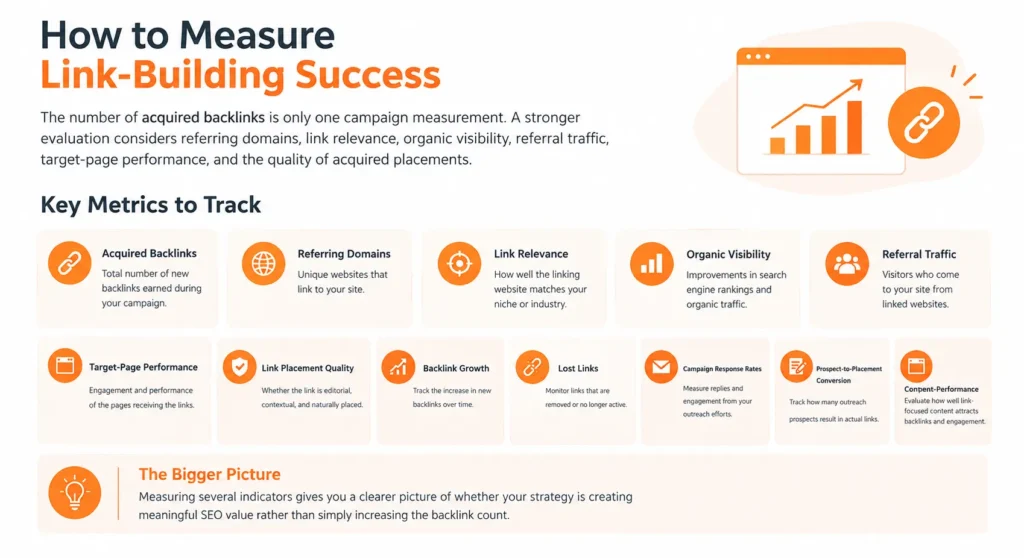
You can also monitor changes in backlink growth, lost links, campaign response rates, prospect-to-placement conversion, and the performance of content created specifically to attract links.
Measuring several indicators gives you a clearer picture of whether your strategy is creating meaningful SEO value rather than simply increasing the backlink count.
What to Look for in a Link-Building Platform?
The ideal platform should provide reliable data and make your workflow easier. Look for useful filtering, accurate backlink information, competitor research, prospect discovery, contact management, monitoring, reporting, and practical integrations.
Ease of use also matters. A platform with hundreds of features can still be inefficient if important information is difficult to find or if the workflow requires excessive manual steps.
Scalability is another consideration. Your requirements may change as your website grows, so choose a solution that can support larger campaigns without making your process unnecessarily complicated.
Conclusion
The right Link Building Tools can simplify backlink research, competitor analysis, prospecting, outreach, monitoring, and campaign measurement. Instead of chasing links based only on authority scores, build your strategy around relevance, quality, useful content, and genuine audience value. When technology supports thoughtful SEO decisions, your link-building process becomes more efficient and sustainable.
Frequently Asked Questions
What are link building tools used for?
They help SEO professionals research backlinks, analyze competitors, discover prospects, evaluate websites, manage outreach, monitor acquired links, and identify new link opportunities.
Are free tools enough for link building?
Free resources can be enough for basic research and small campaigns. Larger campaigns may benefit from paid databases, automation, advanced filtering, contact discovery, and monitoring features.
Should I focus on Domain Authority or Domain Rating?
Neither metric should be used alone. Authority scores can help compare websites, but relevance, traffic, content quality, referring domains, link placement, and audience fit provide additional context.
Can link-building software guarantee higher rankings?
No. Software can improve research and campaign efficiency, but it cannot guarantee search rankings.
How many backlinks should I build?
There is no universal number that applies to every website. Focus on earning relevant, useful backlinks from quality sources instead of setting an arbitrary monthly backlink target.
Featured Blogs

10 Best Backlink Software for SEO
Today, search engines heavily rely on backlinks to evaluate your website's credibility and authority. One powerful strategy gaining traction is...
Automated Link Building: The Future of SEO Success
Digital marketers, SEO specialists, and agencies all around the world are using automated link building to stand out in the...

James Robert
James Robert is a seasoned Off-Page SEO expert specializing in strategic link building, digital outreach, and authority growth for businesses aiming to improve search visibility and rankings. With over five years of hands-on experience, he helps brands strengthen their online presence through high-quality backlinks, niche-relevant placements, and ethical SEO practices aligned with Google’s guidelines. James’s core specialties include guest posting, blogger outreach, niche edits, brand mentions, and backlink profile optimization. He is highly skilled at building relationships with authoritative publishers and executing scalable outreach campaigns that drive long-term organic growth. As a contributor to leading marketing platforms, James regularly shares actionable insights on off-page SEO strategies, link acquisition, and sustainable ranking improvements, helping businesses achieve consistent and measurable SEO success.