
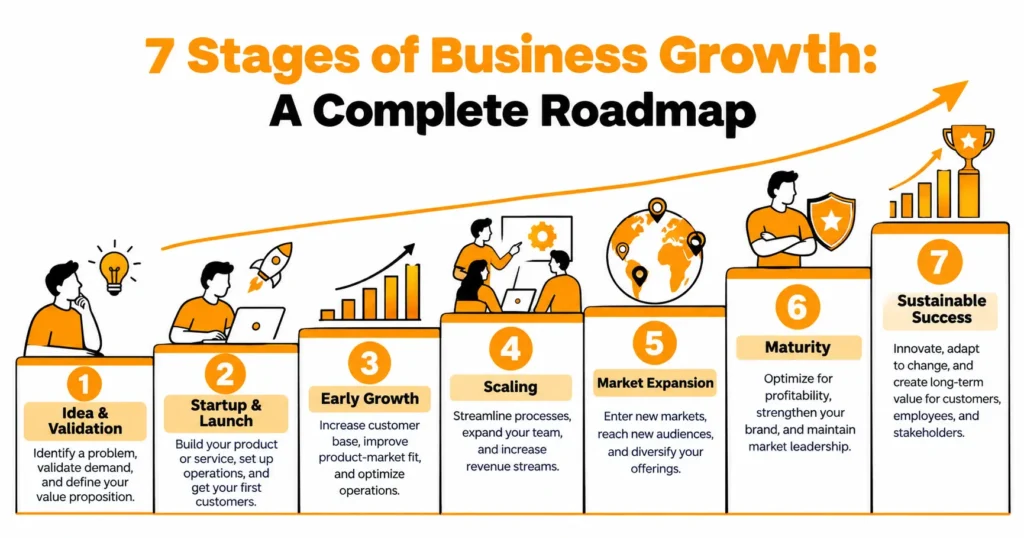
Every business goes through different challenges as it moves from an idea to a stable and growing company. Understanding the 7 stages of business growth helps owners recognize their current position, prepare for new challenges, and make smarter decisions at every phase.
From startup growth and customer acquisition to business scaling, leadership development, and market expansion, each stage requires a different approach. A company that succeeds in its early years may need completely different systems and strategies as its team and operations become more complex.
By understanding these growth stages and their key priorities, business owners can identify potential problems earlier, strengthen their operations, and build a clear path toward sustainable growth.
What Are the 7 Stages of Business Growth?
The 7 stages of business growth represent the major phases a company can experience as it develops from an early idea into a mature organization. Each stage brings different goals, risks, management requirements, and operational challenges.
There is no universal timeline for moving through these stages. A technology startup, local service company, manufacturer, and professional firm may experience the same general phases at very different speeds.
A practical growth model includes seed and validation, startup, early growth, established operations, expansion, maturity, and renewal or transition.
The 7 Stages of Business Growth at a Glance
| Stage | Primary Focus | Common Pain Point | Growth Priority |
| Seed | Validate the opportunity | Uncertain demand | Market research |
| Startup | Build a customer base | Cash flow | Product-market fit |
| Early Growth | Increase capacity | Workload and hiring | Systems |
| Established | Strengthen operations | Complexity | Efficiency |
| Expansion | Enter new opportunities | Resources | Scalable growth |
| Maturity | Maintain performance | Competition | Innovation |
| Renewal or Transition | Prepare for the future | Market disruption | Transformation |
This framework should be treated as a guide rather than a rigid formula. A company can remain in one stage for years, move rapidly through several stages, or encounter setbacks that create challenges associated with an earlier phase.
Stage 1: Seed and Business Idea Validation
The first stage begins with an idea, customer problem, market opportunity, or new business concept. The company may have few employees, limited revenue, and an untested business model.
The biggest question is whether there is a real market for the proposed product or service. Entrepreneurs need to understand customer needs, competitors, pricing, demand, and the value their business can provide.
Market research and customer conversations can help validate assumptions before significant resources are invested. Testing a minimum viable offer can also provide useful feedback about whether customers are willing to pay.
Main Challenges in the Seed Stage
Uncertain demand, limited funding, unclear positioning, and an unproven business model are common challenges. Founders may also try to serve too many customer groups instead of identifying a specific target market.
The priority should be building a strong foundation rather than pursuing growth at any cost. A clear value proposition, realistic financial plan, defined audience, and validated offer can prepare the business for market entry.
Stage 2: Startup and Market Entry
After validating the opportunity, the business begins turning its concept into a functioning operation. The focus shifts toward acquiring customers, generating revenue, improving the product or service, and developing a recognizable market position.
Customer acquisition becomes particularly important. Marketing, sales, referrals, partnerships, and other channels can help the company create its first reliable source of demand.
Managing Cash Flow During the Startup Stage
Cash flow is one of the most important concerns for an early business. Sales may increase while expenses for employees, technology, inventory, marketing, and operations continue to put pressure on available cash.
Business owners should monitor income and expenses closely, establish realistic budgets, and understand how long available funds can support operations. Revenue growth is valuable, but sustainable growth requires financial control.
Stage 3: Early Business Growth
Early growth begins when customer demand becomes more consistent and the business starts handling greater volumes of work. Revenue may increase, new employees may be hired, and the founder may begin building a larger team.
This stage often exposes weaknesses that were easy to manage when the company was small. Informal processes can become confusing when several people perform the same tasks or when customers expect faster service.
Why Delegation Becomes Important
A founder cannot continue doing every sales, operational, administrative, and customer-service task forever. Delegation allows employees and managers to take ownership of defined responsibilities.
Successful delegation requires clear expectations, authority, training, and accountability. The goal is not simply to give people more work but to create a structure where responsibilities can be managed without constant founder involvement.
Building Systems for Sustainable Growth
Business processes should become more consistent as the company expands. Standard operating procedures, customer relationship management, project management, financial reporting, and workflow automation can reduce unnecessary manual work.
Strong systems make the organization less dependent on individual employees and help maintain quality while demand increases.
Stage 4: Established Business and Professional Management
An established business generally has a stronger customer base, recognizable operations, experienced employees, and more predictable revenue. The central challenge now changes from survival to effective management and continued performance.
Organizational complexity can increase quickly. Departments may develop different priorities, communication can become slower, and decisions may require coordination between multiple managers.
Developing a Professional Management Structure
Leadership must evolve as the organization grows. Instead of making every operational decision, the founder may begin managing through department heads, senior managers, and specialized teams.
A clear management structure can improve accountability and decision-making. Employees should understand who owns each responsibility, how performance is measured, and how information moves through the organization.
Improving Operational Efficiency
Established businesses should regularly review their processes for unnecessary costs, delays, duplicated work, and quality problems. Technology and automation can improve efficiency, but only when they solve a genuine operational need.
The objective is to create a business that can deliver consistent results without depending on constant intervention from the owner.
Stage 5: Expansion Into New Markets
Expansion occurs when a company moves beyond its existing market, customer base, products, or geographic area. It may introduce new services, enter another region, target a new audience, or develop additional distribution channels.
Expansion creates significant opportunities, but it also increases risk. A strategy that works in the existing market may not automatically succeed in a new one.
Preparing for Business Expansion
Before expanding, a company should evaluate market demand, competition, pricing, resources, staffing, technology, and financial capacity. Market research can reveal whether the new opportunity is large enough to justify the investment.
Leadership should also determine whether existing systems can support additional customers. Expanding a weak operation can multiply existing problems rather than solve them.
Managing Resources During Expansion
Growth requires more than additional sales. Companies may need new employees, managers, equipment, technology, inventory, suppliers, marketing resources, and working capital.
A detailed expansion plan can help leadership estimate costs, establish targets, assign responsibilities, and monitor performance. Controlled expansion is generally easier to manage than growth that happens without sufficient operational preparation.
Stage 6: Maturity and Strategic Growth
Maturity means the company has established a strong operational foundation and developed a stable position in its market. However, maturity does not mean that growth is finished.
Customer expectations, competitors, technology, and economic conditions continue to change. A company that depends entirely on an old product, process, or business model can eventually lose its competitive position.
Preventing Business Stagnation
Mature organizations should look for opportunities to improve products, strengthen customer relationships, enter relevant markets, automate inefficient processes, and develop new revenue streams.
Innovation does not always require creating an entirely new product. It can involve improving customer experience, changing delivery methods, adopting new technology, or finding a more efficient business model.
Strategic Planning at the Maturity Stage
Long-term planning becomes increasingly important as organizational complexity increases. Leaders should consider future market conditions, talent requirements, technology investments, financial performance, and potential growth opportunities.
Strategic planning helps the company move beyond short-term decisions and build a clearer direction for sustainable growth.
Stage 7: Renewal, Transformation, or Business Transition
The final stage can take several forms. A mature company may continue expanding, reinvent its business model, introduce new products, prepare for succession, merge with another organization, or plan an eventual exit.
The important issue is maintaining adaptability. Businesses that continue learning and responding to market changes can create new growth opportunities even after reaching maturity.
When a Business Needs Renewal
Declining demand, changing customer preferences, new technology, increased competition, or falling profitability can signal that the existing strategy needs to change.
Renewal may involve repositioning the brand, entering a new market, changing the product portfolio, improving operations, developing new leadership, or adopting a different business model.
How to Identify Your Current Growth Stage?
Knowing the 7 stages of business growth is only useful when you can connect the framework to your own organization. The best way to identify your stage is to examine the business’s dominant challenge.
If you are still testing demand and searching for your first customers, your business is likely in an early phase. If demand is increasing faster than your team can handle, you may be entering a growth phase.
If your main problems involve management layers, internal communication, standardized processes, or departmental coordination, the organization is likely becoming more mature.
A business entering new geographic markets or customer segments may be experiencing expansion, while a mature company struggling with market disruption may need renewal and innovation.
Employee Growth and Organizational Complexity
Employee numbers can provide a useful indication of organizational development, but they should never be treated as universal stage boundaries. A company with ten employees can have more operational complexity than another company with fifty employees.
The more important issue is how responsibilities are structured. As teams grow, businesses generally need clearer roles, stronger management, better communication, and more formal processes.
Leadership should therefore monitor both workforce size and organizational complexity when planning the next phase of growth.
Key Business Challenges Across the Growth Cycle
Different stages create different pain points. Early companies often struggle with validation, customer acquisition, funding, and cash flow. Growing companies commonly face hiring, delegation, workload, and process problems.
Established organizations may struggle with management complexity, communication, efficiency, and competition. Expansion introduces market-entry and resource challenges, while mature businesses may need to address innovation, stagnation, and changing customer expectations.
Recognizing the challenge early gives leaders an opportunity to solve the underlying problem before it becomes a major barrier to growth.
Key Metrics to Track at Every Stage
Business growth should be measured with more than revenue. A company can increase sales while becoming less profitable or creating serious cash-flow problems.
Important performance indicators can include revenue growth, profit margin, operating costs, cash flow, customer acquisition cost, customer lifetime value, conversion rate, retention rate, employee productivity, and market share.
The right metrics depend on the stage. An early business may prioritize customer acquisition and product-market fit, while a mature organization may focus more on profitability, retention, efficiency, innovation, and market position.
How to Move From One Growth Stage to the Next?
Moving forward requires solving the constraints of the current stage. A business should not rush into expansion if its finances, customer service, staffing, or operational processes cannot handle additional demand.
Before scaling, leadership should assess whether the business has repeatable processes, reliable financial controls, capable employees, effective management, and sufficient market demand.
The transition should also be supported by measurable objectives. Clear revenue targets, hiring plans, process improvements, customer goals, and financial forecasts can turn business growth from an informal ambition into a manageable strategy.
Leadership Changes as the Business Grows
Leadership is one of the most significant changes throughout the business lifecycle. Founders often begin as the primary decision-maker and gradually become responsible for building leaders rather than controlling every task.
Delegation becomes essential as the organization expands. Managers can take ownership of daily operations while senior leadership concentrates on strategy, culture, financial performance, innovation, and long-term planning.
This shift can be challenging because founders may be reluctant to give up responsibilities. However, effective delegation creates a stronger organization by distributing knowledge, authority, and accountability.
Common Mistakes That Slow Business Growth
Growing too quickly can create serious problems when infrastructure cannot keep pace with demand. Hiring without clear roles, accepting unprofitable customers, and expanding without sufficient working capital can put unnecessary pressure on the business.
Another common mistake is failing to document important processes. When knowledge exists only in the founder’s head, the company becomes difficult to scale and vulnerable when key employees leave.
Ignoring existing customers can also hurt long-term performance. Customer retention, service quality, employee development, financial discipline, and innovation should remain priorities throughout the business lifecycle.
Is Business Growth Always Linear?
Business growth should be treated as a flexible framework rather than a fixed sequence. Economic downturns, new competitors, funding challenges, leadership changes, and shifts in customer demand can alter a company’s growth path.
A business may remain in one stage for a long period, move quickly through several phases, or return to earlier challenges after launching a new product or entering an unfamiliar market.
The purpose of a growth framework is therefore not to predict exactly what will happen. It is to help leadership recognize current conditions and make informed decisions about what the organization needs next.
How to Build a Sustainable Business Growth Strategy?
Sustainable growth requires alignment between customers, people, processes, finances, and leadership. Increasing sales without strengthening these areas can create operational pressure rather than lasting success.
A strong growth strategy should connect short-term objectives with long-term goals. It should also account for available resources, market opportunities, competitive conditions, financial capacity, and the organization’s ability to deliver consistently.
The best strategy is one that matches the company’s current capabilities while preparing it for future complexity.
Frequently Asked Questions
What are the 7 stages of business growth?
The 7 stages of business growth can be viewed as seed and validation, startup, early growth, established operations, expansion, maturity, and renewal or transition.
What is the most difficult stage of business growth?
The most challenging stage depends on the company. Early businesses may struggle with funding and customer acquisition, while larger organizations may face management complexity, delegation, competition, or innovation challenges.
How can I identify my business growth stage?
Start by identifying the company’s dominant challenge. Consider whether you are validating an idea, acquiring customers, managing rapid growth, building management systems, expanding into new markets, or protecting an established position.
Why is delegation important when a business grows?
Delegation allows responsibility to move from the founder to capable employees and managers.
Can a business move backward in its growth cycle?
Yes. A company can experience declining revenue, reduced demand, financial pressure, or major market disruption.
Conclusion
The 7 stages of business growth provide a useful roadmap for understanding how companies evolve from an early idea into established, expanding, and mature organizations. By recognizing the current stage, addressing its biggest challenges, strengthening leadership and systems, tracking meaningful metrics, and preparing for the next transition, businesses can create a stronger foundation for sustainable long-term growth.

James Robert
James Robert is a seasoned Off-Page SEO expert specializing in strategic link building, digital outreach, and authority growth for businesses aiming to improve search visibility and rankings. With over five years of hands-on experience, he helps brands strengthen their online presence through high-quality backlinks, niche-relevant placements, and ethical SEO practices aligned with Google’s guidelines. James’s core specialties include guest posting, blogger outreach, niche edits, brand mentions, and backlink profile optimization. He is highly skilled at building relationships with authoritative publishers and executing scalable outreach campaigns that drive long-term organic growth. As a contributor to leading marketing platforms, James regularly shares actionable insights on off-page SEO strategies, link acquisition, and sustainable ranking improvements, helping businesses achieve consistent and measurable SEO success.