
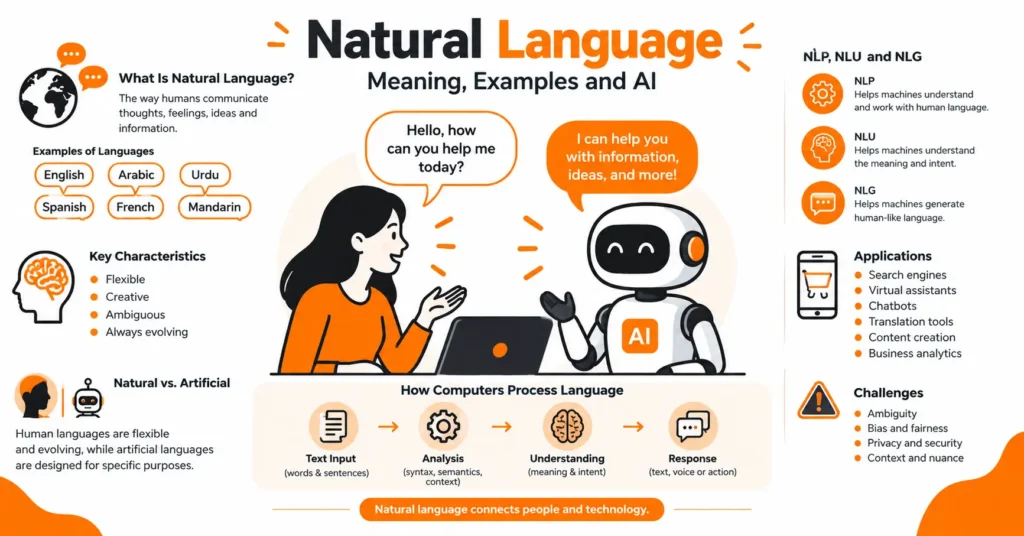
Natural language is the everyday way people communicate ideas, questions, emotions, and information through spoken or written words. Unlike programming or formal languages, it develops naturally within communities and changes over time.
English, Urdu, Arabic, Spanish, and many other human languages are common examples. Its meaning can depend on grammar, context, tone, vocabulary, and cultural expressions, which makes it both flexible and complex.
As technology advances, artificial intelligence increasingly needs to understand human communication. This is where natural language processing (NLP) becomes important, helping computers analyze, interpret, and generate language.
From machine learning and chatbots to large language models, language technology now shapes how people interact with modern digital systems.
Why Is Natural Language Important?
Language is one of the primary ways people interact with one another and increasingly with technology. People can communicate complex ideas without following rigid rules or knowing how a computer internally processes information.
As artificial intelligence becomes more conversational, understanding human language has become increasingly important. Search engines, virtual assistants, chatbots, translation platforms, and generative AI all depend on technologies that can process language effectively.
How Does Natural Language Work?
Human communication involves much more than individual words. People combine words according to grammatical structures while relying on context, previous knowledge, tone, and social conventions to understand the intended message.
For example, the statement “It is cold here” could simply describe the temperature or indirectly suggest that someone should close a window. Humans can often infer the intended meaning automatically, whereas an AI system must analyze linguistic and contextual patterns.
What Are the Characteristics of Natural Language?
Human language is flexible, creative, ambiguous, and constantly evolving. People can create sentences they have never heard before and still understand them because they understand vocabulary, grammar, context, and meaning.
Another important characteristic is ambiguity. A single word can have multiple meanings, and the correct interpretation may depend entirely on the surrounding sentence or situation. Slang, idioms, accents, abbreviations, and cultural references add further complexity.
Examples of Natural Language
English is one of the most widely used examples, but natural human communication exists across thousands of languages. Each language can have distinctive vocabulary, grammatical structures, pronunciation patterns, and cultural expressions.
Even within one language, communication varies between regions and communities. Dialects, informal expressions, internet slang, and new terminology demonstrate how quickly language can adapt to social and technological changes.
Natural Language vs Artificial Language
A human language develops primarily through communication among communities, while an artificial language is deliberately designed according to specific objectives or rules. Artificial systems can be created for communication, experimentation, logic, or other specialized purposes.
The distinction is useful because not every language people encounter is designed in the same way. Some systems prioritize flexibility and expression, while others prioritize consistency, precision, or a specific technical function.
| Language Type | Purpose | Example | Main Characteristic |
| Human language | Everyday communication | English | Flexible and evolving |
| Constructed language | Deliberately created communication | Esperanto | Intentionally designed |
| Formal language | Precise symbolic communication | Mathematical notation | Strict structure |
| Programming language | Giving instructions to computers | Python | Rule-based syntax |
| Machine language | Direct computer instructions | Binary code | Low-level representation |
Natural Language vs Formal Language
Formal languages use clearly defined rules for constructing valid expressions. Mathematics, logic, and computer systems often rely on formal structures because precision is essential.
Human communication is considerably more flexible. A person can understand a sentence containing a grammatical mistake, missing information, or informal wording because context helps fill in the gaps.
Natural Language vs Programming Language
Programming languages are designed to provide computers with precise instructions. Their syntax and structure must generally follow predefined rules so that software can interpret commands correctly.
Human communication does not work this way. People can understand abbreviations, incomplete sentences, spelling mistakes, humor, and implied meanings without requiring every part of a message to follow a rigid structure.
How Do Computers Understand Natural Language?
Computers process language differently from humans. A computer does not automatically understand a sentence simply because it contains familiar words. Language must be converted into representations that algorithms and models can analyze.
Traditional systems may break text into tokens, identify grammatical structures, recognize entities, and analyze relationships between words. Modern AI models can learn complex patterns across enormous amounts of language data and use those patterns to interpret or generate text.
What Is Natural Language Processing?
Natural Language Processing, or NLP, is a field of artificial intelligence and computational linguistics focused on enabling computers to process human language. It can work with written text, spoken language, or both.
NLP combines techniques from linguistics, machine learning, deep learning, and computer science. It supports tasks such as text classification, translation, sentiment analysis, information extraction, speech recognition, summarization, and conversational AI.
How Does Natural Language Processing Work?
NLP systems typically begin by receiving text or speech as input. Text can be cleaned and divided into smaller units through processes such as normalization and tokenization.
The system can then analyze linguistic and contextual patterns using statistical models, machine learning, deep learning, or large language models. Depending on the objective, the output might be a classification, translation, summary, answer, recommendation, or generated response.
What Are NLP Techniques?
Different NLP tasks require different techniques. Tokenization divides text into manageable units, while part-of-speech tagging identifies whether words function as nouns, verbs, adjectives, or other grammatical categories.
Other techniques focus on named entity recognition, sentiment analysis, text classification, machine translation, speech recognition, question answering, and information extraction. Modern systems increasingly combine several techniques within a single AI workflow.
Syntax, Semantics, and Pragmatics in Language
Syntax concerns the way words are arranged to form sentences. Semantics focuses on the meaning of words, phrases, and sentences, while pragmatics considers how context influences the intended meaning.
These areas are important because a grammatically correct sentence can still be misunderstood without context. AI language systems therefore need to recognize both linguistic structure and relationships between words, concepts, and situations.
What Is Natural Language Understanding?
Natural Language Understanding, commonly called NLU, focuses on interpreting what a person means. It can involve identifying intent, entities, relationships, sentiment, and contextual information within a message.
For example, when someone asks a virtual assistant to “book a flight to Dubai tomorrow,” an NLU system needs to recognize the user’s intention and extract important information such as the destination and date.
What Is Natural Language Generation?
Natural Language Generation, or NLG, focuses on producing readable human language from data, instructions, or model-generated information. It allows software to transform structured information into sentences and responses.
NLG is used in conversational assistants, automated reporting, summaries, personalized messages, and generative AI. Modern language models can generate responses dynamically rather than relying entirely on predefined sentences.
How Do Large Language Models Use Human Language?
Large language models, commonly called LLMs, learn statistical and contextual relationships from large collections of text. They process language as sequences of tokens and use learned patterns to predict and generate suitable outputs.
This capability allows LLMs to perform tasks such as answering questions, summarizing documents, rewriting text, translating content, extracting information, and maintaining conversational context. Their usefulness comes from their ability to work across many language-related tasks using a shared model.
Natural Language and Semantic Search
Search technology has increasingly moved beyond simple keyword matching. Semantic search attempts to understand the meaning and intent behind a query so that results can better match what the user is actually looking for.
For example, a user searching for “ways to reduce website loading time” may receive content about page speed, Core Web Vitals, image optimization, caching, and performance even when those exact words are not present in the query.
Applications of Natural Language Technology
Language-processing technology is used across search, customer service, healthcare, finance, education, ecommerce, marketing, and many other industries. Organizations can analyze large collections of documents without manually reviewing every sentence.
Common applications include chatbots, voice assistants, machine translation, sentiment analysis, spam detection, document classification, speech-to-text, text summarization, content analysis, and intelligent search systems.
How Businesses Use NLP
Businesses can use NLP to understand customer conversations, analyze reviews, classify support requests, search internal documents, and extract information from unstructured data.
Customer-support systems can automatically identify the subject of a request and route it appropriately. Marketing teams can analyze customer feedback, while organizations can use document-processing systems to find relevant information within large volumes of text.
How Voice Assistants Process Human Speech
Voice assistants introduce another layer of complexity because spoken language must first be converted into a machine-readable representation. Speech recognition technology transforms audio into text or another linguistic representation.
NLP can then help determine what the user wants. A response-generation system can produce an answer, while text-to-speech technology can convert that response back into spoken language.
Challenges of Natural Language Processing
Human communication contains ambiguity, sarcasm, humor, idioms, slang, spelling variations, and cultural references. These elements can make interpretation difficult even when a sentence appears simple.
Language also changes continuously. New words, expressions, technologies, and social trends can quickly alter how people communicate, requiring language-processing systems to handle evolving vocabulary and new contexts.
Bias and Privacy in Language AI
AI language systems can reflect problems present in their training data. If the underlying data contains inaccurate, biased, or unbalanced information, the resulting system may reproduce some of those patterns.
Privacy is another important consideration. Language systems may process customer conversations, documents, personal messages, or other sensitive information. Responsible AI development therefore requires appropriate data protection, security, transparency, and human oversight.
Why Context Is Difficult for AI
Humans naturally connect a statement with previous conversations and real-world knowledge. AI systems must use learned representations and contextual information to approximate this process.
Consider the sentence “I went to the bank because I needed cash.” Context strongly suggests a financial institution. Without the surrounding words, however, the term “bank” could also describe the land beside a river.
The Role of Machine Learning in Language Processing
Machine learning allows systems to identify patterns in language data rather than relying exclusively on manually written rules. Models can learn relationships between words, sentences, categories, and other linguistic features.
Deep learning has expanded these capabilities by allowing models to learn increasingly complex representations. Transformer-based architectures and large language models have further changed how modern AI systems process and generate language.
Natural Language in Generative AI
Generative AI has made language technology accessible through conversational interfaces. Users can provide questions, instructions, or descriptions using everyday language instead of specialized commands.
This interaction model has expanded applications in writing, research, programming, education, customer service, data analysis, and productivity. However, generated responses can still contain factual errors, so important information should be verified.
What Is the Future of Language Technology?
Language technology is moving toward more capable multimodal and conversational systems. AI models can increasingly work with combinations of text, speech, images, and other forms of information.
AI agents may also use language as an interface for completing multi-step tasks. As these systems develop, important areas of focus will include accuracy, explainability, privacy, security, multilingual support, and responsible use.
Frequently Asked Questions About Natural Language
What is natural language in simple words?
Natural language is the way humans communicate naturally through spoken or written languages. English, Urdu, Arabic, Spanish, and Mandarin are examples.
Is English a natural language?
Yes. English developed through generations of human communication and continues to change as people adopt new vocabulary, expressions, and usage patterns.
What is the difference between natural language and NLP?
Natural language refers to human languages and communication. NLP is the technology and field of study that enables computers to process, analyze, interpret, and generate human language.
What are the main examples of natural language?
English, Arabic, Urdu, Spanish, French, Mandarin, German, Japanese, and many other human languages are examples. Each has its own linguistic characteristics and cultural conventions.
Why is human language difficult for computers?
Human communication depends heavily on context and can include ambiguity, sarcasm, idioms, slang, cultural references, and incomplete statements. Computers need specialized models and algorithms to analyze these patterns.
What is the difference between NLU and NLG?
NLU focuses on understanding and interpreting human language, while NLG focuses on generating human-readable language. Both are important components of modern conversational AI systems.
How is NLP used in everyday life?
NLP is used in search engines, translation tools, chatbots, voice assistants, spam filters, sentiment analysis, predictive text, document processing, and many generative AI applications.
Can AI fully understand human language?
AI can process and generate language with impressive capabilities, but this does not necessarily mean it understands language in exactly the same way humans do. Context, ambiguity, factual accuracy, cultural knowledge, and reasoning remain important challenges.
Conclusion
Natural language is the foundation of human communication, while NLP provides the technology that helps computers process and generate it. From linguistics and semantics to search, chatbots, LLMs, and generative AI, understanding language has become central to modern technology. As AI continues to evolve, the ability to process human communication accurately, safely, and contextually will remain increasingly important.

James Robert
James Robert is a seasoned Off-Page SEO expert specializing in strategic link building, digital outreach, and authority growth for businesses aiming to improve search visibility and rankings. With over five years of hands-on experience, he helps brands strengthen their online presence through high-quality backlinks, niche-relevant placements, and ethical SEO practices aligned with Google’s guidelines. James’s core specialties include guest posting, blogger outreach, niche edits, brand mentions, and backlink profile optimization. He is highly skilled at building relationships with authoritative publishers and executing scalable outreach campaigns that drive long-term organic growth. As a contributor to leading marketing platforms, James regularly shares actionable insights on off-page SEO strategies, link acquisition, and sustainable ranking improvements, helping businesses achieve consistent and measurable SEO success.