
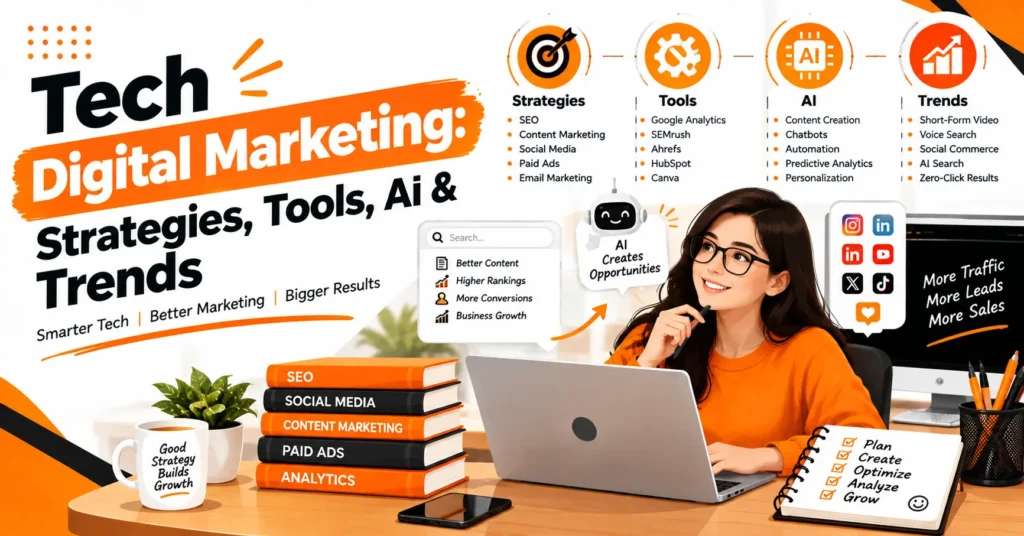
What Is Tech Digital Marketing?
Tech digital marketing combines technology, data, and online strategies to help businesses attract the right audience, generate leads, and build lasting customer relationships.
From SEO and content marketing to AI, automation, analytics, and paid advertising, modern businesses can use digital tools to create more targeted and measurable campaigns.
Technology companies, SaaS brands, IT providers, and startups can use these methods to explain complex products, reach potential buyers, and improve conversions.
Effective marketing automation reduces repetitive work, while digital marketing analytics reveals campaign performance and customer behavior. With AI-powered marketing, businesses can personalize experiences and make faster decisions.
A strong strategy also connects customer acquisition with retention for sustainable digital growth.
How Does Tech Digital Marketing Work?
Modern digital marketing works as a connected customer journey rather than a collection of independent campaigns. A potential customer may discover a company through search, interact with social content, read an educational article, join an email list, and eventually become a customer.
Technology connects these interactions. Analytics can reveal where visitors come from, CRM systems can organize customer information, and automation can trigger relevant communication based on user behavior.
Why Is Digital Marketing Important for Technology Businesses?
Technology products can be difficult to explain because customers may need to understand features, use cases, pricing, integrations, security, and potential business value before making a decision. Digital content gives businesses an opportunity to answer these questions before a sales conversation begins.
A strong online presence can also expand market reach without depending entirely on traditional sales methods. Search optimization, paid advertising, social media, email marketing, and educational content can work together to attract prospects and move them toward conversion.
Digital Marketing vs. Tech Digital Marketing
Traditional digital marketing focuses primarily on channels such as search engines, websites, email, social media, and online advertising. Tech-focused marketing adds a stronger technology layer for collecting data, automating workflows, analyzing performance, and personalizing customer experiences.
The difference is therefore not a completely separate set of marketing channels. Instead, it is the way technology is integrated into planning, execution, measurement, and optimization.
Key Technologies Used in Digital Marketing
Marketing technology, commonly called MarTech, includes the software and systems marketers use to manage campaigns and customer interactions. A modern technology stack may connect analytics, CRM, advertising, email, content, SEO, social media, and automation.
The goal is not to use as many tools as possible. The right technology should solve a specific business problem, improve efficiency, provide reliable insights, or create a better customer experience.
| Technology | Main purpose | Marketing application |
| CRM | Customer management | Lead tracking and sales coordination |
| Analytics | Performance measurement | Traffic and conversion analysis |
| SEO tools | Search visibility | Keyword and website optimization |
| Marketing automation | Workflow automation | Lead nurturing and follow-ups |
| AI tools | Analysis and productivity | Personalization and content assistance |
| Email platforms | Customer communication | Automated campaigns |
| Advertising platforms | Paid acquisition | Search and social campaigns |
| Social media tools | Social management | Publishing and audience engagement |
Major Tech Digital Marketing Channels
Search Engine Optimization
SEO helps technology businesses appear when potential customers search for solutions, products, services, and information. Effective SEO combines technical optimization, useful content, keyword research, internal linking, search intent, and a strong user experience.
Technology companies can benefit from creating content around problems their customers are actively researching. Tutorials, comparisons, product guides, technical explanations, and industry resources can capture users at different stages of the buying funnel.
Content Marketing
Content marketing turns expertise into useful resources that attract and educate an audience. Blog posts, case studies, white papers, videos, webinars, guides, and product documentation can answer questions while demonstrating subject knowledge.
Strong content should focus on the user’s problem rather than simply inserting keywords. Semantic relevance is created by naturally covering related concepts such as customer acquisition, lead generation, conversion optimization, analytics, automation, and customer retention.
Pay-Per-Click Advertising
PPC provides businesses with paid visibility on search engines and other digital platforms. Campaigns can target specific keywords, audiences, locations, devices, and customer segments.
The key challenge is profitability. A campaign should be evaluated through conversions, customer acquisition cost, revenue, and return on advertising spend rather than clicks alone.
Social Media Marketing
Social media helps technology businesses build awareness, communicate expertise, distribute content, and engage existing customers. Different platforms can support different audiences and communication styles.
Successful social marketing is more than frequent posting. Content should provide useful information, demonstrate expertise, encourage meaningful interaction, and guide interested users toward relevant resources.
Email Marketing
Email remains valuable for lead nurturing and customer retention. Businesses can use segmented campaigns to send different messages based on interests, behavior, customer stage, or previous interactions.
Marketing automation can make these campaigns more efficient by delivering timely messages when users complete particular actions, such as downloading a resource, requesting information, or starting a trial.
Tech Digital Marketing Strategies for Technology Companies
Technology companies often have longer or more complex customer journeys. A prospect may compare several solutions, research technical requirements, evaluate pricing, and consult other decision-makers before purchasing.
A strong strategy should therefore combine educational and commercial content. SEO can attract discovery-stage users, detailed resources can support consideration, and product demonstrations or consultation pages can help users take the next step.
How to Build a Tech Digital Marketing Strategy?
Define Clear Business Goals
Start by identifying what the marketing program needs to accomplish. Goals might include increasing organic traffic, generating qualified leads, increasing software trials, improving customer acquisition, or increasing revenue.
Clear objectives make it easier to select channels and determine which metrics matter.
Understand the Target Audience
Audience research should identify customer needs, pain points, search behavior, buying objections, and preferred communication channels. For B2B technology products, it is also important to understand the different people involved in the purchasing decision.
This information can be transformed into buyer personas and customer journey maps that guide content and campaign decisions.
Research Search Intent
Keyword research should go beyond search volume. Identify whether users want definitions, tutorials, comparisons, product information, solutions, or services.
For example, informational searches may require educational guides, while commercial searches may require solution pages, comparisons, demonstrations, or pricing information.
Select the Right Channels
Every business does not need to invest equally in every digital channel. Select platforms according to audience behavior, business goals, available resources, and expected return.
SEO may support long-term organic acquisition, while PPC can provide targeted paid exposure. Content, email, social media, and automation can strengthen the relationship after users enter the marketing funnel.
Create Helpful Content
Content should answer genuine customer questions and provide enough depth to be useful. Technology audiences often want practical explanations rather than vague promotional claims.
Original research, examples, data, tutorials, product use cases, and expert insights can make content more valuable and easier to differentiate.
Measure and Optimize
Launch campaigns with measurement in place from the beginning. Review traffic sources, engagement, conversions, lead quality, customer acquisition cost, and revenue.
Optimization should be continuous. If a campaign attracts visitors but generates few conversions, investigate the landing page, audience, offer, messaging, or conversion path rather than simply increasing traffic.
The Role of AI in Digital Marketing
Artificial intelligence is becoming an important part of modern marketing operations. AI can analyze large datasets, identify behavioral patterns, support audience segmentation, assist with content workflows, and help marketers personalize customer experiences.
Generative AI can also accelerate research, brainstorming, content outlines, campaign variations, and customer communication. However, automated output still requires human review for accuracy, originality, context, brand voice, and factual reliability.
Personalization and Customer Experience
Personalization uses customer information and behavior to make marketing messages more relevant. A visitor researching a particular solution, for example, may receive content related to that specific problem instead of a generic promotion.
When implemented responsibly, personalization can improve engagement and reduce friction. Businesses should avoid excessive targeting or irrelevant automation because trust is an important part of the digital customer experience.
B2B Tech Digital Marketing
B2B technology marketing usually involves longer sales cycles and multiple stakeholders. Decision-makers may include executives, technical teams, finance departments, procurement specialists, and end users.
Because of this complexity, B2B campaigns often benefit from detailed educational content, case studies, webinars, product demonstrations, comparison resources, technical documentation, and lead-nurturing sequences.
B2C Tech Digital Marketing
B2C technology marketing may involve faster purchasing decisions and larger audiences. Smartphones, applications, consumer software, subscriptions, and connected products often require clear messaging and simple conversion paths.
Social media, video, paid advertising, influencer campaigns, email, SEO, and personalized experiences can all contribute to awareness and customer acquisition depending on the product and audience.
Digital Marketing Analytics and KPIs
Analytics turns campaign activity into measurable business information. Instead of asking only how many people visited a website, marketers should determine whether those visitors engaged, converted, generated revenue, or became long-term customers.
Important metrics include organic traffic, click-through rate, conversion rate, qualified leads, customer acquisition cost, customer lifetime value, engagement rate, return on advertising spend, lead-to-customer rate, and marketing ROI.
Common Digital Marketing Challenges
One common problem is using too many technologies without a clear strategy. A complicated marketing stack can create disconnected data, duplicated work, and unnecessary costs.
Another challenge is producing content at scale without maintaining quality. Automation can improve productivity, but it cannot replace expertise, original thinking, audience understanding, and editorial judgment.
Poor attribution can also create misleading conclusions. A customer may interact with search, social media, email, and paid advertising before converting. Looking at only one touchpoint may provide an incomplete picture of the customer journey.
How to Improve Marketing Performance
Improvement starts with identifying the weakest stage of the funnel. If traffic is low, investigate SEO, content, distribution, or advertising. If traffic is strong but conversions are weak, examine the offer, landing page, messaging, and user experience.
Testing different headlines, content formats, calls to action, audience segments, advertisements, and landing pages can reveal what works better. The objective is to make evidence-based improvements rather than relying on assumptions.
Future Trends in Digital Marketing Technology
The future of marketing will increasingly involve AI, predictive analytics, automation, personalization, first-party data, conversational interfaces, and integrated customer experiences.
At the same time, marketers will need to pay greater attention to data quality, privacy, transparency, and authenticity. Technology can make campaigns faster and more scalable, but meaningful customer value will remain essential.
Tech Digital Marketing for SaaS and IT Companies
SaaS and IT businesses can use digital marketing to explain complex products in simple, customer-focused language. Educational SEO content can answer technical questions, while product pages, demos, case studies, and comparison resources can support commercial decisions.
Free trials, newsletters, webinars, downloadable resources, and automated email sequences can also help convert visitors into leads and customers. The most effective approach connects these assets instead of treating each campaign as a separate activity.
How to Create a Strong Digital Marketing Funnel
A digital marketing funnel begins with awareness. SEO, social content, video, advertising, and educational resources can introduce a business to potential customers.
During consideration, users need deeper information such as comparisons, case studies, technical guides, reviews, and demonstrations. At the conversion stage, clear offers, simple forms, strong calls to action, and trustworthy information can reduce friction.
After conversion, email marketing, customer support, educational resources, personalization, and retention campaigns can help strengthen the customer relationship.
What Makes a Digital Marketing Strategy Successful?
A successful strategy connects technology with a clear understanding of customers. Tools should support business objectives rather than become the objective themselves.
The strongest programs usually combine useful content, search visibility, targeted advertising, customer data, automation, accurate measurement, and continuous optimization. This creates a system that can adapt as customer behavior changes.
Frequently Asked Questions
What is tech digital marketing?
It is the use of digital marketing channels together with technology such as AI, analytics, CRM, automation, and MarTech platforms to attract, engage, convert, and retain customers.
How is technology used in digital marketing?
Technology is used for SEO research, customer relationship management, advertising, analytics, content workflows, email automation, personalization, audience segmentation, and campaign optimization.
What are the best digital marketing strategies for tech companies?
SEO, content marketing, PPC, email marketing, social media, webinars, lead nurturing, marketing automation, and data-driven optimization can all support technology companies when matched with the appropriate audience and business goals.
How does AI help digital marketing?
AI can assist with customer segmentation, predictive analysis, personalization, content workflows, campaign analysis, automation, and customer service. Human review remains important for quality and accuracy.
What are the most important digital marketing KPIs?
Useful KPIs include organic traffic, conversion rate, qualified leads, customer acquisition cost, customer lifetime value, engagement, return on advertising spend, revenue, and marketing ROI.
Conclusion
Tech digital marketing connects SEO, content, social media, PPC, AI, automation, analytics, and customer data into a measurable growth system. By understanding the audience, choosing appropriate technologies, creating genuinely useful content, and continuously optimizing campaigns, technology businesses can build stronger digital visibility, generate qualified opportunities, and improve customer relationships.

James Robert
James Robert is a seasoned Off-Page SEO expert specializing in strategic link building, digital outreach, and authority growth for businesses aiming to improve search visibility and rankings. With over five years of hands-on experience, he helps brands strengthen their online presence through high-quality backlinks, niche-relevant placements, and ethical SEO practices aligned with Google’s guidelines. James’s core specialties include guest posting, blogger outreach, niche edits, brand mentions, and backlink profile optimization. He is highly skilled at building relationships with authoritative publishers and executing scalable outreach campaigns that drive long-term organic growth. As a contributor to leading marketing platforms, James regularly shares actionable insights on off-page SEO strategies, link acquisition, and sustainable ranking improvements, helping businesses achieve consistent and measurable SEO success.