
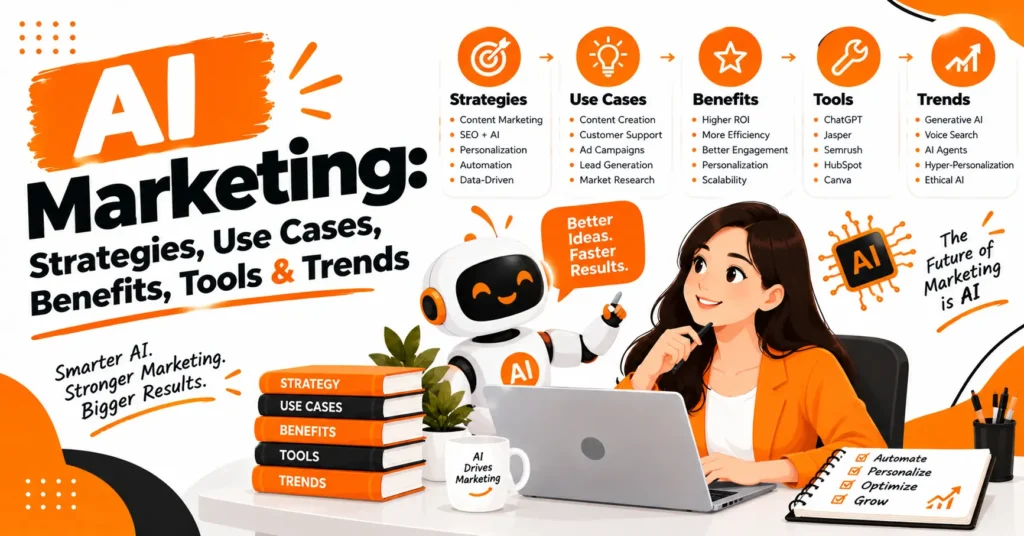
AI marketing is transforming how businesses attract customers, personalize experiences, and improve campaign performance.
By combining artificial intelligence, machine learning, and predictive analytics, marketers can understand customer behavior, automate repetitive tasks, and make faster data-driven decisions.
From generating content and optimizing advertisements to improving customer segmentation and delivering personalized recommendations, AI can support almost every stage of the marketing journey.
Modern businesses can also use marketing automation to streamline workflows, analyze campaign results, and identify new opportunities.
As AI technology continues to evolve, marketers can combine automation with human creativity and strategic judgment to create more relevant customer experiences, improve efficiency, and achieve measurable growth across multiple digital channels.
What Is AI Marketing?
AI marketing is the use of artificial intelligence technologies to plan, execute, personalize, automate, and measure marketing activities. Instead of relying entirely on manual research and fixed rules, marketers can use AI to analyze information and generate insights at scale.
Machine learning can identify patterns in customer behavior, while predictive analytics can estimate future actions. Generative AI can assist with content creation, and conversational AI can help businesses interact with customers through automated conversations.
How Does AI Marketing Work?
The process generally begins with data. Information from websites, CRM systems, email campaigns, advertising platforms, customer interactions, purchases, and other channels can provide signals about audience behavior.
AI systems analyze these signals to identify patterns, make predictions, generate recommendations, or automate specific actions. The results can then be measured and used to improve future campaigns.
For example, an online business may analyze browsing and purchase behavior to identify customers who are likely to buy. The system can then recommend relevant products, personalize an email, or trigger a targeted campaign.
Why Is AI Important in Modern Marketing?
Modern customers interact with businesses across search engines, websites, social media, email, mobile devices, advertisements, and customer-service channels. This creates a huge volume of data that can be difficult to analyze manually.
AI helps marketers turn this information into actionable customer insights. It can identify audience patterns faster, automate repetitive workflows, and help businesses deliver relevant experiences across multiple touchpoints.
AI also allows marketing teams to spend less time on repetitive operations and more time on strategy, creativity, positioning, experimentation, and customer relationships.
Types of AI Used in Marketing
Artificial intelligence is not a single technology. Different AI capabilities solve different marketing problems, so understanding the major categories can help businesses choose suitable applications.
Predictive AI
Predictive AI uses historical and current information to estimate what may happen next. Marketing teams can use predictive models for lead scoring, customer churn, demand forecasting, conversion prediction, and audience analysis.
For example, a predictive model can identify prospects with characteristics similar to previous customers. Marketers can then prioritize those prospects and adjust campaigns around higher-intent audiences.
Generative AI
Generative AI produces new text, images, ideas, summaries, and other forms of content based on instructions and context. It can assist marketers with research, outlines, email drafts, advertising variations, product descriptions, and content ideation.
However, generated material should not automatically be treated as final. Human review is essential for accuracy, originality, brand voice, factual reliability, and strategic value.
Conversational AI
Conversational AI enables automated interactions through chatbots, virtual assistants, and intelligent messaging systems. It can answer frequently asked questions, guide visitors, qualify leads, recommend products, and provide basic support.
When connected with appropriate customer data, conversational systems can make interactions more relevant while allowing human teams to concentrate on complicated customer needs.
AI Agents
AI agents are designed to perform multiple connected actions within defined instructions and workflows. Instead of completing only one isolated task, an agent may analyze information, make a recommendation, prepare an output, and initiate another approved step.
This creates opportunities for more advanced marketing automation. However, permissions, monitoring, privacy controls, and human oversight remain important when AI systems can influence customer-facing activities.
How AI Is Used in Marketing?
The applications of artificial intelligence extend from market research to customer retention. Businesses can apply AI to content, SEO, advertising, email, social media, personalization, analytics, lead generation, and customer experience.
AI Content Marketing
AI can help marketers discover content opportunities, organize ideas, create outlines, draft material, summarize information, and adapt content for different channels.
The strongest approach combines AI assistance with human expertise. Original insights, useful examples, accurate information, editing, brand knowledge, and strategic direction make content more valuable than automated text alone.
AI SEO
AI can support search engine optimization by analyzing search intent, related concepts, content gaps, entities, and semantic relationships. It can also assist with keyword research, content planning, internal linking ideas, and optimization workflows.
AI should complement rather than replace fundamental SEO practices. Helpful content, technical performance, search intent, website architecture, internal links, authority, and user experience remain important components of organic search.
AI Email Marketing
AI-powered email marketing can analyze subscriber behavior and engagement to support audience segmentation, personalization, send-time optimization, lead nurturing, and campaign testing.
Instead of delivering identical messages to every subscriber, marketers can create more relevant experiences based on customer interests, previous interactions, purchase history, and engagement patterns.
AI Social Media Marketing
AI can assist social media teams with content ideas, audience analysis, sentiment analysis, scheduling workflows, post variations, and performance analysis.
It can also identify patterns in engagement and help marketers understand which topics or formats are generating stronger audience responses. Human oversight remains important because social communication requires context and brand awareness.
AI Advertising
AI is widely used to improve digital advertising through audience analysis, predictive targeting, automated bidding, campaign optimization, and performance forecasting.
Generative AI can also help create variations of advertising copy and creative concepts. Marketers should continue monitoring campaign quality, targeting, brand consistency, spending, and conversion performance.
AI-Powered Personalization
Personalization allows businesses to present different experiences based on customer interests and behavior. AI can analyze browsing activity, purchases, engagement, location signals, and other permitted data to identify relevant patterns.
This can support personalized recommendations, website experiences, email messages, offers, and advertising. The objective should be relevance and usefulness rather than excessive tracking or intrusive personalization.
Customer Segmentation
AI can identify patterns among customers using multiple behavioral and transactional signals. This can create more detailed audience segments than simple demographic categories.
Better segmentation allows marketers to tailor messaging, offers, channels, and customer journeys to groups with different needs or levels of purchase intent.
Lead Scoring and Lead Generation
AI-powered lead scoring can evaluate customer signals and estimate which prospects may have a higher probability of conversion. This can help sales and marketing teams prioritize their efforts.
AI can also identify potential audiences, recommend content for lead nurturing, and automate parts of the customer acquisition process.
Marketing Analytics
AI marketing analytics can process large volumes of campaign and customer data to identify trends and relationships. Instead of only reporting what happened, predictive systems can help marketers explore what may happen next.
This can improve campaign optimization, budget allocation, customer forecasting, attribution analysis, and strategic decision-making.
AI Marketing vs Traditional Marketing
Traditional marketing often depends more heavily on manual analysis, predefined rules, and periodic reporting. AI-assisted approaches can process larger datasets, identify patterns, and automate decisions or recommendations.
| Marketing Area | Traditional Approach | AI-Assisted Approach |
| Customer research | Manual analysis | Automated pattern analysis |
| Segmentation | Broad predefined groups | Behavioral and predictive segments |
| Content creation | Primarily manual | AI-assisted workflows |
| Lead scoring | Fixed criteria | Predictive scoring |
| Personalization | Rule-based | Data-driven personalization |
| Advertising | Manual optimization | Automated optimization |
| Reporting | Periodic analysis | Continuous insights |
| Testing | Manual experiments | Automated testing support |
The two approaches do not need to compete. Businesses can combine established marketing principles with AI capabilities to create more efficient workflows while keeping strategic decisions under human control.
Benefits of AI Marketing
One of the biggest benefits is efficiency. AI can reduce the time required for repetitive research, reporting, segmentation, content preparation, and campaign management.
Another advantage is scalability. A marketing team can use automation to personalize communication and analyze customer signals across a much larger audience than would be practical through manual processes.
AI can also support better decision-making. Predictive analytics can reveal patterns in customer behavior, while automated analysis can help marketers identify opportunities and problems sooner.
Personalization is another major benefit. By understanding customer behavior and preferences, businesses can create more relevant experiences throughout the customer journey.
AI Marketing Tools and Technology
The AI marketing ecosystem includes solutions for content creation, SEO, analytics, CRM, advertising, email automation, personalization, customer service, and workflow automation.
Choosing a tool should begin with a specific business problem rather than the popularity of a particular technology. Marketers should consider the desired outcome, available data, integrations, cost, scalability, security, and required level of human control.
A tool that generates impressive outputs but does not integrate with existing workflows may provide less value than a simpler solution that solves an important operational problem reliably.
How to Create an AI Marketing Strategy?
A successful AI strategy begins with a measurable objective. Businesses should determine whether they want to increase conversions, reduce customer acquisition costs, improve retention, personalize experiences, accelerate content production, or improve marketing productivity.
Next, marketers should audit their data and existing workflows. This helps identify repetitive tasks, reliable information sources, customer touchpoints, and areas where predictive insights could improve decisions.
The next stage is testing. Instead of automating an entire marketing operation immediately, businesses can introduce AI into one measurable workflow, establish a baseline, monitor performance, and expand successful processes.
A Practical AI Marketing Workflow
A strong AI workflow connects data, insight, action, and measurement. Customer information is first collected from permitted sources and organized so that it can be analyzed effectively.
AI then identifies patterns or generates recommendations. Marketing teams use those insights to personalize content, adjust campaigns, prioritize leads, or improve customer experiences.
The final stage is measurement. Results should be compared against established KPIs, allowing marketers to determine whether the AI-assisted workflow is actually improving business performance.
How to Measure AI Marketing ROI?
AI initiatives should be measured through business outcomes rather than the amount of technology being used. Useful metrics include conversion rate, customer acquisition cost, return on ad spend, customer lifetime value, engagement rate, retention, revenue, and cost per lead.
Before implementing an AI workflow, marketers should establish a performance baseline. Comparing results before and after implementation makes it easier to identify whether the technology is creating meaningful improvement.
Qualitative measures can also matter. Better customer experiences, faster campaign execution, improved employee productivity, and higher-quality decision-making can provide additional evidence of value.
Challenges and Risks of AI Marketing
Data quality is a major concern. AI models depend on the information provided to them, so inaccurate, incomplete, outdated, or biased data can produce unreliable results.
Privacy and security also require careful attention. Businesses should use customer information responsibly and establish appropriate controls for sensitive data.
AI-generated content can contain factual errors, biased assumptions, repetitive language, or information that does not match a company’s brand. Human review helps identify these problems before they affect customers.
Over-automation presents another risk. Marketing involves creativity, empathy, positioning, cultural awareness, and judgment. Removing humans from important decisions can create experiences that feel generic or disconnected.
AI Ethics and Responsible Marketing
Responsible AI marketing requires transparency, appropriate data use, human oversight, and ongoing monitoring. Businesses should understand how AI is being used and determine which decisions require human approval.
Marketers should also consider whether personalization could become intrusive. Customers should receive useful experiences without unnecessary collection or misuse of personal information.
Responsible implementation builds trust while reducing the operational and reputational risks associated with poorly controlled AI systems.
AI Marketing Trends in 2026
The next stage of AI adoption is moving beyond isolated tools toward connected marketing workflows. AI agents, predictive personalization, real-time analytics, conversational experiences, and automated experimentation are becoming increasingly important areas of development.
Another major trend is the combination of generative and predictive capabilities. Instead of simply generating content, AI systems can increasingly use customer and campaign signals to help determine what should be created, who should receive it, and how performance should be evaluated.
Marketing teams are also placing greater emphasis on governance and human oversight. As AI becomes more integrated into customer-facing operations, accuracy, privacy, brand safety, and accountability become increasingly important.
AI Marketing Best Practices
The most effective implementation starts small and focuses on measurable problems. Businesses should choose use cases where AI can provide a clear advantage rather than adopting technology simply because it is trending.
High-quality data should remain a priority, and every automated workflow should have appropriate monitoring. Marketers should review important outputs, test performance regularly, and update processes when customer behavior or business objectives change.
AI should enhance human expertise rather than remove it. The strongest marketing workflows combine machine speed and data processing with human creativity, judgment, strategy, and empathy.
Frequently Asked Questions
What is AI marketing?
AI marketing uses artificial intelligence technologies to analyze customer data, automate marketing tasks, personalize experiences, generate content, predict behavior, and optimize campaigns.
How does AI help marketers?
AI can reduce repetitive work, analyze large datasets, identify customer patterns, support personalization, improve campaign optimization, and provide predictive insights that help marketers make better decisions.
What are the main types of AI used in marketing?
The major applications include predictive AI, generative AI, conversational AI, machine learning, natural language processing, and increasingly AI agents for connected workflows.
Can AI replace marketing professionals?
AI can automate many repetitive activities, but it does not eliminate the need for marketing professionals. Strategy, creativity, brand positioning, customer understanding, ethical judgment, and quality control still require human expertise.
What are examples of AI in marketing?
Common examples include personalized recommendations, predictive lead scoring, AI-generated content, automated email campaigns, advertising optimization, customer-service chatbots, audience segmentation, and marketing analytics.
Conclusion
AI marketing is becoming an important part of modern digital strategy because it can connect customer data, automation, personalization, analytics, and content into more efficient workflows. Businesses can gain the most value by starting with clear objectives, reliable data, measurable use cases, and human oversight.
Used strategically, AI can help marketers understand customers better, improve campaign performance, and build more relevant experiences without sacrificing creativity or responsible decision-making.
This version expands the original into a more complete topical resource while keeping the focus keyword natural and avoiding competitor names or references to the pages you supplied.

James Robert
James Robert is a seasoned Off-Page SEO expert specializing in strategic link building, digital outreach, and authority growth for businesses aiming to improve search visibility and rankings. With over five years of hands-on experience, he helps brands strengthen their online presence through high-quality backlinks, niche-relevant placements, and ethical SEO practices aligned with Google’s guidelines. James’s core specialties include guest posting, blogger outreach, niche edits, brand mentions, and backlink profile optimization. He is highly skilled at building relationships with authoritative publishers and executing scalable outreach campaigns that drive long-term organic growth. As a contributor to leading marketing platforms, James regularly shares actionable insights on off-page SEO strategies, link acquisition, and sustainable ranking improvements, helping businesses achieve consistent and measurable SEO success.