
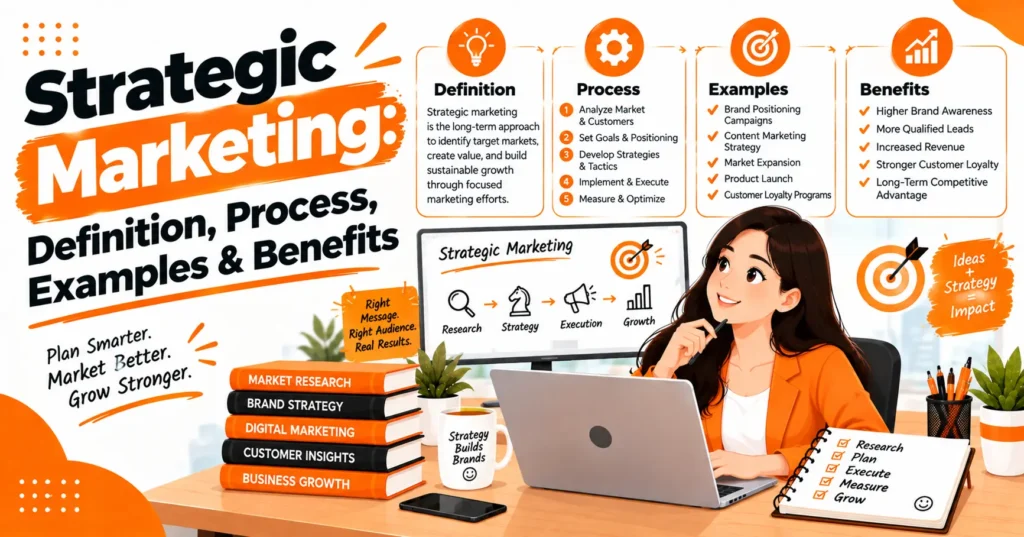
Strategic marketing is a structured approach to achieving business goals by understanding customers, analyzing markets, evaluating competitors, and developing a clear marketing direction.
It connects research and long-term objectives with practical decisions about positioning, products, pricing, promotion, distribution, and customer relationships.
Unlike isolated campaigns, strategic marketing considers the bigger picture. It helps businesses decide which customers to serve, what value to provide, how to differentiate from competitors, which channels to prioritize, and how to measure whether marketing activities are producing meaningful business results.
Why Is Strategic Marketing Important?
Markets change quickly because of new technologies, customer expectations, economic conditions, competitors, and emerging trends. Businesses that make marketing decisions without a clear direction can waste resources on channels and campaigns that do not support their objectives.
A strategic approach creates alignment between marketing and the wider business strategy. It can help improve brand positioning, customer acquisition, retention, market share, revenue growth, and competitive advantage while giving marketing teams a clearer framework for making decisions.
What Are the Key Characteristics of Strategic Marketing?
Effective strategic marketing is research-driven, customer-focused, goal-oriented, measurable, and adaptable. It starts by understanding the current market before deciding where the business should compete and how it should create value.
It also takes a long-term view while remaining flexible enough to respond to changing conditions. Performance data, customer feedback, competitor activity, and market trends should continuously influence future decisions rather than leaving the original plan unchanged.
Strategic Marketing vs Marketing Strategy vs Marketing Tactics
These terms are related but describe different levels of marketing decision-making. Strategic marketing is the broader discipline of aligning marketing with business objectives, market opportunities, customer needs, and competitive conditions.
A marketing strategy describes the approach used to achieve specific objectives, while tactics are the individual actions used to execute that approach.
For example, choosing small businesses as a priority market is strategic, developing a content-led acquisition strategy is part of the marketing strategy, and publishing a monthly guide is a tactical activity.
What Are the Main Components of Strategic Marketing?
A complete strategic marketing framework brings together market research, customer analysis, segmentation, targeting, positioning, value proposition development, objectives, marketing mix decisions, channel selection, implementation, and measurement.
Each component should support the others. Research identifies opportunities, segmentation determines who matters most, positioning establishes differentiation, objectives define success, and marketing channels provide ways to reach the selected audience.
The Strategic Marketing Process
The strategic marketing process is a continuous cycle rather than a one-time exercise. Businesses analyze their current position, research the market, identify attractive customer segments, establish objectives, develop positioning, select appropriate marketing activities, measure results, and improve the strategy.
A practical framework can be summarized as:
Analyze → Segment → Target → Position → Set Objectives → Develop Strategy → Implement → Measure → Optimize
Following this sequence helps prevent businesses from jumping directly into campaigns without understanding the market or defining what success should look like.
1. Conduct a Situation Analysis
Before developing a marketing strategy, businesses need to understand their current position. A situation analysis examines internal capabilities as well as external market conditions that could influence growth.
SWOT analysis can identify strengths, weaknesses, opportunities, and threats. PESTEL analysis provides another perspective by examining political, economic, social, technological, environmental, and legal factors that may affect the market.
2. Perform Market Research
Market research provides evidence for better marketing decisions. It can reveal customer needs, purchasing behavior, market demand, emerging trends, competitor strengths, and gaps that existing solutions are not addressing effectively.
Businesses can use surveys, interviews, customer reviews, website analytics, sales data, industry research, and competitor analysis. The goal is to replace assumptions with useful customer and market insights.
3. Understand the Target Audience
Understanding the target audience is essential because businesses cannot create an effective message without knowing whom they are trying to reach. Customer research should examine motivations, challenges, preferences, objections, purchasing behavior, and desired outcomes.
Buyer personas and ideal customer profiles can make this information easier to apply. Instead of creating generic campaigns for everyone, marketers can develop messages and offers around the needs of specific customer groups.
4. Segment the Market
Market segmentation divides a broad audience into smaller groups that share meaningful characteristics. Segments can be based on demographics, geography, behavior, purchasing patterns, business size, industry, or customer needs.
Effective segmentation allows businesses to identify which groups have the strongest potential. It can also improve personalization because different customer segments may require different products, messages, channels, and offers.
5. Select the Target Market
After identifying market segments, businesses need to decide where to focus their resources. A target market should provide a realistic combination of customer demand, profitability, accessibility, and strategic fit.
Trying to appeal to everyone often creates vague messaging and weak positioning. A clearly defined target market gives marketers a stronger foundation for content, advertising, product development, sales, and customer experience.
6. Analyze Competitors
Competitive analysis helps businesses understand how alternatives are positioned and where opportunities for differentiation exist. Marketers can examine competitors’ products, pricing, messaging, customer experience, distribution, content, and promotional approaches.
The purpose is not to imitate competitors. A stronger approach is to identify underserved needs and develop a value proposition that gives customers a compelling reason to choose your business instead.
7. Define Marketing Objectives
Marketing objectives turn broad business ambitions into measurable targets. Depending on the organization, objectives might focus on revenue growth, lead generation, customer acquisition, retention, market expansion, brand awareness, or market share.
SMART objectives are particularly useful because they establish specific, measurable, achievable, relevant, and time-bound targets. Clear objectives also make it easier to determine whether marketing resources are being used effectively.
8. Develop Positioning and a Value Proposition
Positioning determines how a brand should be perceived by its chosen audience compared with competing alternatives. Effective positioning connects a real customer need with a clear and credible business advantage.
The value proposition should explain why the target customer should care about the offer. Strong positioning is specific enough to differentiate the business but relevant enough to address something the audience genuinely values.
9. Develop the Marketing Mix
The marketing mix translates the broader strategy into decisions about the offer and customer experience. The traditional 4Ps are product, price, place, and promotion.
For service-based organizations, the 7Ps extend this framework with people, process, and physical evidence. These additional elements help address the human and experiential factors that influence how customers perceive service quality.
| Marketing Element | Strategic Focus | Key Question |
| Product | Customer value | What problem does the offer solve? |
| Price | Value and profitability | What should customers pay? |
| Place | Accessibility | Where should customers find the offer? |
| Promotion | Communication | How should the value be communicated? |
| People | Customer experience | Who delivers the experience? |
| Process | Service delivery | How is the customer journey managed? |
| Physical Evidence | Trust and credibility | What demonstrates quality and reliability? |
10. Choose the Right Marketing Channels
Channel selection should be based on audience behavior and business objectives rather than simply following popular trends. Marketers need to understand where potential customers search for information, compare options, interact with brands, and make purchasing decisions.
Depending on the business, the channel mix may include SEO, content marketing, email marketing, social media, paid advertising, partnerships, events, direct sales, or referral programs. The objective is to prioritize channels that can reach the target market efficiently.
11. Create a Strategic Marketing Plan
A strategic marketing plan turns the overall direction into an organized roadmap. It should explain the current situation, target audience, market opportunity, positioning, objectives, channel strategy, marketing activities, resources, budget, timeline, and KPIs.
The plan should be detailed enough to guide execution without becoming unnecessarily rigid. Reviewing it regularly allows the business to respond to new customer insights, market changes, competitive threats, and performance data.
12. Implement the Strategy
Implementation is where strategic decisions become measurable marketing activities. Teams need clear responsibilities, realistic timelines, appropriate budgets, content, campaigns, technology, and operational resources.
Every major activity should have a purpose connected to an objective. This prevents teams from spending resources on activities simply because they generate visibility without contributing to customer acquisition, retention, revenue, or another meaningful business outcome.
13. Measure Marketing Performance
Measurement helps determine whether the strategy is working. Important marketing KPIs can include conversion rate, qualified leads, customer acquisition cost, customer lifetime value, retention rate, market share, revenue, and marketing ROI.
The right metrics depend on the business model and objectives. A brand focused on awareness may emphasize reach and brand searches, while a growth-focused company may place greater importance on qualified leads, acquisition cost, revenue, and customer lifetime value.
14. Optimize and Improve
A marketing strategy should evolve as new information becomes available. Performance data can reveal which audiences, messages, channels, offers, and campaigns are producing the strongest results.
Optimization may involve changing budgets, improving landing pages, refining positioning, adjusting content, testing new messages, or removing ineffective channels. Continuous improvement turns marketing from a fixed plan into an adaptable growth system.
Strategic Marketing Examples
Imagine a SaaS company targeting growing businesses. Research shows that its potential customers are frustrated by complicated software and lengthy implementation processes. The company could position its solution around simplicity, automation, and faster onboarding.
An e-commerce business may discover that its customers value convenience more than the lowest possible price. Instead of relying heavily on discounts, it could differentiate through fast delivery, easy returns, personalized recommendations, and a smoother purchasing experience.
A B2B consulting company could use customer research to identify a specific industry with recurring operational problems. It could then create specialized content, case studies, service packages, and sales messaging around those problems instead of promoting generic consulting services.
B2B vs B2C Strategic Marketing
B2B marketing typically involves longer sales cycles, multiple stakeholders, higher purchase consideration, and greater emphasis on trust and expertise. Content marketing, case studies, thought leadership, lead nurturing, sales enablement, and account-based marketing can therefore play important roles.
B2C marketing often involves shorter buying journeys and greater emphasis on convenience, emotional connection, product experience, promotions, reviews, and brand recognition. However, both models require customer understanding, strong positioning, effective communication, and measurable objectives.
Strategic Marketing for Business Growth
Growth becomes more predictable when marketing decisions are connected to specific business opportunities. Instead of pursuing every audience or channel, businesses can concentrate resources on the segments and activities most likely to produce valuable outcomes.
This approach can also improve alignment between marketing and sales. When both teams understand the target customer, value proposition, positioning, qualification criteria, and business objectives, the customer journey becomes more consistent.
Common Strategic Marketing Mistakes
One major mistake is creating a marketing plan without sufficient research. If businesses do not understand customer needs or competitive conditions, even well-funded campaigns can fail to generate meaningful results.
Another problem is confusing activity with progress. Publishing more content, increasing social posts, or launching additional campaigns does not automatically create growth. Businesses should connect activities to measurable objectives and regularly evaluate whether those activities are producing value.
Trying to target everyone is another common weakness. A broad audience may sound attractive, but unclear targeting often produces generic messaging. Focused segmentation and positioning can make marketing communication more relevant and persuasive.
Benefits of Strategic Marketing
A strong strategic approach can improve decision-making because marketing investments are guided by research and clearly defined objectives. It can also help organizations identify better market opportunities and establish stronger differentiation.
Other benefits include more efficient resource allocation, clearer customer targeting, stronger brand positioning, improved customer relationships, better performance measurement, and greater adaptability when market conditions change.
How to Measure Strategic Marketing Success?
There is no single metric that can determine whether a marketing strategy is successful. Performance should be evaluated against the specific objectives established during the planning process.
For customer acquisition, businesses may monitor qualified leads and customer acquisition cost. For profitability, marketing ROI and customer lifetime value may be more important. For retention, repeat purchases and customer retention rate can provide valuable insight.
The strongest measurement framework combines financial, customer, conversion, and marketing performance indicators. This provides a more complete view of whether marketing is contributing to sustainable growth.
How to Build a More Effective Marketing Strategy?
An effective strategy begins with a clear business objective rather than a channel. Instead of starting with “Which platform should we use?”, businesses should first ask what they want to achieve, whom they need to reach, and what customer problem they can solve better than alternatives.
The next step is connecting research, positioning, messaging, channels, and measurement. When these elements reinforce one another, marketing becomes easier to execute and more consistent across the customer journey.
Frequently Asked Questions
What is strategic marketing?
Strategic marketing is a long-term approach to marketing that aligns customer needs, market opportunities, competitive positioning, and marketing activities with broader business objectives.
What are the main stages of strategic marketing?
The main stages include situation analysis, market research, segmentation, target-market selection, competitor analysis, objective setting, positioning, marketing mix development, channel selection, implementation, measurement, and optimization.
What is the difference between strategy and tactics in marketing?
A strategy establishes the overall approach for achieving a marketing objective, while tactics are the specific actions used to execute that approach. Strategy determines direction; tactics determine what the marketing team does to move in that direction.
What are the 4Ps of marketing?
The 4Ps are product, price, place, and promotion. They provide a framework for making decisions about what a business offers, how it prices the offer, where customers can access it, and how the offer is communicated.
What are the 7Ps of marketing?
The 7Ps include product, price, place, promotion, people, process, and physical evidence.
Conclusion
Strategic marketing connects research, customer understanding, positioning, objectives, marketing channels, implementation, and performance measurement into a unified growth approach. By focusing on the right audience, communicating meaningful value, measuring outcomes, and continuously adapting to market changes, businesses can make smarter marketing decisions and build sustainable competitive advantage.

James Robert
James Robert is a seasoned Off-Page SEO expert specializing in strategic link building, digital outreach, and authority growth for businesses aiming to improve search visibility and rankings. With over five years of hands-on experience, he helps brands strengthen their online presence through high-quality backlinks, niche-relevant placements, and ethical SEO practices aligned with Google’s guidelines. James’s core specialties include guest posting, blogger outreach, niche edits, brand mentions, and backlink profile optimization. He is highly skilled at building relationships with authoritative publishers and executing scalable outreach campaigns that drive long-term organic growth. As a contributor to leading marketing platforms, James regularly shares actionable insights on off-page SEO strategies, link acquisition, and sustainable ranking improvements, helping businesses achieve consistent and measurable SEO success.