
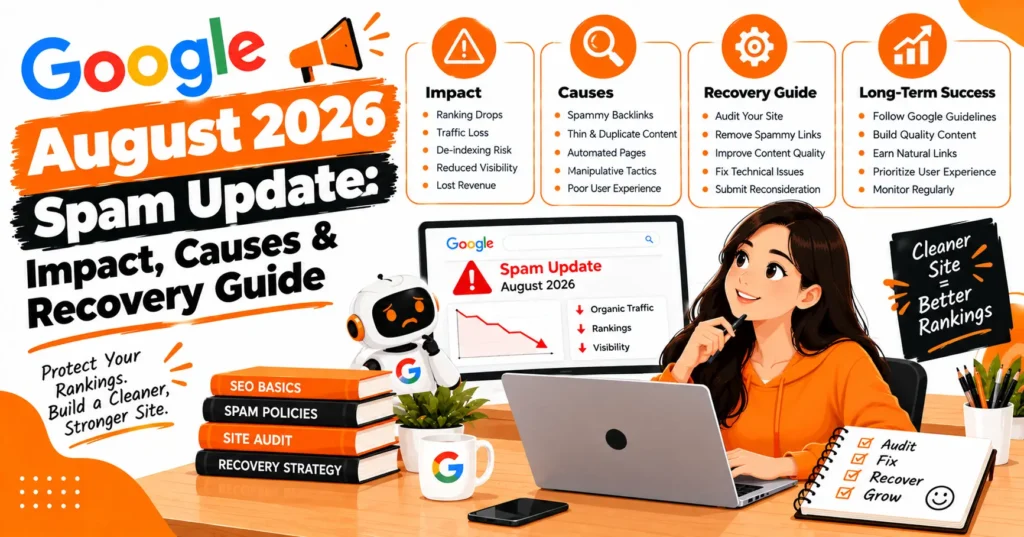
The Google August 2026 Spam Update has brought renewed attention to how Google detects spam, evaluates content quality, and protects search results from manipulative practices.
Rolled out globally in August 2026, the update can influence search rankings, organic visibility, and website traffic when pages or publishing practices conflict with Google’s spam policies.
Understanding the update is important for businesses, publishers, and SEO professionals experiencing ranking volatility.
Rather than reacting to sudden traffic changes, website owners should examine scaled content, AI-assisted publishing, link practices, and other potential spam signals.
This guide explains the update, its potential impact, key spam policies, recovery strategies, and practical steps for protecting long-term search visibility.
What Is the Google August 2026 Spam Update?
The Google August 2026 Spam Update is a global search update focused on improving systems that detect and address spam.
Google’s spam policies cover practices intended to manipulate search systems or deceive users, including attempts to manipulate visibility in traditional Search and generative AI experiences.
This type of update should not automatically be treated as a broad core update. A spam-focused rollout is more closely connected with detecting violations of search spam policies, while core updates involve broader reassessments of relevance and overall search quality.
When Did the August 2026 Spam Update Roll Out?
The rollout started on August 18, 2026, at 9:27 a.m. Pacific Time and finished on August 21 at 1:49 a.m. Pacific Time. Google confirmed that the update applied globally and to all languages.
This timeline gives SEO professionals an important comparison point. Instead of judging performance from a single day, compare Search Console data before, during, and after the rollout to identify meaningful ranking and traffic patterns.
What Impact Did the Update Have on Search Rankings?
The impact of a spam update can vary significantly between websites. Some domains may experience substantial ranking losses, while others remain stable or gain visibility as search systems reassess competing content.
A decline in organic traffic alone does not prove that spam detection caused the problem. Look for patterns across affected URLs, queries, content categories, publishing methods, and website sections.
Ranking volatility can also be influenced by other Google systems, competitor improvements, changes in search intent, technical problems, or fluctuations in demand. A reliable diagnosis requires comparing multiple signals rather than relying on traffic alone.
How Is a Spam Update Different From a Core Update?
Understanding this distinction can prevent an ineffective SEO response. A spam update primarily relates to Google’s systems for identifying practices that violate spam policies, while a core update represents a broader change to how search results are evaluated.
| Factor | Spam Update | Core Update |
| Main focus | Spam detection and enforcement | Relevance, quality, and ranking systems |
| Primary concern | Manipulative or policy-violating practices | Overall usefulness and search satisfaction |
| Investigation | Spam and compliance audit | Content and quality audit |
| Typical symptoms | Visibility loss on problematic content | Broader ranking redistribution |
| Recovery strategy | Resolve underlying spam issues | Improve relevance and content quality |
| Manual action | May be involved separately | Not automatically involved |
This difference matters because rewriting every article after a ranking decline may not solve the actual problem. First identify whether the affected pages share a specific characteristic.
Which Spam Practices Should You Investigate?
Google’s spam policies cover a broad range of manipulative practices. Website owners experiencing a ranking decline should review their content and SEO processes against these guidelines instead of focusing on one suspected tactic.
Scaled content abuse is particularly important. It involves creating large amounts of content primarily to manipulate rankings rather than genuinely helping users.
This can include automatically generated pages, scraped information, lightly transformed content, or large collections of pages with little original value.
Other areas worth reviewing include cloaking, doorway abuse, scraping, hidden text or links, hacked content, misleading functionality, thin affiliate content, user-generated spam, link spam, and expired-domain abuse.
Does AI-Generated Content Cause Ranking Problems?
AI-generated content should not automatically be considered spam. The important question is whether the content provides genuine value and complies with Google’s Search Essentials and spam policies.
Google specifically states that generative AI can be useful for research and structuring original content. However, using automated systems to produce large numbers of pages without adding value can fall under scaled content abuse.
For that reason, websites using AI should focus on editorial quality. Content should be factually accurate, original, relevant, useful, and reviewed before publication.
Firsthand experience, expert insight, unique examples, original research, and meaningful analysis can make content substantially more valuable.
Could Scaled Content Be a Ranking Risk?
Large-scale publishing is not automatically problematic. The concern arises when quantity becomes more important than usefulness and pages are created primarily to capture search queries.
A website with thousands of similar pages should examine whether those pages provide distinct value. If changing the location, keyword, product name, or topic produces almost identical content, the publishing strategy deserves closer examination.
Google’s guidance specifically describes scaled content abuse as producing many pages for the primary purpose of manipulating search rankings rather than helping users.
How Can You Tell If Your Website Was Affected?
Google Search Console should be the starting point for investigating a suspected ranking decline. Compare clicks, impressions, average position, and queries across periods before and after the update.
Next, identify which URLs experienced the largest changes. Look for common characteristics such as content type, publishing process, template, directory, word count, internal linking, affiliate elements, or automation.
A useful investigation compares both losing and stable pages. If high-quality original resources remain stable while repetitive pages decline, that pattern can provide a stronger clue than a sitewide traffic chart.
What Are the Signs of a Spam-Related Ranking Drop?
One potential warning sign is a sharp decline concentrated within a particular group of pages. For example, a website may retain visibility for original research while losing rankings across large collections of low-differentiation pages.
Another signal is a significant reduction in impressions. If pages are receiving fewer impressions as well as fewer clicks, they may have lost visibility for important queries rather than simply suffering from a lower click-through rate.
However, these symptoms are not proof of a spam issue. Technical SEO problems can produce similar results. Check indexing, canonical tags, robots directives, redirects, server availability, and accidental no index settings before reaching a conclusion.
How Should You Audit Content After a Ranking Drop?
Start by separating your website into meaningful content groups. Analyze informational articles, commercial pages, category pages, location pages, affiliate content, user-generated content, and automatically generated sections separately.
Then evaluate whether each group satisfies a clear user need. Ask whether the information is original, whether it demonstrates expertise, whether it answers the query completely, and whether users would still find the page useful if search engines did not exist.
Pages with overlapping intent may benefit from consolidation. Weak pages may need substantial improvement, while genuinely useful pages should not be deleted simply because they experienced temporary ranking volatility.
What About Doorway Pages and Duplicate Location Content?
Doorway abuse can become a problem when websites create multiple highly similar pages designed to rank for variations of a query while providing little independent value.
Location-based SEO deserves particular attention because businesses sometimes create dozens or hundreds of city pages with nearly identical content.
A legitimate location page should provide useful local information rather than simply replacing one city name with another.
Google describes doorway abuse as creating pages for specific similar queries that provide little additional usefulness and can funnel users toward another destination.
Can Link Spam Affect Search Visibility?
Manipulative links should also be included in an SEO audit. Buying or generating large numbers of irrelevant links solely to influence rankings can create an unhealthy link profile.
However, a ranking decline following a spam update should not automatically be blamed on backlinks. Evaluate the entire website, including content quality, technical signals, publishing practices, and spam-policy compliance.
A sustainable link-building strategy should focus on relevance and genuine editorial value. Useful resources, original research, expert contributions, legitimate partnerships, and strong digital PR can naturally attract relevant references.
What Is Site Reputation Abuse?
Site reputation abuse involves publishing third-party content on an established website primarily to take advantage of that site’s existing ranking signals. It is an important concept for publishers and businesses that host substantial external or commercially produced content.
The important distinction is purpose. Third-party material is not automatically problematic simply because it appears on a larger domain. The content, publishing arrangement, editorial context, and intent all matter.
The site reputation policy was also updated separately in August 2026, particularly regarding enforcement in the European Economic Area. That development should not be confused with the August spam rollout itself.
What Should You Do After a Ranking Drop?
Do not immediately delete large amounts of content or make hundreds of SEO changes. First establish whether the decline is real, when it began, and which sections were affected.
After identifying a pattern, correct the underlying problem. Improve weak content, remove genuinely useless pages, consolidate overlapping resources, strengthen editorial review, eliminate manipulative practices, and ensure important pages provide clear value.
If a manual action exists, treat it differently from an algorithmic ranking decline. Manual actions are specifically communicated through the relevant search-management tools and require addressing the identified policy issue before requesting reconsideration.
What Should You Avoid Doing?
One of the worst responses to ranking volatility is panic. Removing useful content simply because rankings declined can reduce a website’s overall value and eliminate pages that could recover later.
Avoid blindly rewriting every page, changing URLs unnecessarily, purchasing additional backlinks, or assuming that all AI-assisted content must be removed. These actions may address the wrong problem.
Do not submit a reconsideration request for a manual action before properly fixing the underlying issue. A complete compliance review is more appropriate than making a few superficial changes.
How Can You Improve Content Quality?
The strongest defense against search-quality problems is content that genuinely satisfies users. Every page should have a clear purpose and provide information that is accurate, useful, and relevant to the query.
Add original perspectives rather than simply expanding existing information. Practical examples, expert analysis, firsthand observations, unique data, comparisons, explanations, and useful recommendations can give a page stronger value.
Content should also be reviewed for factual accuracy and unnecessary repetition. A shorter page that completely solves a user’s problem can be more valuable than a long article filled with generic information.
How Long Does Recovery Take?
There is no universal recovery period after a spam-related ranking decline. The timeline depends on the severity of the problem, the changes made, crawling frequency, and how Google’s systems reassess the website.
After making substantial improvements, continue monitoring impressions, clicks, rankings, and indexed pages. Avoid changing the strategy every few days because temporary fluctuations can make it difficult to determine which improvements actually worked.
In some cases, meaningful recovery can take considerable time. This makes prevention, editorial quality, and regular SEO auditing more valuable than attempting to repair a site after a major visibility loss.
How Can Websites Prepare for Future Spam Updates?
Long-term SEO resilience comes from building a website around people rather than search manipulation. Publishing should have a clear editorial purpose, and every page should provide a reason for users to visit it.
Websites that publish at scale should establish quality-control processes before content reaches production. Human review, fact checking, originality checks, search-intent analysis, and regular content audits can reduce the risk of low-value pages accumulating.
It is also wise to diversify traffic sources. Organic search can be an important acquisition channel, but direct traffic, email, social platforms, communities, referrals, and brand recognition can reduce dependence on a single source of visitors.
Google August 2026 Spam Update FAQs
What is the Google August 2026 Spam Update?
The Google August 2026 Spam Update is a global spam-focused search update that improved systems for detecting and addressing practices that violate Google’s spam policies.
Did Google target AI-generated content?
AI-generated content was not automatically the target. The important issue is whether content provides genuine value.
Is the August 2026 update a core update?
No. It was a spam-focused update rather than a broad core update. This means website owners should investigate spam-policy compliance alongside normal technical and content-quality checks.
How can I check whether my website was affected?
Compare Google Search Console performance before and after the rollout.
Should I delete low-ranking pages?
Not automatically. A low-ranking page is not necessarily spam.
Conclusion
The Google August 2026 Spam Update highlights a continuing shift toward stronger spam detection and higher expectations for useful search content. Website owners should focus on diagnosing real ranking patterns, reviewing spam-policy compliance, improving original value, and removing genuinely manipulative practices rather than reacting to volatility with rushed changes. A people-first content strategy, careful technical SEO, and ongoing quality audits provide the strongest foundation for maintaining long-term search visibility.

James Robert
James Robert is a seasoned Off-Page SEO expert specializing in strategic link building, digital outreach, and authority growth for businesses aiming to improve search visibility and rankings. With over five years of hands-on experience, he helps brands strengthen their online presence through high-quality backlinks, niche-relevant placements, and ethical SEO practices aligned with Google’s guidelines. James’s core specialties include guest posting, blogger outreach, niche edits, brand mentions, and backlink profile optimization. He is highly skilled at building relationships with authoritative publishers and executing scalable outreach campaigns that drive long-term organic growth. As a contributor to leading marketing platforms, James regularly shares actionable insights on off-page SEO strategies, link acquisition, and sustainable ranking improvements, helping businesses achieve consistent and measurable SEO success.