
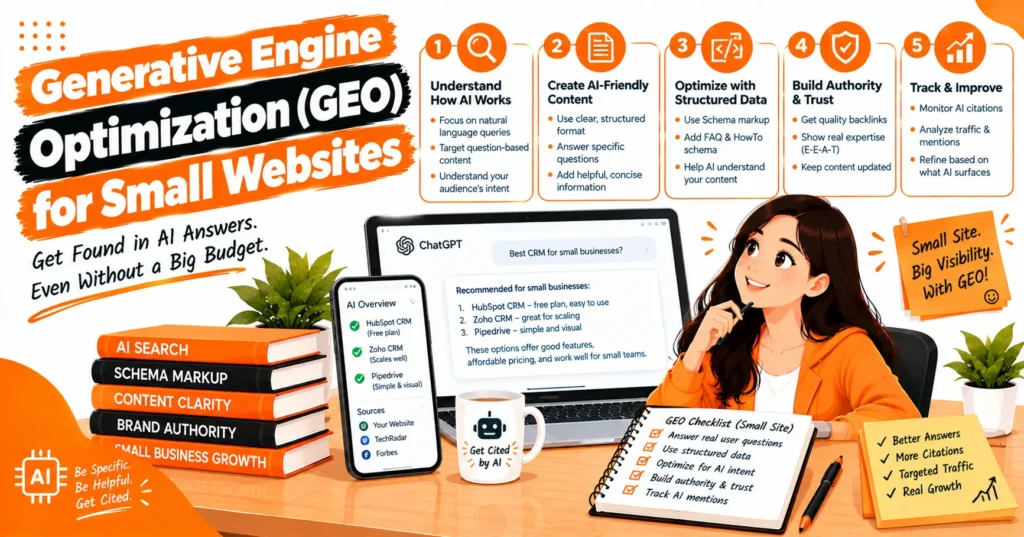
Generative engine optimization (GEO) for small websites is becoming an important part of modern digital marketing as people increasingly use AI-powered search experiences to research products, compare services, and find reliable answers.
Traditional SEO remains essential, but website owners must also consider how their content can be discovered, understood, and potentially cited in AI-generated responses. Small businesses do not need massive budgets or hundreds of published pages to build visibility.
They need a clear content strategy, accessible website architecture, credible information, and a strong understanding of customer intent.
By combining technical SEO, topical authority, answer-focused content, and consistent performance tracking, small websites can improve their opportunities to reach relevant audiences across traditional search engines and emerging AI discovery platforms.
What Is Generative Engine Optimization (GEO)?
Generative engine optimization is the process of improving a website’s content, technical accessibility, and credibility to increase its chances of being referenced in responses produced by AI-powered search and answer systems. These systems may retrieve information from multiple sources and combine it into a conversational response rather than presenting only a conventional list of links.
For small website owners, GEO involves creating information that directly answers user questions, demonstrates subject knowledge, and provides clear supporting evidence.
It also requires making important pages accessible to search engines and maintaining accurate business information. Although these practices can improve discoverability, no optimization method guarantees that an AI platform will mention a particular website.
Why Does GEO Matter for Small Websites?
Small websites often compete with established brands that have larger content libraries, stronger brand recognition, and more marketing resources. Generative search creates additional opportunities for businesses with specialized knowledge to become useful sources for specific questions and customer needs.
For example, a small cybersecurity consultancy could publish detailed guidance about securing websites for small businesses rather than competing for broad cybersecurity terms.
By answering specific questions with practical examples and accurate explanations, the company can build topical relevance and demonstrate expertise. The goal is to become a genuinely useful resource, not simply to appear in every AI-generated answer.
GEO vs. SEO vs. Answer Engine Optimization
Generative engine optimization, traditional search engine optimization, and answer engine optimization share several principles, including relevance, clarity, and helpful content. Their main difference lies in the type of visibility they aim to improve and the way success is evaluated.
| Feature | Traditional SEO | GEO | AEO |
| Main objective | Organic search visibility | Visibility in generative AI responses | Visibility in direct answers |
| Content strategy | Relevant, comprehensive content | Credible, accessible, information-rich content | Clear answers to specific questions |
| Technical priorities | Crawling, indexing, and usability | Strong SEO foundations and accessible information | Understandable, well-structured answers |
| Performance metrics | Impressions, clicks, rankings, conversions | AI mentions, citations, referrals, conversions | Answer visibility and relevant search features |
| Core benefit | Reach people through search results | Increase opportunities for AI-driven discovery | Help users find direct answers |
These approaches should complement one another. A well-optimized website can serve traditional search users while also making its information easier to discover and interpret in generative search experiences.
How to Optimize a Small Website for Generative AI Search
1. Establish a Strong Technical SEO Foundation
Before investing heavily in GEO content, confirm that search engines can access and index your important pages. Review robots.txt rules, meta robots directives, canonical URLs, XML sitemaps, HTTP status codes, and internal links.
A page that is unintentionally blocked or excluded from indexing may struggle to gain visibility through conventional search.
Use Google Search Console to investigate indexing issues, inspect important URLs, and monitor organic search performance. Make essential content available in accessible HTML, check that JavaScript does not hide critical information from crawlers, and resolve broken links or redirect chains.
Technical accessibility supports discoverability, although indexing alone does not guarantee inclusion in AI-generated answers.
2. Understand Search Intent and Conversational Queries
Effective AI search optimization begins with understanding the questions your audience asks before making a decision. Research informational, commercial, and transactional queries related to your niche, then organize them according to the problems your website can genuinely solve.
A small website selling accounting software, for example, could answer questions about invoicing, cash flow management, tax preparation, and bookkeeping mistakes.
Use these insights to create focused pages that address the underlying need rather than producing numerous articles targeting minor keyword variations.
3. Create Clear, Answer-Focused Content
Content should provide a direct answer before expanding into supporting details. Begin each important section with a clear explanation, then add examples, practical instructions, relevant qualifications, and evidence where appropriate. Descriptive headings and concise paragraphs make information easier for readers to scan.
For instance, a guide about website indexing should explain what indexing means before discussing common errors and solutions.
Avoid unnecessary introductions that delay the answer. Clear definitions, comparison tables, original examples, and well-organized explanations improve usability and help readers understand the subject without searching through irrelevant information.
4. Build Topical Authority With Focused Content Clusters
Small websites can establish expertise by covering a relevant subject comprehensively. Start with a central guide addressing the main topic, then publish supporting articles that explore related questions, processes, challenges, and practical applications.
Connect these pages through relevant internal links and use descriptive anchor text that explains each destination.
A digital marketing website might link its GEO guide to resources about technical SEO, keyword research, content optimization, and search performance measurement. This approach helps visitors navigate the site and clarifies relationships between related topics.
5. Demonstrate Experience, Expertise, and Trustworthiness
Reliable information is more valuable than content that merely sounds authoritative. Explain who created the content, provide appropriate author or business details, verify factual claims, and support important statements with credible evidence.
Where relevant, demonstrate firsthand experience through original tests, documented processes, or real examples.
Small businesses can use their specialized knowledge to differentiate themselves from generic content publishers. A local service provider might explain how it solves a common customer problem, while a software company could share findings from a carefully documented experiment.
Never invent case studies, testimonials, credentials, or statistics to make content appear more trustworthy.
6. Use Structured Data Where It Is Appropriate
Structured data provides explicit information about elements of a webpage. Depending on the content, suitable types may include Organization, Article, Product, and BreadcrumbList.
Accurate markup can help search engines interpret supported information and may enable eligibility for certain search features.
Implement schema that matches visible page content and follows applicable guidelines. Validate the markup and correct errors that could affect eligibility.
Do not add irrelevant schema or assume that FAQ markup, a particular schema type, or a special GEO file will automatically improve AI citations.
Structured data is a supporting technical practice, not a guaranteed shortcut to generative search visibility.
7. Strengthen Internal Links and Relevant External Mentions
Internal linking helps users discover related resources and establishes meaningful connections between your pages. Link from broader guides to relevant supporting articles and from supporting pages back to important cornerstone content where it improves navigation.
External recognition can also help establish a credible online presence. Contribute original insights to relevant industry discussions, publish useful research, and build relationships with reputable publications and communities.
Focus on genuine relevance and editorial value instead of artificial brand mentions, spammy backlinks, or manipulative link schemes.
8. Improve Mobile Usability and Page Experience
A website must be easy to use once visitors arrive. Ensure that text is readable on mobile screens, navigation works properly, important content is accessible, and intrusive pop-ups do not interfere with the main experience.
Compress images, use effective caching, minimize unnecessary scripts, and monitor Core Web Vitals to identify performance problems. These improvements can reduce friction for visitors and support a stronger technical foundation.
However, a perfect performance score does not guarantee better rankings or AI citations.
9. Keep Important Information Accurate and Current
Outdated pricing, incorrect specifications, obsolete instructions, and unsupported claims can reduce a page’s usefulness. Review important content periodically and update it when facts, products, regulations, or established practices change.
Content freshness should serve a genuine purpose. Changing publication dates without meaningful improvements does not make an article more valuable. Prioritize pages that attract visitors, support business decisions, or cover subjects where information changes frequently.
How to Make Your Website Easier for AI Systems to Understand
A useful page communicates its subject clearly and consistently. Use a descriptive title, a focused introduction, meaningful headings, and terminology that matches the topic.
Explain abbreviations when they first appear and define technical concepts before using them in more complex discussions.
Present important information in a logical order. Comparisons may work well in tables, while procedures often benefit from clearly separated steps. Include relevant context so individual sections remain understandable without removing necessary qualifications.
These practices improve human readability and information clarity, but no particular formatting pattern guarantees selection by an AI system.
Best Free and Affordable GEO Tools for Small Businesses
Small businesses can begin with tools they may already use. Google Search Console helps monitor indexing, search queries, impressions, and clicks, while an analytics platform can show traffic sources, engagement, and conversions.
Website crawlers and structured data validators help identify technical issues that could affect accessibility or search eligibility.
Manual AI prompt testing provides another practical starting point. Search for realistic customer questions across relevant AI platforms and record whether your brand appears, which URLs are cited, and whether the information is accurate.
Paid visibility monitoring platforms can help automate testing at larger scales, but they are optional for a small website beginning its GEO strategy.
How to Measure Generative Engine Optimization Performance
Measuring generative engine optimization (GEO) for small websites requires a consistent approach because AI responses can change with the query, platform, location, and time.
A single successful citation is not enough to establish a sustained improvement, just as one missing citation does not prove that a strategy has failed.
Create a fixed set of relevant prompts and test them periodically. Record brand mentions, cited URLs, citation accuracy, and the proportion of tested prompts where your website appears.
Also monitor organic impressions, clicks, referral visits, qualified leads, and conversions. These metrics help distinguish increased visibility from meaningful business results.
| Metric | What it tells you | How to evaluate it |
|---|---|---|
| AI mention frequency | How often your brand appears in tested responses | Compare consistent prompt sets over time |
| Source citation frequency | How often your pages are referenced | Record cited URLs across repeated tests |
| Organic impressions | How often your pages appear in search results | Review Search Console trends |
| Organic clicks | How many visits come from search results | Compare clicks and click-through rates |
| AI referral traffic | Visits attributed to identifiable AI sources | Review available analytics and referral data |
| Conversions | Whether visibility produces useful business outcomes | Track leads, sales, or other defined goals |
Not every AI platform exposes complete referral data, and some visits may not be attributed accurately. Treat manual prompt testing as a directional measurement rather than a universal ranking score, and evaluate visibility alongside conventional SEO performance.
Common GEO Mistakes Small Websites Should Avoid
Publishing large volumes of generic AI-generated content is not a reliable way to establish authority. Repetitive pages, keyword stuffing, copied explanations, and unsupported claims can reduce usefulness and weaken trust.
Every page should serve a clear audience need and offer sufficient value to justify its existence.
Another mistake is treating technical tricks as guaranteed ranking factors. Special files, excessive schema markup, artificial mentions, and rigid content chunking do not replace strong SEO foundations.
Avoid changing your entire content strategy in response to isolated AI results. Use reliable evidence, repeated measurements, and genuine user needs to guide decisions.
A Practical 30-Day GEO Strategy for Small Websites
Week 1: Audit and Establish a Baseline
Review indexing, technical SEO, mobile usability, important landing pages, and existing organic performance. Select a set of relevant customer prompts and record whether your brand or website appears in AI-generated answers. This baseline helps you compare future results.
Week 2: Improve Existing Content
Update the most important pages before creating large amounts of new content. Improve introductions, answer common questions directly, add relevant examples, verify claims, and strengthen internal linking. Prioritize pages that support your main business goals or address important customer needs.
Week 3: Expand Topical Coverage
Create supporting content for unanswered questions within your niche. Improve author information, add original insights, and pursue legitimate opportunities to demonstrate expertise. Focus on filling meaningful information gaps rather than publishing articles simply to increase page count.
Week 4: Measure and Refine
Repeat your AI prompt tests and compare the results with your baseline. Review indexing changes, organic traffic, citations, referral visits, and conversions. Use the findings to identify successful improvements and determine which pages need further work. Continue testing over subsequent months because results may take time to develop.
Frequently Asked Questions
What is generative engine optimization for small websites?
It is the process of improving a small website’s content, technical accessibility, and credibility to increase its opportunities to appear in AI-generated answers. It combines established SEO practices with attention to AI-driven discovery.
Can a small website compete with larger brands in GEO?
Yes. A small website can develop visibility by focusing on a specialized audience, answering detailed questions, and providing original, reliable information. However, no website can guarantee inclusion in AI-generated responses.
Does GEO replace traditional SEO?
No. Traditional SEO remains important for crawling, indexing, relevance, and organic visibility. GEO complements these practices by considering how content may be discovered, interpreted, and cited in generative search experiences.
How long does GEO take to produce results?
There is no fixed timeline. Indexing, content improvements, external recognition, and AI citation patterns may change at different rates. Track performance consistently over several weeks or months instead of expecting immediate results.
Do I need special schema markup for GEO?
No special GEO-only schema is required. Use appropriate structured data when it accurately describes your content and complies with search-engine guidelines. Valid markup does not guarantee AI citations.
Conclusion
Generative engine optimization (GEO) for small websites works best when it combines technical SEO, helpful content, niche expertise, credible information, and consistent performance measurement.
Improve your website’s accessibility, answer customer questions clearly, build relevant topical coverage, and track AI visibility alongside organic traffic and conversions.
Rather than chasing guaranteed-citation shortcuts, focus on creating a trustworthy resource that deserves to be discovered, referenced, and used by your audience.

James Robert
James Robert is a seasoned Off-Page SEO expert specializing in strategic link building, digital outreach, and authority growth for businesses aiming to improve search visibility and rankings. With over five years of hands-on experience, he helps brands strengthen their online presence through high-quality backlinks, niche-relevant placements, and ethical SEO practices aligned with Google’s guidelines. James’s core specialties include guest posting, blogger outreach, niche edits, brand mentions, and backlink profile optimization. He is highly skilled at building relationships with authoritative publishers and executing scalable outreach campaigns that drive long-term organic growth. As a contributor to leading marketing platforms, James regularly shares actionable insights on off-page SEO strategies, link acquisition, and sustainable ranking improvements, helping businesses achieve consistent and measurable SEO success.