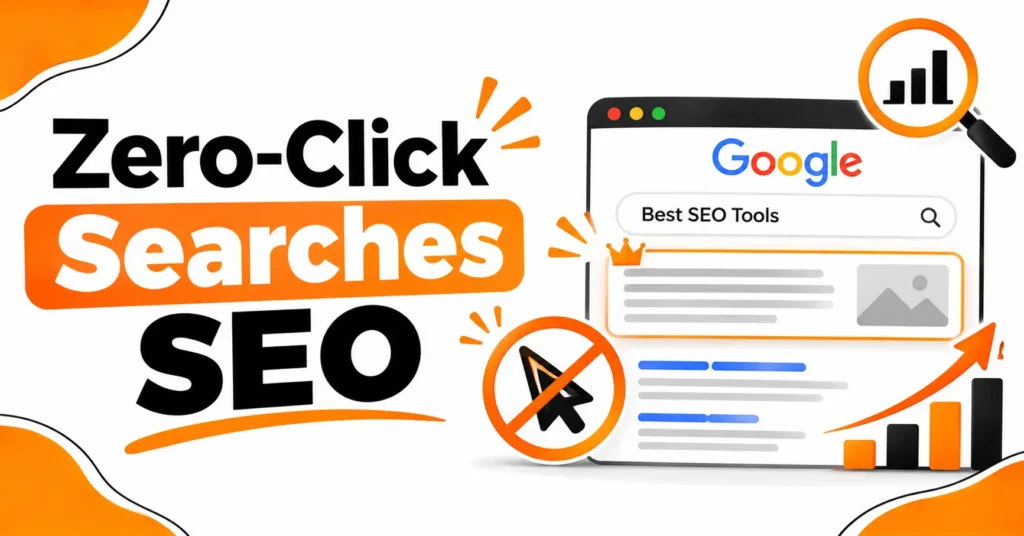
Search engines are transforming how people discover information online. Users no longer need to visit multiple websites to find answers because search results increasingly provide definitions, summaries, business information, and recommendations directly on the results page.
This change has made zero-click searches SEO an important consideration for businesses that depend on organic visibility. Features such as Google AI Overviews, featured snippets, knowledge panels, and People Also Ask can satisfy search intent without generating a website visit.
Although this behavior creates challenges for traditional traffic-focused SEO, it also offers opportunities to increase brand awareness, establish topical authority, and reach potential customers. Understanding this shift is essential for building a search strategy that delivers sustainable results.
What Are Zero-Click Searches in SEO?
Zero-click searches happen when someone searches for information and receives a satisfactory answer directly on a search engine results page (SERP) without clicking an external website. Search engines display information in different formats to help users complete their searches quickly.
For example, someone searching for “What is link building?” might see a featured snippet containing a short definition. Similarly, a search for a business address may display a knowledge panel or local listing with contact details and directions.
These interactions are called zero-click searches because the user does not need to visit another webpage to obtain the information. However, websites can still receive impressions and visibility from these searches, even when they generate no direct traffic.
An important distinction is that zero-click searches do not necessarily mean that SEO has stopped working. Instead, they change how search visibility translates into website visits, brand recognition, and business opportunities.
Why Are Zero-Click Searches Increasing?
The growth of zero-click searches is closely connected to improvements in search technology and changing user expectations. People increasingly want immediate answers rather than spending time opening several websites and comparing information.
Search engines now understand queries more effectively and display relevant information through featured snippets, knowledge panels, local packs, calculators, and other SERP features. These experiences are particularly useful for straightforward informational searches.
Artificial intelligence is accelerating this transformation. AI-powered search experiences can summarize information, explain complicated subjects, and provide conversational responses using information from multiple sources.
Mobile search and voice assistants also contribute to this behavior. Users frequently search while traveling, working, or completing everyday activities, making quick and accessible answers especially valuable.
What Are the Different Types of Zero-Click Searches?
Understanding different search result features helps businesses identify opportunities to improve their online visibility. Each feature serves a specific purpose and responds to a particular type of search intent.
Featured Snippets
Featured snippets display selected information from a webpage near the top of search results. They commonly answer informational questions with definitions, short paragraphs, numbered steps, or tables.
For example, a search for “How does technical SEO work?” may display a concise explanation extracted from a relevant webpage. These placements can introduce users to a website even when they do not click through.
Google AI Overviews
AI Overviews provide AI-generated summaries that help users understand topics without opening multiple search results. They may combine information from different sources and display links to supporting content.
This feature creates new opportunities for brands to become visible in AI-powered search experiences. However, appearing in an AI Overview is not guaranteed, even when a webpage ranks well in traditional organic results.
Knowledge Panels
Knowledge panels display information about recognized people, businesses, organizations, products, and other entities. Depending on the search, they may include descriptions, images, locations, contact information, and related details.
Consistent business information and a clear digital identity help users recognize an organization across different online platforms.
People Also Ask
People Also Ask displays related questions based on the original search query. Users can expand individual questions to view additional answers without necessarily visiting a website.
Creating useful content that addresses related questions can help businesses cover broader search intent and provide more complete information.
Local Search Packs
Local packs display nearby businesses based on location-related search queries. They commonly include business names, ratings, addresses, operating hours, and directions.
For example, someone searching for “digital marketing agency near me” may see a selection of local businesses directly in the results.
Instant Answers and Calculators
Search engines can also display immediate answers for calculations, currency conversions, weather information, dates, and other straightforward queries.
These features are particularly common when users need a specific piece of information rather than a detailed explanation.
| Search feature | Example query | Information displayed |
| Featured snippet | What is SEO link building? | Direct definition |
| AI Overview | How does SEO work? | AI-generated summary |
| Knowledge panel | Information about a company | Entity information |
| People Also Ask | Why is SEO important? | Related questions |
| Local pack | Marketing agency near me | Local business listings |
| Calculator | Percentage of 500 | Instant calculation |
| Image carousel | SEO infographic examples | Relevant images |
How Do Zero-Click Searches Affect SEO?
The growing presence of direct answers creates both challenges and opportunities for website owners. The biggest concern is that users may obtain information without visiting the websites that originally published it.
This can influence organic click-through rates, website sessions, and traffic generated by informational keywords. However, the overall impact depends on the query, industry, search features, and user intent.
Declining Organic Click-Through Rates
When search engines provide answers directly, fewer users may click traditional organic listings. A webpage can maintain its ranking position while experiencing fewer visits than before.
For example, a website ranking near the top for a basic informational query may receive substantial impressions but a relatively low CTR because the search result already satisfies the user’s question.
This is why businesses should evaluate impressions, clicks, and average position together rather than assuming that ranking improvements will always produce proportional traffic growth.
Reduced Traffic From Informational Keywords
Informational searches are particularly exposed to zero-click behavior because users often want simple explanations, definitions, or quick answers.
A search for “What is domain authority?” may be satisfied through a short search result summary. However, a user looking for a complete backlink audit process may still need a detailed tutorial.
Businesses should therefore distinguish between quick-answer queries and searches that require deeper information, practical guidance, or professional services.
Increased Brand Awareness and Visibility
Zero-click searches can also introduce businesses to new audiences. Appearing in a featured snippet, AI-generated response, or knowledge panel can increase familiarity with a brand.
Users may remember the business name and search for it later, visit through another marketing channel, or consider its products and services during a future purchase.
Consequently, search visibility should not be evaluated exclusively through immediate website visits.
How to Optimize Your Website for Zero-Click Searches
A successful zero-click optimization strategy combines keyword research, helpful content, technical SEO, and brand authority. The objective is to make your information accessible to search engines while providing enough value to encourage users to explore your website.
1. Identify Keywords That Trigger Zero-Click Results
Start by researching search queries that frequently display featured snippets, AI Overviews, knowledge panels, and People Also Ask results.
Question-based keywords containing phrases such as “what is,” “how to,” “why does,” and “which is better” can reveal opportunities for answer-focused content.
Analyze the search engine results page before targeting a keyword. Determine whether users are looking for a definition, a comparison, a tutorial, a local service, or a purchasing recommendation.
Prioritize queries based on their search intent and business value. A lower-volume keyword that attracts potential customers may be more valuable than a high-volume query that generates little engagement.
2. Optimize Content for Featured Snippets
Featured snippets often provide concise answers to specific questions. Organizing your content around clear questions and informative responses can make it easier for search engines to understand your information.
Place a direct answer immediately after the relevant heading. For example, if your heading is “What Is Off-Page SEO?” begin with a straightforward definition before discussing its techniques and benefits.
Use descriptive headings, relevant comparison tables, and short explanations. Avoid unnecessary introductions that force readers to search through several paragraphs before finding an answer.
There is no guaranteed method of obtaining a featured snippet. Content quality, relevance, and the search engine’s assessment of the best result remain important.
3. Structure Content Around Search Intent
Search intent explains what users expect to accomplish when they enter a query. Understanding this expectation helps you create content that satisfies the actual information need.
For informational searches, provide definitions, explanations, and examples. For commercial searches, include comparisons, advantages, limitations, and buying considerations.
For transactional searches, make relevant product or service information easy to access. Matching the content format to the search intent can improve its usefulness and relevance.
4. Implement Relevant Structured Data
Structured data helps search engines interpret information about webpages, organizations, products, articles, and other entities.
Use appropriate schema markup when it accurately describes the content on your website. For example, Article schema can describe an editorial resource, while Organization schema can provide information about a business.
Validate your implementation and ensure that structured data matches the visible page content. Schema markup does not guarantee featured snippets, AI citations, or rich results, but it can help search engines interpret supported information.
5. Create Helpful Question-Based Content
Users frequently search using natural language and conversational questions. Developing content around these queries can help your website address more specific search needs.
Create dedicated sections for important questions and answer them with accurate, self-contained explanations. Expand those answers with relevant examples, practical advice, and additional context.
Avoid publishing multiple pages that repeat the same information. Instead, build comprehensive resources that cover related subtopics without unnecessary duplication.
6. Improve Internal Linking and Topical Authority
Internal links help users and search engines discover related information across your website. They also establish meaningful connections between supporting articles and broader topic pages.
For example, an article about zero-click searches can link naturally to relevant resources covering technical SEO, keyword research, AI search optimization, and organic CTR.
Developing a connected content structure helps demonstrate subject coverage and gives readers a reason to explore additional resources.
How to Optimize Content for Google AI Overviews
AI-powered search is changing how information is summarized and presented. Instead of simply displaying a list of webpages, AI Overviews can generate explanations that combine information from different sources.
To improve your content’s suitability for these experiences, focus on accuracy, clarity, and originality. Provide direct answers, explain complex concepts in understandable language, and support important claims with reliable information.
Include practical examples, original research, expert perspectives, and useful comparisons. Content that contributes meaningful information offers more value than pages that simply repeat commonly available explanations.
Technical accessibility also matters. Ensure that important pages are crawlable, indexable, mobile-friendly, and organized with a logical heading structure.
There is no special AI Overview schema or guaranteed optimization technique. The most sustainable approach is to follow established search fundamentals and publish genuinely helpful content.
How to Build Brand Authority in a Zero-Click Search Environment
Brand authority becomes increasingly valuable when users can discover information without visiting individual websites. A recognizable business can build familiarity through consistent, useful, and credible information across the web.
Publish original research, detailed industry guides, case studies, and expert contributions that demonstrate real knowledge. Maintain accurate brand information and consistent business details across relevant platforms.
Digital PR and genuine editorial mentions can also help expand brand recognition. Focus on earning relevant coverage and providing useful information rather than pursuing meaningless mentions or backlinks.
Building a strong brand presence creates opportunities for users to recognize your business across traditional search results, AI-powered experiences, and other discovery channels.
How to Find and Analyze Zero-Click Keywords
Keyword research should go beyond search volume and competition. Businesses also need to understand which queries generate direct answers and how those results influence organic visibility.
Google Search Console is a useful starting point because its Performance report shows impressions, clicks, average CTR, and average position for individual queries and pages.
Identify keywords with significant impressions but comparatively low CTR. Then inspect the corresponding search results to understand whether featured snippets, AI Overviews, local packs, or other features may explain the behavior.
Keyword research tools can provide additional information about question-based searches, search intent, related terms, and SERP features. Combine these findings with your business objectives to prioritize content improvements.
How to Measure Zero-Click Search Performance
Traditional SEO reporting often focuses on organic traffic, keyword rankings, and backlinks. However, these measurements do not capture every benefit or limitation associated with zero-click searches.
Businesses should combine traditional performance indicators with brand visibility and conversion measurements.
| Performance metric | What it measures | SEO importance |
| Organic impressions | Search result exposure | Measures visibility |
| Click-through rate | Percentage of impressions generating clicks | Identifies CTR changes |
| Average position | Average organic ranking position | Evaluates ranking trends |
| Branded search volume | Searches containing your brand name | Indicates brand awareness |
| AI citations | Brand or content references in AI responses | Provides AI visibility insights |
| Conversion rate | Percentage of visitors completing desired actions | Measures effectiveness |
| Qualified leads | Potential customers generated | Measures business value |
| Organic engagement | How visitors interact with content | Evaluates traffic quality |
AI citation monitoring is still developing, and no single tool captures every mention across AI platforms. Treat these measurements as directional indicators rather than complete records of AI visibility.
The most important objective is to understand whether search visibility contributes to qualified visitors, stronger brand recognition, and meaningful business results.
Zero-Click Searches SEO vs. Traditional SEO
Traditional SEO concentrates heavily on organic rankings and attracting visitors through search engine results. Modern search optimization also considers how businesses appear in instant answers, featured snippets, and AI-generated responses.
Both approaches remain important. Businesses should not abandon traditional optimization simply because search engines are introducing more direct-answer features.
| Comparison | Traditional SEO | Zero-click optimization |
| Main objective | Generate organic traffic | Improve visibility and traffic |
| Content focus | Relevant, useful webpages | Direct answers and comprehensive information |
| Search experience | Website visits | SERP features and AI responses |
| Optimization | Keywords, content, links, technical SEO | Snippet readiness, answer clarity, brand visibility |
| Performance metrics | Clicks, sessions, rankings | Impressions, visibility, citations, conversions |
| Business value | Traffic and conversions | Awareness, discovery, traffic, and conversions |
The strongest approach combines both strategies. Businesses need traditional organic visibility while adapting their content to the different ways users discover information.
Common Zero-Click SEO Mistakes to Avoid
One common mistake is assuming that every high-impression keyword deserves the same optimization strategy. Some queries have limited click potential because users only need a quick answer.
Another mistake is publishing short, generic content solely to target featured snippets. Direct answers are useful, but the surrounding content should provide meaningful explanations and additional value.
Ignoring branded searches and conversion data is another problem. A decline in organic clicks does not automatically indicate a decline in business performance.
Finally, avoid relying exclusively on schema markup or AI optimization tricks. Technical improvements are useful, but they cannot replace accurate information, strong content, and a trustworthy online presence.
Best Practices for Winning in a Zero-Click Search Environment
Businesses should diversify their marketing channels rather than depending entirely on organic search traffic. Email marketing, social media, referral partnerships, and other relevant platforms can help maintain audience engagement.
Create content that offers something beyond a basic answer. Original research, detailed tutorials, expert opinions, practical examples, and product comparisons give readers stronger reasons to visit your website.
Continue improving technical SEO, internal linking, content quality, and brand recognition. Monitor changes in search features and update important resources when information becomes outdated.
Most importantly, focus on qualified visibility rather than traffic volume alone. Reaching an audience that recognizes your brand and is interested in your services can create long-term business value.
Are Zero-Click Searches Bad for SEO?
Zero-click searches are not automatically harmful to SEO. They can reduce organic traffic for certain informational keywords, but they can also increase brand exposure and help businesses become recognized sources within their industries.
The impact depends on search intent, industry, keyword type, and the search features displayed. An informational blog may experience a different effect than an ecommerce store or local service business.
Rather than treating every lost click as a failure, evaluate how search visibility contributes to brand awareness, qualified traffic, leads, and conversions. This broader approach helps businesses adapt without abandoning traditional SEO fundamentals.
Frequently Asked Questions About Zero-Click Searches
1. What is an example of a zero-click search?
Searching for a simple definition, weather forecast, business address, or currency conversion can produce an immediate answer directly on the search results page. Users receive the information without necessarily visiting an external website.
2. How do zero-click searches affect SEO rankings?
Zero-click searches do not automatically lower a website’s rankings. However, they can reduce the number of clicks generated by existing rankings because search engines may satisfy user intent directly within the results page.
3. Why are zero-click searches increasing?
They are increasing because search engines provide more direct answers through AI Overviews, featured snippets, knowledge panels, local results, and other search features. Users also expect faster and more convenient information.
4. How can I optimize my website for zero-click searches?
Research keywords that trigger SERP features, create helpful and structured content, answer questions directly, implement relevant schema markup, and strengthen brand authority. Regularly analyze impressions and CTR to identify optimization opportunities.
5. Do featured snippets help with SEO?
Featured snippets can improve search visibility and introduce users to a website’s expertise. However, their effect on organic traffic varies according to the query and how much information is displayed directly in search results.
6. How do Google AI Overviews affect website traffic?
AI Overviews can provide summarized information without requiring users to visit individual websites. This may reduce clicks for some informational queries while creating opportunities for cited sources to gain visibility and brand recognition.
7. What is the difference between SEO, AEO, and GEO?
SEO focuses on improving visibility in traditional search engines. Answer Engine Optimization (AEO) focuses on making information useful for direct-answer experiences, while Generative Engine Optimization (GEO) focuses on improving content visibility in generative AI responses.
8. How can I identify zero-click keywords?
Use keyword research platforms and analyze Google search results for features such as AI Overviews, featured snippets, and knowledge panels. Google Search Console can also help identify queries receiving impressions without generating proportional clicks.
9. Can zero-click searches increase brand awareness?
Yes. A business appearing in search features or AI-generated responses can become familiar to users even when they do not immediately visit its website. This exposure may contribute to future branded searches and customer engagement.
10. How should businesses measure zero-click SEO success?
Businesses should monitor organic impressions, CTR, average positions, branded search trends, AI visibility, qualified leads, and conversions. Combining these indicators provides a broader understanding of search performance.
Conclusion
Search behavior is evolving, and businesses must adapt to remain competitive. Zero-click searches SEO requires more than maintaining traditional rankings; it involves improving search visibility, creating helpful content, optimizing for SERP features, building brand authority, and measuring meaningful business outcomes. By combining traditional SEO with AI search optimization and a strong content strategy, businesses can maintain online visibility, attract qualified audiences, and build sustainable growth even when users do not immediately click through to their websites.

James Robert
James Robert is a seasoned Off-Page SEO expert specializing in strategic link building, digital outreach, and authority growth for businesses aiming to improve search visibility and rankings. With over five years of hands-on experience, he helps brands strengthen their online presence through high-quality backlinks, niche-relevant placements, and ethical SEO practices aligned with Google’s guidelines. James’s core specialties include guest posting, blogger outreach, niche edits, brand mentions, and backlink profile optimization. He is highly skilled at building relationships with authoritative publishers and executing scalable outreach campaigns that drive long-term organic growth. As a contributor to leading marketing platforms, James regularly shares actionable insights on off-page SEO strategies, link acquisition, and sustainable ranking improvements, helping businesses achieve consistent and measurable SEO success.