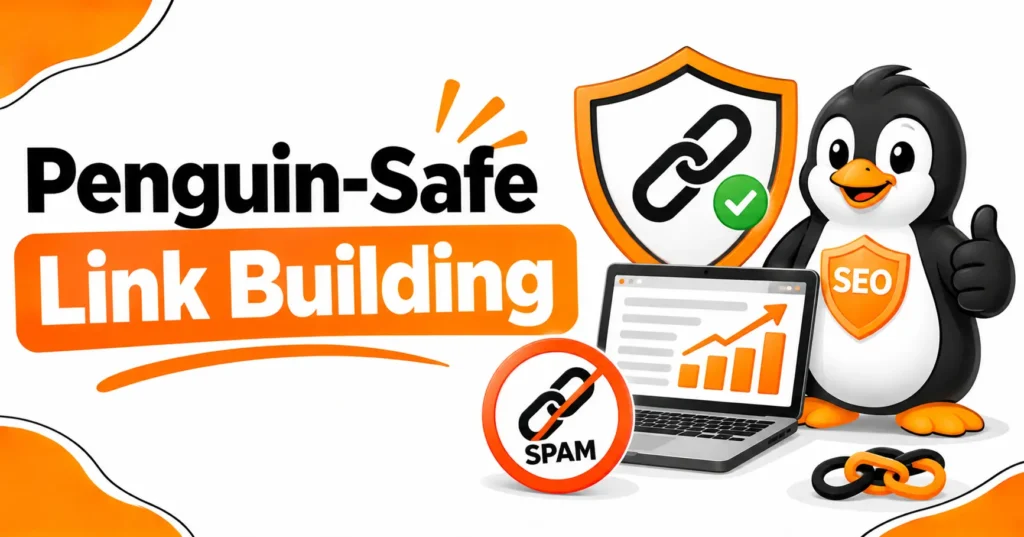
Building backlinks is essential for improving search visibility, but using the wrong techniques can put your website at risk. Penguin-safe link building focuses on earning relevant, trustworthy backlinks without manipulating search engine rankings.
By following ethical SEO practices, businesses can develop a healthy backlink profile, strengthen website authority, and attract valuable referral traffic. Understanding Google’s Penguin update helps website owners recognize harmful link schemes and prioritize genuine editorial recommendations.
From personalized blogger outreach to high-quality content creation, choosing the right strategies makes a significant difference. A strong approach to natural backlinks, white-hat link building, and anchor text optimization supports sustainable SEO growth and long-term search performance.
What Is Penguin-Safe Link Building?
Penguin-safe link building is the process of acquiring backlinks through legitimate methods that prioritize editorial value, topical relevance, and genuine audience benefits. Instead of purchasing large quantities of links or using automated software, businesses earn references by publishing useful content and building professional relationships within their industries.
The objective is to make every backlink meaningful. A relevant link placed naturally within an informative article can help readers discover additional resources, generate referral traffic, and establish connections between related topics. This approach supports sustainable SEO without depending on artificial link popularity.
Understanding Google Penguin and Its Impact on SEO
Google Penguin was introduced in April 2012 to address websites manipulating search rankings through unnatural backlink practices. At the time, some businesses relied heavily on paid links, private blog networks, keyword-rich anchor text, and large-scale link exchanges to improve their positions in search results.
The update changed how Google evaluated manipulative linking patterns and made backlink quality increasingly important. In September 2016, Penguin 4.0 became part of Google’s core ranking systems and began operating in real time. This means Penguin is no longer a separate algorithm that website owners need to wait for periodic updates to address.
How Penguin’s Principles Apply to Modern SEO
Although Penguin has evolved, its central message remains important: backlinks should represent meaningful relationships rather than artificial attempts to influence rankings. Modern link-spam systems identify patterns associated with manipulative link acquisition and may neutralize the ranking benefits of unnatural links.
Website owners should therefore concentrate on editorial references, relevant publications, original content, and responsible outreach. Simply increasing referring domain counts or acquiring links with high third-party authority scores does not guarantee improved search performance.
What Makes a Backlink Safe and Valuable?
A valuable backlink usually comes from a relevant website that publishes useful information and serves a genuine audience. The linking article should provide context, and the destination should offer additional information that helps readers understand the subject.
However, no individual metric can guarantee that a backlink is safe. Evaluate the website’s content quality, editorial standards, audience relevance, linking patterns, and acquisition method together. A smaller industry publication with an engaged readership may provide a more meaningful opportunity than a large but unrelated website.
Topical Relevance and Contextual Placement
Topical relevance refers to the relationship between the linking website, the individual article, and the destination content. For example, a marketing publication linking to a detailed SEO guide creates a logical connection because both resources address related subjects.
Contextual placement also matters. A backlink included naturally within an informative paragraph makes more sense than an unrelated link inserted into a footer, sidebar, or author biography solely for ranking purposes.
Editorial Quality and Genuine Audience Value
Editorial backlinks are references included because a publisher considers another resource useful to its readers. They can result from original research, expert insights, comprehensive guides, or valuable industry contributions.
Evaluate whether the linking publication maintains consistent editorial standards and whether its articles provide meaningful information. Avoid websites that publish large volumes of unrelated content with excessive commercial links and little attention to quality.
Natural Anchor Text Variation
Anchor text is the clickable wording used to link one webpage to another. It helps readers understand what they can expect after following a link and provides context about the destination.
A natural backlink profile can include branded phrases, naked URLs, descriptive wording, partial-match keywords, and occasional exact-match anchors. Repeatedly requesting the same commercial keyword may create an unnatural pattern, particularly when links are acquired through coordinated ranking-focused campaigns.
12 Penguin-Safe Link Building Strategies That Work
Building a sustainable backlink profile requires more than one technique. Combining content marketing, digital PR, personalized outreach, and genuine industry relationships creates multiple opportunities to earn relevant editorial references.
1. Create Valuable Linkable Assets
Linkable assets are resources that other publishers naturally want to reference. Original research, detailed tutorials, industry statistics, downloadable templates, and practical tools can attract backlinks because they provide information that improves other articles.
Focus on subjects where your business can offer something genuinely useful or different. Support your resources with accurate information, clear explanations, and practical examples so publishers have a meaningful reason to reference them.
2. Develop Personalized Blogger Outreach Campaigns
Blogger outreach involves connecting with website owners, editors, and industry publishers who cover subjects related to your business. Start by researching relevant publications and understanding their audience before contacting them.
Personalize every message by explaining why your content would benefit their readers. Avoid mass-produced emails, misleading promises, and requests that treat backlinks as guaranteed transactions. Genuine communication helps establish professional relationships and creates better opportunities for editorial exposure.
3. Publish High-Quality Guest Contributions
Guest posting allows professionals to share useful knowledge with audiences outside their own websites. Original articles containing practical insights, expert explanations, and relevant examples can establish credibility and attract referral visitors.
The important distinction is the purpose of the campaign. Publishing genuinely valuable contributions is different from producing large quantities of keyword-rich articles primarily to manipulate search rankings. Paid or sponsored placements should use appropriate link attributes, such as rel=”sponsored” or rel=”nofollow”, when applicable.
4. Use Digital PR to Earn Editorial Backlinks
Digital PR involves developing newsworthy stories, original research, expert commentary, and industry insights that attract attention from journalists and publishers. Instead of requesting links directly, businesses provide information that publishers may independently reference.
For example, a company can publish a survey about changing industry trends or share original research supported by transparent methodology. When other publications discuss the findings, they may naturally cite the original resource and introduce new audiences to the business.
5. Publish Original Research and Industry Statistics
Original research creates information that cannot easily be found elsewhere. Surveys, experiments, case studies, market reports, and data-driven insights can become valuable references for writers and industry professionals.
Present your findings with clear explanations, supporting evidence, and a transparent research process. Avoid unsupported statistics or exaggerated conclusions. Accurate information increases credibility and gives publishers a stronger reason to reference your work.
6. Find Relevant Resource Page Opportunities
Resource pages collect useful guides, educational materials, tools, and references around a particular subject. They can offer legitimate backlink opportunities when your content provides something genuinely valuable to the intended audience.
Identify relevant resource collections and examine the type of material they recommend. Contact the publisher with a concise explanation of how your resource complements the existing collection rather than sending generic requests for link insertion.
7. Apply Broken Link Building
Broken link building involves identifying unavailable resources on relevant websites and suggesting a suitable replacement. This approach helps publishers improve their content while giving your own resources an opportunity to earn editorial references.
Look for outdated links within industry articles, educational resources, and relevant directories. Create or identify a replacement that covers the original subject and provides useful information. Your suggestion should genuinely solve the problem rather than serve as an excuse for unrelated promotion.
8. Reclaim Unlinked Brand Mentions
Businesses are sometimes mentioned in online articles without receiving a clickable backlink. These unlinked brand mentions can provide opportunities to establish useful editorial connections.
Find relevant mentions and contact the publisher politely. Explain how adding a link could help readers access the original business, product, research, or resource. Do not assume every mention needs a backlink; the request should make sense within the article’s context.
9. Build Relationships With Industry Publishers
Strong publisher relationships can create opportunities for expert interviews, original contributions, collaborative research, and natural editorial references. Regularly sharing useful information helps establish professional credibility.
Avoid treating every interaction as a link-building transaction. Genuine industry relationships develop through consistent communication, useful contributions, and mutual professional value.
10. Promote Comprehensive Industry Guides
Detailed guides can become useful reference materials when they explain complicated subjects in an accessible way. Cover important questions, provide practical instructions, and include examples that readers can apply.
Publishing alone is not enough. Share your guides through relevant professional communities, newsletters, and industry conversations. Reaching the right audience increases the possibility that publishers will discover and reference your work.
11. Earn Backlinks Through Expert Contributions
Industry publications often look for knowledgeable professionals who can explain complex subjects or provide original opinions. Sharing practical experience and accurate insights can create opportunities for expert features and editorial citations.
Keep contributions informative and relevant to the discussion. Promotional links should not dominate your responses, and any references should genuinely support the information being presented.
12. Participate in Relevant Industry Communities
Professional groups, discussion platforms, and online communities help businesses connect with potential customers, publishers, and industry experts. Answering questions and sharing useful resources can increase brand visibility and establish subject expertise.
Avoid automated comments, repetitive promotional messages, and irrelevant links. Community participation should focus on solving problems and contributing useful knowledge rather than creating backlinks for their own sake.
Link Building Practices That Can Put Your Website at Risk
Some backlink techniques attempt to manufacture popularity without providing genuine editorial value. These practices can violate search engine spam policies and may result in links being ignored or, in more serious cases, manual actions.
Paid links intended to manipulate rankings, private blog networks, automated backlink creation, excessive reciprocal exchanges, and large-scale low-quality guest-post campaigns are important risks to understand. Other questionable practices include link farms, irrelevant directory submissions, hidden links, and keyword-rich placements across unrelated websites.
The difference between legitimate promotion and manipulation often comes down to intent and implementation. Advertising, sponsorships, and genuine business partnerships can be legitimate, but compensated links should be appropriately qualified. Avoid strategies where the primary objective is to manufacture ranking signals rather than provide value to users.
How to Maintain a Natural Anchor Text Profile?
Anchor text provides context about the destination of a backlink. A healthy profile develops through genuine publisher references rather than a predetermined formula that forces every link to contain a target keyword.
Different publishers naturally describe the same resource in different ways. Some may use a brand name, others may use a descriptive phrase, and some may simply include the destination URL.
| Anchor text type | Example | SEO purpose |
| Branded | RankingChamps | Brand recognition |
| Naked URL | rankingchamps.com | Direct website reference |
| Generic | Read this guide | General navigation |
| Partial match | Effective link building strategies | Descriptive relevance |
| Exact match | Penguin-safe link building | Specific topic reference |
| Contextual | Natural backlink acquisition methods | Subject description |
There is no universal percentage distribution that guarantees a natural backlink profile. Instead, monitor repeated exact-match patterns and avoid asking publishers to use identical commercial anchors across multiple placements.
How to Evaluate a Website Before Building a Backlink
Choosing the right linking website is just as important as selecting the right acquisition strategy. Before contacting a publisher, investigate its subject matter, content quality, publishing consistency, audience, and editorial standards.
Third-party metrics such as Domain Authority and Domain Rating can help with initial research, but they are not official Google ranking measurements. A high score does not automatically make a website trustworthy, relevant, or suitable for your campaign.
| Evaluation factor | What to examine |
| Topical relevance | Connection with your industry |
| Organic visibility | Relevant search presence |
| Content quality | Original and useful articles |
| Editorial standards | Genuine publishing practices |
| Backlink profile | Suspicious linking patterns |
| Audience engagement | Real readers and interaction |
| Link placement | Natural contextual relevance |
| Website history | Consistent publishing and credibility |
Consider the entire publication rather than judging it through one metric. The most useful question is whether the link would make sense to a real reader even if search engines did not exist.
How to Audit Your Backlink Profile for Penguin Risks?
A backlink audit helps identify unusual patterns and understand how other websites reference your content. Start by reviewing referring domains, anchor text, linking pages, and the history of your backlink acquisition.
Look for obvious paid link networks, irrelevant groups of websites, automated link creation, and repeated keyword-rich placements. Compare suspicious patterns with your actual outreach and marketing activities to understand how those links appeared.
Google Search Console provides external link information and a Manual Actions report. Additional backlink research tools can help investigate referring domains and anchor text, but automated toxicity scores should be treated as indicators for further investigation, not proof of a Google penalty.
When Should You Use the Disavow Links Tool?
The disavow tool is not intended for routine backlink cleanup. Google can automatically ignore many spammy links, so receiving an unrelated or low-quality backlink does not necessarily mean you need to take action.
Consider disavowing links when there is a substantial pattern of artificial backlinks and you have a manual action or strong evidence of manipulative link creation that you cannot resolve through removal. Investigate the situation carefully before submitting a disavow file.
How to Recover From an Unnatural Links Penalty?
If you suspect a backlink-related penalty, first check the Manual Actions report in your search console account. A manual action means a human reviewer has identified a policy violation, while algorithmic link evaluation does not necessarily generate a notification.
Investigate the unnatural links, contact relevant webmasters to request removal or appropriate qualification, and document your corrective actions. If a significant number of artificial links remain and meet the disavow criteria, use the disavow tool where appropriate.
After resolving a manual action, submit a reconsideration request explaining the issue, the corrective measures taken, and the steps implemented to prevent future violations. Recovery is not guaranteed, and improvements in search visibility may take time.
Best Tools for Safe Link Building and Backlink Analysis
Effective backlink management requires reliable research and monitoring tools. Google Search Console helps website owners review external link information, monitor search performance, and identify manual actions.
Backlink research platforms can help compare referring domains, examine anchor text, discover competitor link opportunities, and investigate suspicious patterns. Website crawling tools can also identify internal linking problems and technical issues that affect how pages are discovered.
Use these tools to support informed decisions rather than relying entirely on automated scores. No third-party platform can guarantee that a particular backlink is safe or that it will improve search rankings.
Common Mistakes to Avoid When Building Backlinks
One of the biggest mistakes is prioritizing backlink quantity over relevance and editorial quality. A large number of unrelated links may increase reported backlink counts without contributing meaningful referral traffic or genuine industry recognition.
Another mistake is chasing high authority metrics, forcing exact-match anchor text, or purchasing ranking-focused guest posts. These shortcuts distract from the real objective of earning references that readers find useful.
Avoid judging your SEO progress solely by the number of backlinks acquired. Monitor organic visibility, relevant referring domains, referral traffic, branded searches, and the quality of the relationships created through your campaigns.
Frequently Asked Questions
What Is Penguin-Safe Link Building?
Penguin-safe link building involves acquiring relevant, editorially valuable backlinks through legitimate methods. It focuses on useful content, genuine publisher relationships, natural anchor text, and avoiding manipulative link schemes.
Is Google Penguin Still Active?
Penguin’s original principles remain relevant, but it is no longer a separate algorithm. Penguin 4.0 was integrated into Google’s core ranking systems in 2016, making link-spam evaluation part of ongoing search systems.
What Types of Backlinks Are Safe for SEO?
Genuine editorial references, relevant industry citations, and links earned through useful content can contribute to a healthy backlink profile. Their context, purpose, and acquisition methods matter more than a third-party authority score.
Can Guest Posting Cause a Google Penalty?
Guest posting is not automatically against Google’s guidelines. However, large-scale campaigns created primarily to manipulate rankings through keyword-rich backlinks can violate link spam policies. Paid placements should use appropriate link attributes.
Are Paid Backlinks Against Google’s Guidelines?
Buying or selling links intended to manipulate search rankings violates Google’s link spam policies. Legitimate advertising and sponsorships are possible when the associated links are appropriately qualified using attributes such as sponsored or nofollow.
Conclusion
Sustainable SEO depends on earning relevant backlinks through valuable content, genuine relationships, and responsible outreach. Avoid manipulative link schemes, maintain natural anchor text, and regularly evaluate your backlink profile instead of chasing link volume or authority scores. Penguin-safe link building provides a practical foundation for protecting your website, developing industry credibility, and building lasting organic search visibility.

James Robert
James Robert is a seasoned Off-Page SEO expert specializing in strategic link building, digital outreach, and authority growth for businesses aiming to improve search visibility and rankings. With over five years of hands-on experience, he helps brands strengthen their online presence through high-quality backlinks, niche-relevant placements, and ethical SEO practices aligned with Google’s guidelines. James’s core specialties include guest posting, blogger outreach, niche edits, brand mentions, and backlink profile optimization. He is highly skilled at building relationships with authoritative publishers and executing scalable outreach campaigns that drive long-term organic growth. As a contributor to leading marketing platforms, James regularly shares actionable insights on off-page SEO strategies, link acquisition, and sustainable ranking improvements, helping businesses achieve consistent and measurable SEO success.