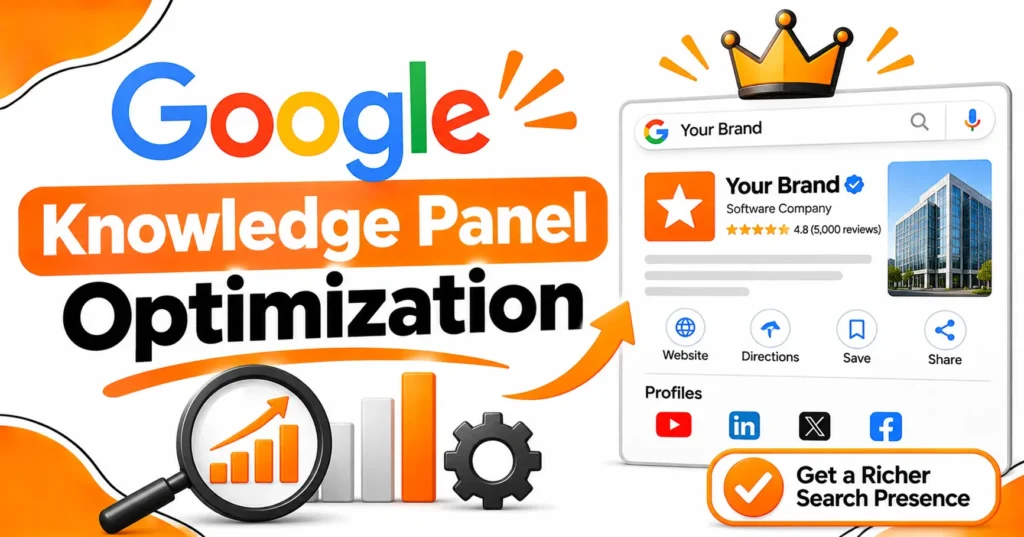
Google Knowledge Panel optimization helps businesses, professionals, and public figures build a stronger presence in Google Search. A well-established Knowledge Panel displays important information such as brand details, official websites, logos, and social profiles, making it easier for people to recognize an entity.
However, earning a panel requires more than basic SEO techniques. Google must understand your identity through reliable information, entity authority, Google Knowledge Graph, structured data, and consistent online profiles.
In this guide, you’ll discover how to build brand credibility, implement Schema markup, claim an existing panel, improve its accuracy, and strengthen your digital presence to support long-term search visibility.
What Is a Google Knowledge Panel?
A Google Knowledge Panel is an information box displayed in Google Search when someone searches for an entity that Google’s systems recognize. It can represent individuals, businesses, organizations, places, products, and other identifiable subjects.
Depending on the entity, the panel may show a short description, official website, logo, founder, social media accounts, location, images, related people, and other information. Google automatically generates this content using its Knowledge Graph and information gathered from different sources across the web.
Unlike a traditional search result, which primarily directs users to a webpage, a Knowledge Panel provides a summarized view of an entity. Its purpose is to help people understand who or what they are searching for without having to visit multiple websites.
How Does Google’s Knowledge Graph Work?
Google’s Knowledge Graph helps its systems understand real-world entities and the relationships between them. Instead of interpreting searches only as individual keywords, Google attempts to identify the people, organizations, places, and concepts behind those searches.
For example, Google may connect a company’s official website with its founder, industry, social media profiles, and independent media coverage. These relationships help establish a clearer picture of the organization and distinguish it from other entities with similar names.
This is why entity SEO goes beyond traditional keyword optimization. Building a recognizable identity requires consistent information, meaningful relationships, and reliable references that support the same entity.
Why Is Google Knowledge Panel Optimization Important?
A Knowledge Panel can provide a prominent brand presence when users search for a company or individual. It can make essential information easier to find and help people recognize an entity across different search experiences.
For businesses, this visibility can support brand awareness, credibility, and reputation management. For professionals and public figures, a panel can help consolidate information about their experience, achievements, and professional identity.
It is important to understand that a Knowledge Panel is not a direct ranking guarantee. Having one does not automatically improve organic rankings, but it can strengthen how an entity is represented in branded search results.
How to Get a Google Knowledge Panel for Your Brand
Getting a Knowledge Panel starts with building a clear and recognizable online identity. Google needs enough reliable information to understand that your business or personal brand represents a distinct entity.
There is no guaranteed application process or fixed eligibility checklist. However, establishing an authoritative website, maintaining consistent profiles, earning independent mentions, and providing accurate structured data can help Google understand your identity.
1. Establish a Strong Online Entity Identity
Start by defining your brand identity clearly. Your business name, official website, logo, description, industry, and ownership information should remain consistent across important online platforms.
Create a detailed About Us page that explains what your company does, when it was established, who founded it, and what makes it relevant to its industry. Individuals should maintain professional biography pages that describe their expertise, achievements, experience, and notable contributions.
A consistent identity helps search engines distinguish your organization from other businesses or individuals with similar names.
2. Build an Authoritative Official Website
Your website should act as the central source of accurate information about your organization. It should clearly explain your business identity, services, leadership, history, and contact details.
Create useful content that demonstrates real industry knowledge rather than publishing large amounts of repetitive material. Dedicated company, founder, author, and leadership pages can provide additional context about the people and organization behind the brand.
Make sure your website is technically accessible, internally connected, mobile-friendly, and properly indexed. Search engines need to be able to discover and understand your important identity information.
3. Strengthen Your Social Media Presence
Maintain official profiles on relevant platforms such as LinkedIn, Facebook, Instagram, and YouTube. Use consistent business names, descriptions, logos, and website information wherever possible.
Your social profiles should clearly represent the same organization and link to its official website. Avoid maintaining multiple unofficial accounts that create confusion about which profile represents your real business.
Social media profiles alone do not guarantee entity recognition, but consistent official information can contribute to a clearer digital identity.
4. Build Brand Authority Through Digital PR
Independent editorial coverage can help establish your brand’s identity and reputation. Relevant interviews, industry publications, expert contributions, press coverage, and professional recognition can provide useful external context about your organization.
Prioritize meaningful mentions from reputable sources that genuinely relate to your industry. The objective is not simply to collect backlinks but to develop an online presence supported by accurate, independent information.
A strong digital PR strategy can also increase brand awareness and create additional opportunities for people to discover your business.
5. Develop Your Wikidata Presence Where Appropriate
Wikidata is a structured knowledge database containing information about people, organizations, locations, and other entities. It uses identifiers and relationships to organize information in a machine-readable format.
An accurate and eligible Wikidata entry can help connect information about an entity. However, entries should contain verifiable facts and reliable references rather than promotional descriptions.
Wikipedia has separate editorial and notability requirements. Creating an article about your own business purely to obtain a Knowledge Panel is not a reliable strategy and may violate editorial guidelines.
6. Build Consistent Brand Mentions and Citations
Your brand should be represented consistently wherever it is mentioned online. Business directories, professional associations, industry publications, and relevant databases can provide useful information about your identity.
Check that your organization has the correct name, website, description, location, and other identifying details. Remove or correct outdated information where possible.
Focus on relevant, trustworthy references instead of submitting your business to hundreds of low-quality directories.
How to Use Schema Markup for Knowledge Panel Optimization?
Structured data helps search engines interpret the information published on your website. It provides additional context about your organization, people, relationships, and official online profiles.
Although Schema markup cannot force Google to generate a Knowledge Panel, it can help clarify your entity information and reduce ambiguity.
Important Schema Types for Entity SEO
| Schema type | Purpose |
| Organization | Describes a company or organization |
| Person | Identifies an individual |
| LocalBusiness | Describes an eligible local business |
| WebSite | Identifies the official website |
| sameAs | Connects profiles representing the same entity |
| Article | Identifies published editorial content |
For a business, Organization Schema can describe its official name, URL, logo, founding information, and other applicable properties. Person Schema can provide structured information about an individual, while LocalBusiness is appropriate for eligible local businesses.
Example of Organization Schema Markup
The following JSON-LD example demonstrates how a company can identify itself and connect its official profiles.
{
“@context”: “https://schema.org”,
“@type”: “Organization”,
“name”: “Example Company”,
“url”: “https://www.example.com/”,
“logo”: “https://www.example.com/logo.png”,
“description”: “A company providing professional business services.”,
“sameAs”: [
“https://www.linkedin.com/company/example”,
“https://www.facebook.com/example”
]
}
Replace the example information with accurate details about your organization. Only include profiles that genuinely represent the same entity.
After implementation, validate your structured data and check for errors. Keep the markup consistent with visible website content, because structured data should describe information users can actually verify.
How to Claim and Verify Your Google Knowledge Panel?
If Google has already generated a Knowledge Panel for your business or personal identity, you may be eligible to claim it. Verification allows an authorized representative to demonstrate their association with the entity and access available management features.
Search for your exact brand or personal name and locate the correct panel. If a claim option is available, follow the verification instructions and use an eligible official account to establish your relationship with the entity.
After verification, you may be able to suggest changes, manage eligible information, and provide feedback about inaccurate details. However, claiming a panel does not give you complete control over Google’s automatically generated information.
How to Optimize an Existing Google Knowledge Panel?
Once a panel appears, the next priority is ensuring that its information accurately represents your identity. Review the displayed details and compare them with your official website and other authoritative profiles.
This is where Google Knowledge Panel optimization becomes an ongoing reputation management process. Accurate descriptions, consistent branding, updated images, and reliable external information can help maintain a stronger representation of your entity.
Improve Your Brand Logo and Images
Your logo and images should represent your organization clearly. Use a high-quality official logo and maintain consistent visual branding across your website and professional profiles.
Google may select images from different sources, so make sure your official branding is accurate and publicly accessible. Keep outdated logos and incorrect images from remaining on important profiles wherever you have permission to update them.
Connect Your Official Social Media Profiles
Your official website should link to relevant social media accounts, and those profiles should identify your organization correctly. Consistent naming and branding can help users and search engines understand which accounts belong to the same entity.
Use the same official business information across your important profiles and avoid linking unrelated or unofficial accounts.
Correct Inaccurate Knowledge Panel Information
If your panel displays an outdated description, incorrect image, or wrong social profile, use Google’s available feedback or editing process to report the problem.
Provide clear information and supporting evidence when requested. Google reviews suggested changes and determines whether they should be accepted, so not every requested edit will necessarily appear.
Google Knowledge Panel vs. Google Business Profile
Knowledge Panels and Google Business Profiles serve different purposes, even though they can both appear in search results.
A Knowledge Panel is generated automatically to represent an entity, while a Google Business Profile is a separate product that eligible businesses can claim and manage for their presence in Google Search and Maps.
| Feature | Knowledge Panel | Google Business Profile |
| Main purpose | Represents recognized entities | Represents eligible businesses |
| Creation | Automatically generated by Google | Created or claimed by an eligible business |
| Information sources | Knowledge Graph and web sources | Business-submitted information and Google data |
| Main audience | People searching for an entity | Customers searching for local businesses |
| Editing | Feedback and eligible management features | Business profile management tools |
| Main benefit | Entity recognition and brand visibility | Local search and Maps visibility |
Optimizing your Business Profile can improve local search visibility, but it does not automatically create a Knowledge Panel. Both should be managed according to their respective requirements.
Common Google Knowledge Panel Optimization Mistakes
One of the biggest mistakes is assuming that Schema markup, a Wikipedia entry, or a single backlink will automatically produce a Knowledge Panel. These elements may contribute to a clearer entity presence, but Google considers information from multiple sources.
Another common problem is inconsistent brand information. Different company names, duplicate profiles, outdated descriptions, and conflicting details can make entity identification more difficult.
Avoid fake reviews, artificial brand mentions, misleading citations, and promotional encyclopedia entries. These shortcuts do not establish genuine authority and can damage your reputation.
A better approach is to build a consistent digital identity, publish accurate information, earn relevant editorial coverage, and maintain reliable business profiles.
Why Is My Google Knowledge Panel Not Showing?
A missing Knowledge Panel does not necessarily indicate a technical SEO problem. Google may not yet recognize your business or individual identity as a n entity with sufficient reliable information.
Start by checking whether your official website is indexed and whether important identity pages are accessible. Review your Organization or Person Schema, verify your brand information, and check for inconsistencies across external profiles.
Continue building genuine brand recognition through relevant publications, authoritative references, and useful content. There is no guaranteed way to force a panel to appear, and repeated submissions will not necessarily speed up the process.
How Long Does It Take to Get a Google Knowledge Panel?
There is no guaranteed timeframe for obtaining a Knowledge Panel. Some entities may already have sufficient information for Google to recognize them, while others may need more time to establish a reliable online presence.
The process depends on Google’s understanding of the entity, the availability of trustworthy information, and the relationships between different sources. Publishing structured data or earning a new backlink should not be treated as an immediate trigger.
How to Monitor and Maintain Your Knowledge Panel
Maintaining an accurate digital identity requires regular monitoring. Search for your brand name periodically and review whether the displayed information accurately reflects your organization.
Keep your website, social profiles, business information, and important external references updated. When your company changes its name, logo, leadership, or official website, update relevant sources to maintain consistency.
Ongoing reputation management, relevant media coverage, and accurate entity information can help preserve a recognizable online presence.
Frequently Asked Questions About Google Knowledge Panel Optimization
1. How do I get a Google Knowledge Panel for my business?
Build a recognizable business identity using an authoritative website, consistent social profiles, relevant editorial mentions, and accurate structured data. Google automatically determines whether sufficient information exists to generate a panel.
2. Is a Google Knowledge Panel free?
Yes. Google does not charge businesses or individuals to generate or claim an eligible Knowledge Panel. However, professional SEO, digital PR, and reputation management services may involve costs.
3. Can anyone create a Google Knowledge Panel?
No. Users cannot manually create a panel whenever they want. Google automatically generates Knowledge Panels for entities it recognizes through its Knowledge Graph and other information sources.
4. How do I claim my Google Knowledge Panel?
Find your existing panel in Google Search and look for the available claim or verification option. Follow Google’s instructions to prove your association with the person or organization represented.
5. Does Schema markup help with Knowledge Panels?
Schema markup helps Google understand your organization and its online identity. Organization, Person, and sameAs properties provide useful context, but structured data does not guarantee a Knowledge Panel.
Conclusion
Building a recognizable digital identity requires consistent information, authoritative brand mentions, structured data, and a trustworthy online presence. From establishing entity authority to claiming and maintaining an existing panel, every step helps Google better understand your business or personal identity. Google Knowledge Panel optimization is a long-term strategy rather than a guaranteed shortcut to search visibility. Focus on accuracy, credibility, and genuine brand recognition to build a stronger presence in Google Search.

James Robert
James Robert is a seasoned Off-Page SEO expert specializing in strategic link building, digital outreach, and authority growth for businesses aiming to improve search visibility and rankings. With over five years of hands-on experience, he helps brands strengthen their online presence through high-quality backlinks, niche-relevant placements, and ethical SEO practices aligned with Google’s guidelines. James’s core specialties include guest posting, blogger outreach, niche edits, brand mentions, and backlink profile optimization. He is highly skilled at building relationships with authoritative publishers and executing scalable outreach campaigns that drive long-term organic growth. As a contributor to leading marketing platforms, James regularly shares actionable insights on off-page SEO strategies, link acquisition, and sustainable ranking improvements, helping businesses achieve consistent and measurable SEO success.