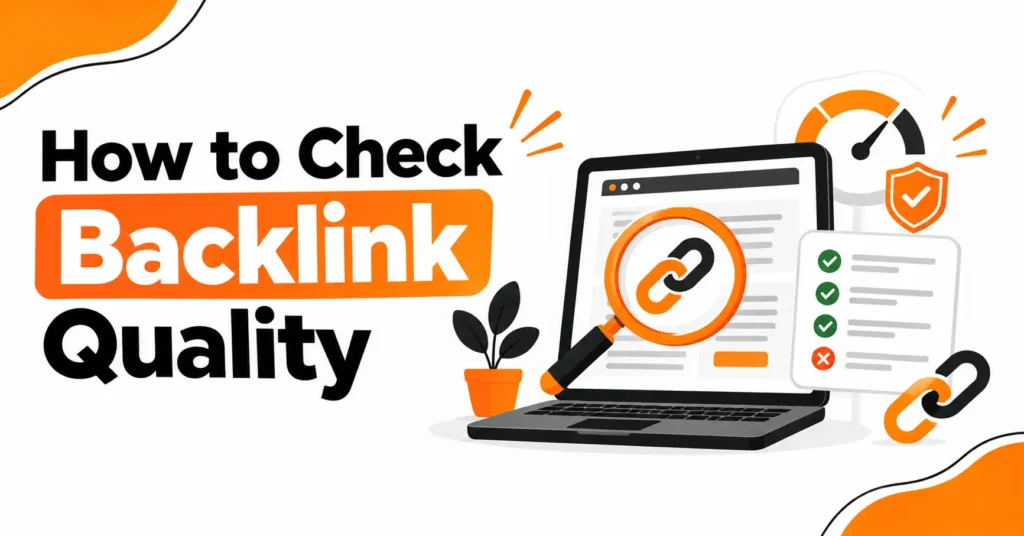
Learning how to check backlink quality is essential for building a strong backlink profile and improving your website’s SEO performance. Not every backlink provides value, and links from irrelevant or suspicious websites may require closer investigation.
By evaluating Domain Authority, referring domains, anchor text, and topical relevance, you can identify valuable link-building opportunities and understand potential risks.
A reliable backlink analysis process combines SEO tools with manual checks to assess the source website, linking page, and editorial context.
This guide explains practical methods, useful metrics, and common warning signs to help you evaluate backlinks confidently and develop a sustainable link-building strategy.
What Is Backlink Quality?
Backlink quality describes how relevant, credible, and useful an incoming link is within its surrounding context. A link from a respected publication that naturally references a relevant resource can provide more value than an unrelated link placed solely to influence search rankings.
Quality depends on several factors, including the source website’s credibility, the linking page’s content, topical relevance, anchor text, editorial placement, and how the link was acquired. No single metric can fully measure all these characteristics.
Why Is Backlink Quality Important for SEO?
Evaluating backlinks helps you understand your website’s link profile and identify opportunities to improve your link-building strategy. Relevant editorial links can help search engines discover content, bring interested visitors, and contribute to your website’s broader search visibility.
Backlink analysis also helps uncover suspicious patterns, such as unnatural anchor text or links created through manipulative schemes. However, low authority, limited traffic, or a nofollow attribute does not automatically make a backlink harmful.
How to Check Backlink Quality: 9 Proven Methods
Understanding how to check backlink quality requires a combination of SEO tools and manual investigation. The following methods help you evaluate existing backlinks, review potential link-building opportunities, and make informed decisions about questionable links.
1. Evaluate the Referring Domain’s Credibility
Start by examining the website that links to your content. Review its main subject, publishing history, content standards, and apparent purpose. A legitimate website usually provides useful information for a recognizable audience rather than publishing unrelated content primarily to sell backlinks.
Domain Authority and Domain Rating can help you compare potential link sources, but neither metric directly measures Google’s assessment of a website. Consider these scores alongside content quality, topical relevance, and the site’s overall credibility.
2. Inspect the Linking Page’s Quality
A website may have a strong backlink profile while hosting individual pages that provide little value. Open the exact page containing your backlink and check whether its content is original, informative, and relevant to the subject of your destination page.
Look for meaningful explanations, a clear structure, and useful information for readers. Thin content, scraped material, excessive advertisements, and unrelated commercial links can be warning signs, especially when several appear together.
3. Measure Topical and Contextual Relevance
Topical relevance describes how closely the linking content relates to your website or destination page. For example, a link to an SEO guide placed naturally within an article about digital marketing has a clear contextual connection.
Relevance does not mean that every backlink must come from a website in exactly the same niche. Legitimate references can cross industries when they help readers. The important question is whether the link makes sense in the context where it appears.
4. Analyze Anchor Text and Link Placement
Anchor text is the clickable wording used in a hyperlink. Descriptive text helps readers understand the destination, while the surrounding paragraph explains why that resource is relevant.
Review whether your backlinks use natural brand names, URLs, descriptive phrases, or commercial keywords. Repeated exact-match commercial anchors across unrelated websites may indicate manipulative link-building, particularly when the links were deliberately created to influence rankings.
Also check where the link appears. A relevant editorial citation can be more meaningful than an unrelated footer link or a placement surrounded by dozens of commercial references.
5. Check Dofollow, Nofollow, Sponsored, and UGC Attributes
Inspect the link’s HTML to understand whether it includes attributes such as rel=”nofollow”, rel=”sponsored”, or rel=”ugc”. These attributes communicate information about the relationship between the linking website and the destination.
A standard followed link may be eligible to pass ranking signals, but that does not guarantee a ranking improvement. Nofollow links can still attract referral visitors, while sponsored links should be appropriately qualified. Do not classify a link as bad simply because it uses nofollow.
6. Examine Organic Visibility and Outbound Links
Check whether the source website appears to serve a real audience and publish content that people may find useful. Organic traffic estimates can help you compare potential link sources, but third-party tools do not provide exact traffic measurements.
Next, examine the website’s outbound links. A page that references useful resources naturally is different from a page that links to unrelated commercial websites throughout its content. Repeated link-selling patterns, thin articles, and excessive keyword-rich anchors may warrant further investigation.
7. Compare Authority and Trust Metrics
Backlink analysis tools provide different metrics to help evaluate domains, pages, and link profiles. Understanding what each metric measures prevents you from assigning too much importance to a single number.
| SEO metric | What it measures | How to use it |
| Domain Authority (DA) | A third-party estimate of comparative domain authority | Compare potential link sources |
| Domain Rating (DR) | A third-party estimate of backlink profile strength | Assess relative domain-level link strength |
| Page Authority (PA) | An estimate of comparative page-level authority | Compare individual pages |
| Trust Flow | A link-based trust metric | Consider alongside topical relevance |
| Citation Flow | A metric associated with link influence | Compare with Trust Flow and other signals |
| Spam Score | An estimate based on patterns associated with potentially spammy sites | Use as an investigation signal, not a verdict |
| Referring domains | Distinct domains linking to a website or page | Review diversity and individual source quality |
There is no universal DA, DR, or Trust Flow threshold that makes a backlink good. A smaller industry publication can provide a legitimate and relevant link, while a high-scoring domain may contain an irrelevant or manipulative placement.
8. Identify Suspicious Backlink Patterns
A suspicious backlink should be evaluated within the context of the wider link profile. Warning signs may include links from link farms, private blog networks, hacked pages, automatically generated websites, and unrelated pages created primarily to manipulate rankings.
Look for patterns across multiple links rather than reacting to one isolated metric. Repeated commercial anchors, unnatural acquisition spikes, and large groups of unrelated placements can justify closer investigation, but none of these signals independently proves that a penalty will occur.
9. Evaluate How the Backlink Was Acquired
The method used to obtain a backlink matters. Links earned through original research, useful resources, genuine recommendations, and legitimate editorial decisions are different from links created through manipulative schemes.
Paid placements, excessive reciprocal linking, automated link creation, and other practices intended to manipulate rankings may violate search engine spam policies. Review the circumstances surrounding questionable links before deciding whether any action is necessary.
Best Tools to Check Backlink Quality
A backlink checker helps you discover links, compare referring domains, and investigate anchor-text patterns. Combining several data sources with manual verification provides a more complete assessment than relying on a single tool.
Google Search Console
Google Search Console provides a Links report containing information about linking sites, top linked pages, and commonly used anchor text. It is a useful starting point for understanding the backlinks reported for your verified website.
However, the report is not a complete, real-time inventory of every backlink. Supplement it with other backlink analysis tools when you need broader coverage or additional metrics.
Backlink Analysis Platforms
Professional backlink analysis platforms can provide referring-domain reports, anchor-text distributions, link attributes, historical changes, and comparative authority metrics. These features help you investigate competitors, identify link-building opportunities, and monitor your backlink profile.
Different platforms maintain different indexes, so their reported backlink counts may not match. Treat the data as a research resource and manually verify important findings.
Free Backlink Quality Checkers
Free backlink quality checker tools can quickly display available information about referring domains, link attributes, anchor text, and selected SEO metrics. They are useful for preliminary assessments and small-scale backlink research.
Before making important decisions, open the source page and evaluate its relevance, content quality, and editorial context. Automated tools can highlight potential concerns, but they cannot reliably determine every link’s real-world value.
How to Perform a Backlink Quality Audit?
A structured backlink audit helps you organize findings and prioritize the links that deserve attention. Start by exporting available backlink data, combining reports where appropriate, and removing duplicate records.
Next, review the source domain, linking page, anchor text, link attributes, and acquisition context. Record your observations in a spreadsheet and group links into practical categories such as valuable, uncertain, and potentially manipulative.
Do not automatically remove or disavow every link in the uncertain category. Investigate the evidence first, then decide whether the link should be monitored, reviewed further, or addressed.
Good Backlinks vs. Bad Backlinks
The following comparison summarizes common differences between valuable editorial references and potentially manipulative links.
| Factor | Potentially valuable backlink | Potential warning sign |
| Relevance | Fits the topic and surrounding content | Unrelated placement without a clear purpose |
| Content | Appears within useful, original material | Appears on thin or scraped content |
| Placement | Provides a meaningful reference | Appears forced, hidden, or template-generated |
| Anchor text | Reads naturally | Repeatedly uses aggressive commercial phrases |
| Website purpose | Serves a genuine audience | Appears designed primarily to sell links |
| Outbound links | References relevant resources | Contains many unrelated commercial links |
| Acquisition | Earned through legitimate editorial reasons | Created through manipulative link schemes |
These are evaluation signals, not absolute rules. A low-authority website may publish excellent content, and a legitimate backlink may have little measurable traffic. Consider the full context before making a decision.
What Should You Do About Low-Quality Backlinks?
Finding a weak or suspicious backlink does not automatically mean that it needs to be removed. Naturally occurring links from low-authority websites are common, and search engines can often ignore links that provide little value.
If you discover links associated with a manipulative campaign, investigate their origin and consider contacting the website owner when appropriate. Google’s disavow tool is intended for specific circumstances, particularly when a website has a considerable number of spammy or artificial backlinks and there is a relevant risk of manual action. Most websites do not need to use it routinely.
How to Check Backlink Quality Before Link Building?
Evaluating a website before pursuing a backlink helps you prioritize better opportunities. Review its topical relevance, editorial standards, audience, source-page quality, and outbound-link patterns before requesting a guest post or pitching a useful resource.
Avoid choosing link prospects solely because they advertise high authority scores. Focus on legitimate websites where your content can genuinely help readers. A relevant editorial placement can be more worthwhile than an unrelated link from a domain with impressive metrics.
Common Backlink Quality Mistakes to Avoid
One common mistake is treating DA, DR, or Spam Score as a definitive judgment. These metrics provide useful comparative information, but they do not establish how Google will treat an individual link.
Another mistake is assuming that every nofollow backlink is worthless or that every low-traffic domain is harmful. Removing links without evidence can waste time and distract you from more important SEO improvements. A careful, context-based audit is more useful than reacting to individual metrics.
Frequently Asked Questions
How can I tell if a backlink is high quality?
Evaluate the source website’s credibility, the linking page’s content, topical relevance, anchor text, editorial placement, and acquisition method. A relevant and legitimate editorial reference is generally a stronger prospect than an unrelated or manipulative placement.
What is the best metric for backlink quality?
There is no single best metric. DA, DR, PA, Trust Flow, and other measures provide different perspectives, but none independently establishes backlink quality. Combine these metrics with manual checks of relevance and source-page quality.
Can I check backlink quality for free?
Yes. Google Search Console and several free backlink checkers provide useful starting data. Free tools may have limited coverage, so manually inspect important backlinks and use additional data sources when necessary.
Are nofollow backlinks harmful?
No. Nofollow backlinks can provide referral traffic, brand visibility, and discovery opportunities. The attribute does not automatically make a link harmful, and the value of a backlink should be assessed in context.
Should I remove every toxic backlink?
No. Investigate the evidence before taking action. Most low-quality or unsolicited backlinks do not require removal or disavowal. Focus on genuine manipulative link patterns and follow the relevant search engine guidance.
How often should I audit my backlink profile?
Review your backlink profile periodically and after significant link-building campaigns. Websites with extensive outreach or unusual backlink activity may benefit from more frequent monitoring, while smaller sites can use a simpler schedule.
Does backlink quality matter more than backlink quantity?
A large number of backlinks is not automatically beneficial. Relevant, credible links acquired through legitimate methods are generally more useful than large volumes of unrelated or manipulative links. Evaluate the quality and context of each link rather than focusing only on totals.
Conclusion
Learning how to check backlink quality helps you evaluate source credibility, topical relevance, anchor text, authority metrics, and suspicious linking patterns. Use backlink analysis tools to discover potential issues, then verify important findings manually. Focus on legitimate editorial links and relevant content instead of chasing high authority scores or removing every weak backlink. A consistent, evidence-based backlink audit supports better link-building decisions and a more sustainable SEO strategy.

James Robert
James Robert is a seasoned Off-Page SEO expert specializing in strategic link building, digital outreach, and authority growth for businesses aiming to improve search visibility and rankings. With over five years of hands-on experience, he helps brands strengthen their online presence through high-quality backlinks, niche-relevant placements, and ethical SEO practices aligned with Google’s guidelines. James’s core specialties include guest posting, blogger outreach, niche edits, brand mentions, and backlink profile optimization. He is highly skilled at building relationships with authoritative publishers and executing scalable outreach campaigns that drive long-term organic growth. As a contributor to leading marketing platforms, James regularly shares actionable insights on off-page SEO strategies, link acquisition, and sustainable ranking improvements, helping businesses achieve consistent and measurable SEO success.