
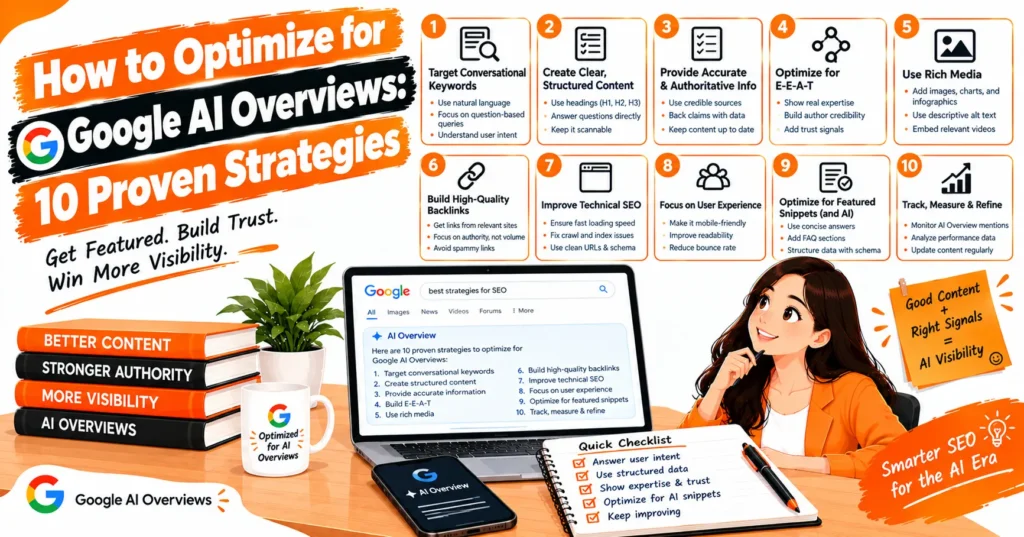
Google Search is evolving, and AI-generated summaries are changing how people discover information online. Understanding how to optimize for google ai overviews can help businesses improve their visibility and reach audiences through AI-powered search results.
The process involves creating helpful content, matching search intent, strengthening technical SEO, and providing clear answers supported by reliable information. Websites should also focus on semantic SEO, relevant keywords, and topical authority to demonstrate expertise in their niche.
Although no strategy guarantees inclusion, following Google’s SEO guidelines and improving content quality can increase opportunities for discovery. By combining organic search optimization with AI search visibility strategies, businesses can build credibility and attract relevant visitors.
What Are Google AI Overviews?
Google AI Overviews are AI-generated summaries that appear within Google Search for certain queries. They synthesize information to help users understand a topic, explore possible solutions, and discover relevant sources.
Depending on the search, an overview may contain explanations, recommendations, comparisons, or links to webpages that provide additional context.
Unlike traditional organic search results, which primarily present individual webpage listings, AI Overviews offer a synthesized response. However, they do not replace the fundamentals of search engine optimization.
Google still needs to discover and evaluate relevant content, so crawlability, indexability, content usefulness, and search intent remain important considerations for website owners.
Why Is Google AI Overviews Optimization Important?
AI-powered search creates additional ways for users to discover businesses and informational resources. A website cited in an AI Overview may reach people researching a problem before they click a conventional organic result.
This can support brand recognition, establish credibility, and introduce a business to potential customers earlier in their decision-making process.
However, AI visibility should not be treated as a substitute for organic traffic or conversions. Some users may find the information they need without visiting a cited page.
A strong strategy therefore focuses on useful citations, qualified traffic, relevant engagement, and business outcomes rather than simply trying to appear in as many AI-generated summaries as possible.
How Do Google AI Overviews Select Sources?
Google uses automated systems to identify relevant information and generate responses to supported queries. The sources selected can vary depending on the topic, the wording of the question, and the information needed to provide a useful answer.
Different searches may produce different summaries and citations, even when their subjects are closely related.
There is no publicly documented formula that guarantees inclusion in an AI Overview. High organic rankings can help establish visibility, but they do not guarantee a citation. Likewise, using particular keywords, adding schema markup, or following a specific content template cannot force a page to appear.
The most reliable approach is to create accessible, relevant, accurate, and genuinely helpful content.
How to Optimize for Google AI Overviews: 10 Proven Strategies
1. Make Your Website Crawlable and Indexable
Technical SEO provides the foundation for search visibility. Important pages should return successful HTTP responses, use appropriate canonical tags, and remain accessible to search engine crawlers.
Check robots.txt rules, robots meta directives, XML sitemaps, JavaScript rendering, and internal links to identify problems that could prevent search engines from accessing the intended content.
Use Google Search Console to inspect important URLs, review indexing reports, and identify crawling issues.
Confirm that the indexed version represents the content you want users to find. If a page is not indexed, resolve that problem before spending significant time refining its headings or adding semantic keywords. Indexability does not guarantee an AI citation, but it is an essential starting point.
2. Target Search Queries That Trigger AI Overviews
Effective AI search optimization begins with understanding what your audience searches for. Research informational keywords, long-tail queries, comparisons, definitions, and problem-solving questions related to your topic.
Then examine live search results to identify which queries display AI Overviews and what information those summaries provide.
Prioritize queries that align with your website’s expertise and business objectives. A keyword may have substantial search volume but offer little value if it attracts the wrong audience.
Evaluate search intent, competition, existing content quality, and the potential to provide a better answer. This creates a focused content plan rather than an unfocused collection of AI-related keywords.
3. Match Search Intent and Answer Questions Clearly
Search intent determines what a person expects to find. Someone searching for a definition wants a concise explanation, while a user comparing solutions needs meaningful differences, examples, and decision-making guidance.
Content that targets the right keyword but fails to satisfy the underlying need may struggle to perform well.
Start important sections with a direct answer, then provide context, evidence, examples, and practical details. For instance, an article explaining AI Overview optimization should define the process before discussing technical SEO or link building.
This answer-first structure makes content easier to understand, although no particular paragraph format guarantees inclusion in an AI-generated summary.
4. Create Original, Helpful, and Trustworthy Content
Originality is essential when competing against established content. Instead of repeating general recommendations, explain how to implement them, why they matter, and when they may not work.
Practical examples, original research, firsthand experience, expert insights, and accurate supporting evidence give readers a reason to choose your content over generic alternatives.
Demonstrate relevant expertise and maintain a clear focus on the reader’s needs. Verify important claims, explain technical concepts in accessible language, and update information when it becomes outdated.
Avoid publishing large numbers of lightly edited AI-generated articles without meaningful review. Content should solve a real problem rather than exist primarily to capture search traffic.
5. Build Semantic Relevance With Comprehensive Topic Coverage
Semantic SEO involves explaining the concepts, entities, and relationships needed to satisfy a search query.
For AI Overview optimization, relevant concepts may include crawling, indexing, organic rankings, search intent, topical authority, structured data, source citations, and AI search visibility. These concepts should support the explanation instead of appearing as disconnected keywords.
Use descriptive headings to organize related ideas and prevent unnecessary repetition. Cover the main question first, then address important subtopics, limitations, examples, and follow-up questions.
Related terminology can strengthen topical coverage when used naturally, but there is no need to include every possible NLP or LSI keyword. Relevance and clarity matter more than keyword quantity.
6. Develop Topical Authority Through Related Content
Topical authority develops when a website consistently provides useful information across a relevant subject area.
For example, a website covering AI search optimization could publish supporting resources about technical SEO, content gap analysis, semantic keyword research, organic visibility, and performance measurement. Together, these resources can help readers explore a topic in greater depth.
Connect related articles with descriptive internal links where they provide genuine value. Make important pages accessible through a logical site structure and ensure each supporting article answers a distinct question.
Avoid creating multiple pages that target nearly identical keywords without a clear difference in intent. A focused content cluster is more useful than a large collection of repetitive articles.
7. Strengthen Traditional Organic SEO Performance
Traditional SEO remains closely connected to AI search visibility. Relevant content, sound technical foundations, useful internal links, and a strong site structure help search engines discover and evaluate webpages.
Research has also identified overlap between pages appearing prominently in conventional results and sources cited in AI Overviews, although this relationship is not universal.
Review pages that already receive impressions for relevant queries. Improve sections that fail to answer important questions, refresh outdated information, strengthen relevant internal links, and make the page more useful than its previous version.
Do not assume that reaching the first organic position will automatically produce an AI citation. Treat conventional rankings as one part of a broader search visibility strategy.
8. Earn Relevant Backlinks and Build Brand Credibility
Relevant editorial backlinks can support organic SEO by connecting your content with other credible resources.
Useful research, expert contributions, original statistics, digital PR, and genuinely informative guides can help attract links from websites operating in related industries. Quality and topical relevance are more important than accumulating large quantities of unrelated links.
Brand mentions and third-party coverage can also help potential customers discover and evaluate a business. However, an unlinked mention or a backlink should not be treated as a guaranteed AI Overview ranking signal.
Avoid manipulative link schemes and focus on earning recognition through useful contributions, accurate information, and a consistent online reputation.
9. Use Structured Data and Accessible Media Correctly
Structured data helps search engines interpret supported information about a webpage when the markup accurately reflects its visible content.
Depending on the page, appropriate schema types may include Article, Product, or Organization. Validate structured data and correct relevant errors, but do not add markup that misrepresents the page.
Google does not require special AI-specific schema markup for eligibility in AI Overviews. Similarly, descriptive image alt text, accessible page elements, and useful media captions improve accessibility and content presentation.
These elements should support the actual content rather than serve as artificial shortcuts for gaining AI search visibility.
10. Monitor AI Overview Visibility and Refresh Content
Optimization should be guided by evidence rather than assumptions. Google Search Console provides organic search metrics, including impressions, clicks, click-through rate, and average position.
Analytics tools can help you understand engagement and conversions, while periodic manual checks can reveal whether target queries display AI Overviews and cite your pages.
Maintain a record of the queries you monitor, the dates of your checks, and the sources appearing in the results. Revisit important queries periodically because AI-generated summaries and citations can change.
Search Console does not provide a complete, dedicated report that isolates every AI Overview citation, so interpret performance changes carefully and avoid attributing every traffic fluctuation to AI search.
Traditional SEO vs. AI Overviews Optimization
Traditional SEO and AI Overview optimization share many foundational practices, but they focus on different visibility outcomes. Understanding the distinction helps businesses develop a balanced strategy.
| SEO factor | Traditional SEO | AI Overviews optimization |
| Primary goal | Improve visibility in organic search listings | Improve opportunities to be cited in AI-generated summaries |
| Content strategy | Satisfy search intent with relevant, useful information | Provide clear, relevant, evidence-supported answers |
| Keyword research | Target relevant queries and related search terms | Identify relevant queries that trigger AI Overviews and related questions |
| Technical SEO | Support crawling, indexing, and page accessibility | Maintain the technical eligibility required for Search |
| Authority | Build credibility and earn relevant editorial links | Support discovery and credibility without assuming links guarantee citations |
| Measurement | Monitor rankings, impressions, clicks, and conversions | Combine organic metrics with observations of AI Overview citations |
| Business value | Generate relevant traffic and conversions | Support brand discovery, qualified visits, and potential conversions |
Neither approach should replace the other. A sustainable strategy combines established SEO practices with content that answers users’ questions effectively and provides meaningful reasons to explore the original source.
How to Optimize Existing Content for AI Overviews?
Updating existing content can be more efficient than creating a new article for every target query. Start by identifying relevant pages that already receive organic impressions or rank for related keywords.
Check whether the page answers the primary question directly, covers essential subtopics, and provides useful information beyond what a reader can find in a basic definition.
Next, review indexing status, heading structure, factual accuracy, internal links, and missing information. Add original examples or supporting evidence where appropriate, remove repetitive sections, and improve explanations that are difficult to understand.
Publish the update only when it makes the page more useful, then monitor organic performance and relevant AI Overview citations over time.
Common Google AI Overviews Optimization Mistakes
Keyword stuffing, excessive heading variations, and unnecessarily long articles do not guarantee AI Overview visibility. Nor does adding every related term from a keyword list. Such practices can make an article repetitive and reduce its usefulness.
Focus instead on covering the subject thoroughly without introducing information that does not serve the reader.
Another common mistake is treating schema markup, backlinks, or a particular formatting style as a shortcut to AI citations. Avoid unsupported ranking claims, fabricated statistics, and superficial content updates that add no new value.
Measure success through a combination of search visibility, relevant traffic, user engagement, and business outcomes rather than relying on AI Overview appearances alone.
Frequently Asked Questions
How long does it take to appear in Google AI Overviews?
There is no guaranteed timeline. Visibility depends on factors such as indexing, query relevance, competition, and Google’s automated systems. Improving a page does not ensure inclusion within a particular number of days or weeks.
Can a website appear in AI Overviews without ranking first?
Yes. AI Overview citations do not always come from the first organic result. Source selection can vary by query, although strong conventional SEO performance remains useful for improving overall search visibility.
Does schema markup help with Google AI Overviews?
Accurate structured data can help search engines understand supported information about a page. However, special AI-specific schema markup is not required for AI Overview eligibility, and structured data does not guarantee a citation.
Do backlinks improve AI Overview visibility?
Relevant editorial backlinks can support conventional SEO and help users discover credible resources. However, there is no guaranteed backlink threshold for earning an AI Overview citation. Prioritize relevance, editorial quality, and legitimate link earning.
How can I track AI Overview citations?
Monitor relevant queries manually and record when your pages appear as cited sources. Use Search Console for organic impressions, clicks, CTR, and ranking trends, and use analytics to assess relevant visits and conversions. Recognize that complete AI Overview attribution may not be available.
Conclusion
Learning how to optimize for Google AI Overviews starts with technically accessible pages, helpful original content, relevant keyword research, clear answers, and credible information. Build topical depth, strengthen organic SEO, earn relevant editorial links, and monitor results using reliable evidence. Although no strategy guarantees an AI Overview citation, a user-focused approach can improve search visibility and create more opportunities for people to discover your content.

James Robert
James Robert is a seasoned Off-Page SEO expert specializing in strategic link building, digital outreach, and authority growth for businesses aiming to improve search visibility and rankings. With over five years of hands-on experience, he helps brands strengthen their online presence through high-quality backlinks, niche-relevant placements, and ethical SEO practices aligned with Google’s guidelines. James’s core specialties include guest posting, blogger outreach, niche edits, brand mentions, and backlink profile optimization. He is highly skilled at building relationships with authoritative publishers and executing scalable outreach campaigns that drive long-term organic growth. As a contributor to leading marketing platforms, James regularly shares actionable insights on off-page SEO strategies, link acquisition, and sustainable ranking improvements, helping businesses achieve consistent and measurable SEO success.