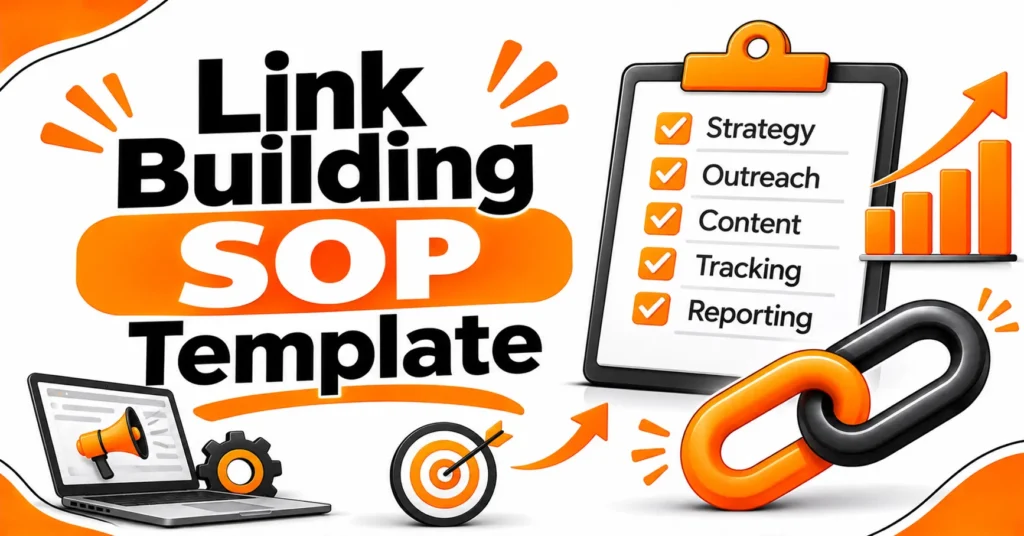
A successful SEO campaign requires more than finding websites and requesting backlinks. It needs a consistent process that helps marketers identify relevant opportunities, evaluate website quality, manage outreach, and monitor results. A Link Building SOP Template provides a structured framework for completing these activities without wasting time or compromising backlink quality. Whether you manage an SEO agency, work as a link-building specialist, or handle campaigns for your own website, having documented procedures makes daily operations easier. This guide explains how to create a repeatable backlink acquisition workflow, assign responsibilities, maintain quality standards, and measure campaign performance using a practical system that your team can implement immediately.
What Is a Link Building SOP?
A Standard Operating Procedure (SOP) is a documented set of instructions explaining how to complete a particular business activity. In SEO, it establishes a consistent process for researching backlink opportunities, contacting publishers, securing relevant placements, and tracking acquired links.
A link-building workflow becomes difficult to manage when every team member follows different methods. One person might prioritize website authority, while another focuses on traffic or topical relevance. Documented procedures eliminate much of this inconsistency by defining expectations, responsibilities, and quality requirements.
Why Does Your SEO Team Need a Standardized Link Building Process?
A documented process makes link acquisition more organized and easier to scale. Without clear instructions, teams can waste hours researching unsuitable websites, sending generic emails, and acquiring links that provide little value.
Standardization also improves accountability. Managers can review completed tasks, identify operational problems, and understand which campaign activities produce meaningful results. New employees can follow the same instructions instead of depending entirely on individual training.
Another advantage is quality control. A defined evaluation system helps prevent irrelevant placements, manipulative link schemes, and websites created primarily to sell backlinks.
How to Create a Link Building SOP Template
Before starting a campaign, create a document that explains its objectives, required resources, execution process, and approval requirements. Every activity should have an assigned owner and a measurable outcome.
Your documentation should include the campaign name, target website, focus pages, responsibilities, tools, prospecting criteria, outreach guidelines, quality standards, and reporting schedule. Keep the instructions simple enough for a new team member to understand.
The following framework provides a reusable structure for organizing your operations.
| SOP section | Required information | Expected outcome |
| Campaign objectives | Target pages and goals | Clear campaign direction |
| Competitor research | Backlink opportunities | Research report |
| Prospecting | Relevant websites | Prospect database |
| Qualification | Quality evaluation | Approved websites |
| Contact research | Publisher details | Verified contacts |
| Outreach | Personalized communication | Outreach records |
| Content development | Relevant editorial content | Approved submissions |
| Link verification | Placement and attributes | Verified backlinks |
| Reporting | Campaign performance | Monthly report |
Step 1: Define Your Link Building Campaign Goals
Every campaign should begin with a specific objective. Instead of focusing exclusively on the number of backlinks, identify which website pages need support and why acquiring relevant referring domains could help.
For example, an agency might prioritize a service page targeting a competitive commercial keyword, while a SaaS company may focus on earning editorial references for an original research report.
Establish realistic targets, timelines, budgets, and performance indicators before starting prospect research. This gives everyone a clear understanding of what the campaign should accomplish.
Step 2: Conduct a Backlink Profile Audit
Review the website’s existing backlink profile before searching for new opportunities. An initial audit helps identify existing referring domains, anchor text distribution, linked pages, lost backlinks, and potentially suspicious patterns.
Use backlink analysis platforms to understand where existing links originate and which pages attract the most references. Pay particular attention to relevant websites that already link to your competitors but have not mentioned your business.
This information creates a baseline for measuring future improvements. It also prevents teams from repeatedly targeting websites that already provide valuable links.
Step 3: Analyze Competitor Backlink Profiles
Competitor analysis helps uncover websites and content opportunities that may be relevant to your industry. Select several competitors that perform well for your target search terms and examine their referring domains.
Look for websites linking to multiple competitors, industry publications, resource pages, expert roundups, and relevant editorial articles. These opportunities can reveal publishers who regularly reference content within your niche.
However, competitor backlinks should be treated as research opportunities rather than automatic targets. Evaluate every website independently before adding it to your campaign.
Step 4: Find Relevant Link Building Opportunities
Prospecting is the process of discovering websites that may have a legitimate reason to reference your content. The best opportunities depend on your industry, target audience, campaign objectives, and available resources.
Guest posting can help establish editorial relationships when publishers accept useful contributions. Broken link building offers another opportunity by identifying outdated references and suggesting relevant replacement resources.
Resource page outreach, digital PR, expert contributions, and unlinked brand mentions can also generate valuable opportunities. Choose methods that match your website’s strengths instead of using the same outreach approach for every prospect.
Step 5: Evaluate Website Quality Before Outreach
Website evaluation is one of the most important parts of a reliable backlink acquisition process. A website should not be approved simply because it has a high Domain Authority or Domain Rating.
Review its topical relevance, organic visibility, editorial standards, referring domains, publishing activity, and overall content quality. Check whether its articles provide genuine value and whether its audience matches your target market.
| Evaluation factor | What to examine |
| Domain Authority | Moz authority estimate |
| Domain Rating | Ahrefs backlink authority metric |
| Organic traffic | Search visibility and estimated visitors |
| Topical relevance | Connection with your industry |
| Content quality | Originality and editorial standards |
| Referring domains | Quality and diversity of linking websites |
| Spam indicators | Suspicious patterns and excessive outbound links |
| Indexation | Whether important pages appear in search results |
Do not rely on a single numerical metric. A smaller industry publication with relevant readers and genuine editorial standards may be more valuable than a larger website with unrelated content.
Step 6: Build and Organize Your Prospect Database
After evaluating potential websites, organize approved opportunities in a central spreadsheet or CRM. Maintaining a single database prevents duplicate outreach and makes campaign management easier.
Record the domain, target page, contact person’s name, email address, website category, authority metrics, estimated traffic, relevance score, outreach status, and notes about potential collaboration.
Assign each prospect a clear status, such as researched, approved, contact found, email sent, follow-up required, interested, rejected, or link published. This allows managers to understand campaign progress without reviewing every email conversation.
Step 7: Find and Verify Publisher Contact Information
Contact the person responsible for editorial decisions rather than sending every message to a generic inbox. Depending on the publication, this might be a content editor, website owner, marketing manager, journalist, or contributor coordinator.
Check the website’s contact page, editorial guidelines, author profiles, and professional social accounts. Email discovery tools can help identify business addresses, but every address should be verified before sending outreach.
Accurate contact information improves communication efficiency and helps protect your sending domain from unnecessary email bounces.
Step 8: Create Personalized Link Building Outreach Emails
Outreach should explain why the proposed collaboration makes sense for the recipient’s audience. Generic messages requesting backlinks rarely provide enough reason for an editor to respond.
Reference a specific article, explain what useful information your resource contributes, and make a clear request. Keep the email professional, relevant, and easy to understand.
For example, when pitching a research resource, explain how its findings could support an existing article. When proposing a guest contribution, suggest a topic that fits the publication’s editorial direction.
Maintain an outreach record containing the email date, recipient, subject, campaign, response, and next action.
Step 9: Manage Follow-Ups and Publisher Responses
Not every publisher responds to the first email. A structured follow-up process ensures that interested prospects are not forgotten while preventing excessive communication.
Send a polite reminder after a reasonable interval, such as three to five business days. If there is still no response, consider one final follow-up after another appropriate interval.
Stop contacting recipients who decline, request no further communication, or unsubscribe. Record the reason for rejection where available, as this information can improve future prospect selection and outreach messaging.
Step 10: Develop High-Quality Content for Link Acquisition
Content quality directly affects whether publishers have a genuine reason to reference your website. Create resources that answer relevant questions, provide original insights, or offer information that improves an existing article.
For guest contributions, follow the publication’s editorial requirements and write for its readers rather than using the article primarily as a backlink vehicle.
For research-based campaigns, include accurate information, useful examples, and credible supporting evidence. The final content should offer independent value even if the publisher decides not to include a backlink.
Step 11: Verify Every Published Backlink
A campaign should not be marked successful simply because a publisher confirms publication. Every placement requires an independent quality check.
Open the published article and confirm that the link appears in the agreed context. Check its destination URL, anchor text, page relevance, HTTP accessibility, and link attributes.
Understand the difference between followed, nofollow, sponsored, and UGC attributes. Paid placements should be appropriately qualified using sponsored attributes, while user-generated links should use UGC where appropriate. Do not assume every backlink needs to be followed to provide value.
Step 12: Monitor Backlinks and Recover Lost Links
Backlink monitoring should continue after publication. Websites update their content, remove old articles, change URLs, and occasionally delete external references.
Use backlink monitoring tools and periodic manual checks to identify missing links, broken destinations, unexpected redirects, and changes in link attributes.
When a valuable backlink disappears, investigate the reason before contacting the publisher. If the page has moved, provide the correct destination. If an editorial decision caused removal, ask politely whether the reference can be restored where appropriate.
Step 13: Measure Link Building Campaign Performance
Reporting helps determine whether your workflow is producing useful results. Track both operational performance and the broader SEO impact of acquired links.
Important measurements include approved prospects, outreach emails delivered, bounce rate, positive responses, published placements, referring domains, lost links, and campaign expenditure.
Also monitor organic visibility, target-page performance, referral traffic, and relevant conversions. Remember that ranking improvements cannot be attributed to backlinks alone because search performance depends on multiple factors.
| KPI | Measurement purpose |
| Qualified prospects | Measures research quality |
| Email bounce rate | Evaluates contact accuracy |
| Positive reply rate | Measures outreach effectiveness |
| Published backlinks | Tracks campaign output |
| Referring domains | Measures linking-domain diversity |
| Link retention | Measures placement stability |
| Referral traffic | Evaluates visitor contribution |
| Target-page visibility | Tracks organic search performance |
| Cost per acquired link | Measures campaign efficiency |
Common Link Building SOP Mistakes to Avoid
One common mistake is prioritizing domain metrics over relevance. High authority numbers do not automatically indicate that a website is suitable for your industry or audience.
Another problem is sending identical outreach emails to hundreds of publishers. This approach often produces poor engagement because the recipient cannot see why the proposed collaboration matters.
Teams should also avoid purchasing manipulative links, participating in excessive link exchanges, using automated spam outreach, or publishing low-quality guest posts solely to influence rankings. Google’s spam policies distinguish genuine editorial references from link schemes designed to manipulate search results.
Finally, failing to verify published placements can create inaccurate reports. Every acquired backlink should be checked and documented before it is counted as a completed deliverable.
How to Improve Your Link Building Workflow Over Time
A documented process should evolve as your team gains experience. Review campaign reports regularly to identify which prospecting sources produce relevant publishers and which outreach messages generate meaningful responses.
Use performance data to improve qualification criteria, update email templates, remove ineffective activities, and refine content strategies. Keep the SOP accessible to everyone involved in the campaign and assign someone to maintain the documentation.
Review the process quarterly or whenever significant changes occur in your tools, editorial requirements, or search engine policies. This prevents outdated instructions from affecting campaign quality.
Frequently Asked Questions
What is a link building SOP?
A link building SOP is a documented procedure that explains how to research prospects, evaluate websites, conduct outreach, acquire backlinks, verify placements, and report campaign performance.
Why is a standardized backlink workflow important?
A standardized workflow improves consistency, reduces repetitive mistakes, clarifies employee responsibilities, and makes it easier to manage multiple campaigns without compromising quality.
Which tools are useful for link building?
Commonly used tools include Ahrefs, Semrush, Moz, Google Search Console, Hunter, and outreach management platforms. Each serves a different purpose, from backlink analysis and prospect research to contact discovery and campaign tracking.
How do you evaluate a website before acquiring a backlink?
Evaluate topical relevance, organic search visibility, editorial quality, referring domains, content standards, and suspicious link patterns. Do not approve websites based exclusively on Domain Authority or Domain Rating.
How many backlinks should a website build each month?
There is no universally safe or effective monthly backlink target. The appropriate pace depends on your industry, available linkable assets, editorial opportunities, and campaign resources. Prioritize genuine relevance and quality over arbitrary volume.
Conclusion
A successful SEO campaign requires a consistent process, clear responsibilities, and reliable quality checks. A well-organized Link Building SOP Template helps teams manage everything from competitor research and prospect qualification to personalized outreach, backlink verification, and performance reporting. Instead of chasing large backlink numbers, focus on earning relevant editorial references that provide genuine value. Document every stage, monitor results regularly, and improve your workflow using campaign data. This approach makes link acquisition more organized, scalable, and sustainable over time.

James Robert
James Robert is a seasoned Off-Page SEO expert specializing in strategic link building, digital outreach, and authority growth for businesses aiming to improve search visibility and rankings. With over five years of hands-on experience, he helps brands strengthen their online presence through high-quality backlinks, niche-relevant placements, and ethical SEO practices aligned with Google’s guidelines. James’s core specialties include guest posting, blogger outreach, niche edits, brand mentions, and backlink profile optimization. He is highly skilled at building relationships with authoritative publishers and executing scalable outreach campaigns that drive long-term organic growth. As a contributor to leading marketing platforms, James regularly shares actionable insights on off-page SEO strategies, link acquisition, and sustainable ranking improvements, helping businesses achieve consistent and measurable SEO success.