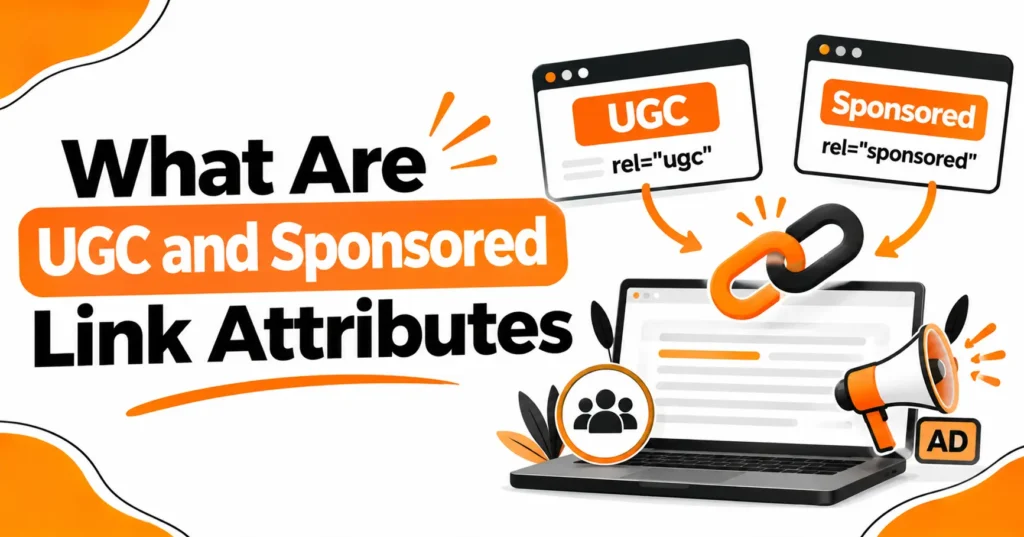
Understanding what are UGC and sponsored link attributes is essential for website owners, bloggers, publishers, and SEO professionals who want to manage backlinks correctly. These HTML link attributes help search engines understand why an external link exists and whether it comes from user-generated content or a commercial relationship. They also help websites maintain transparent linking practices and follow search engine guidelines.
Whether you manage a blog, an online community, or an affiliate website, knowing when to use rel=”ugc” and rel=”sponsored” can improve your link management strategy. This guide explains how these attributes work, how they differ from nofollow links, whether they influence SEO rankings, and how to implement them correctly.
What Are UGC and Sponsored Link Attributes?
UGC and sponsored link attributes are HTML relationship values used to describe the purpose of an external hyperlink. They help search engines understand whether a link was added by a website visitor or included because of a commercial arrangement.
Google introduced these attributes in September 2019 to provide more specific ways of qualifying outbound links. Before this change, website owners primarily used the nofollow attribute for links they did not want to treat as ordinary editorial endorsements.
The UGC attribute identifies user-generated links, while the sponsored attribute identifies paid placements, advertisements, sponsorships, and affiliate relationships. Both provide additional context without changing how hyperlinks appear or function for visitors.
What Is a UGC Link Attribute?
UGC stands for User-Generated Content. The rel=”ugc” attribute identifies hyperlinks added by visitors, customers, community members, or other users rather than directly selected by a website’s editorial team.
For example, when someone shares a website in a blog comment, discussion forum, or public community post, the external hyperlink can be qualified with the UGC attribute. This helps search engines distinguish user-submitted links from editorially placed references.
UGC attributes are particularly useful for websites that allow public contributions. They provide additional context about links appearing in comments, reviews, discussion threads, and other areas where website owners may not directly control every submission.
HTML Example of a UGC Link
The following example shows how to implement the UGC attribute within an HTML anchor element.
<a href=”https://example.com/” rel=”ugc”>
Visit Example Website
</a>
In this example, rel=”ugc” identifies the hyperlink as user-generated content. The visitor can still click the link normally, while search engines receive additional information about its origin.
What Is a Sponsored Link Attribute?
A sponsored link attribute uses rel=”sponsored” to identify hyperlinks associated with payment, advertising, sponsorships, or other forms of compensation. It tells search engines that a commercial relationship influenced the inclusion of the link.
For example, when a business pays a publisher to include a backlink in a promotional article, the link should generally use the sponsored attribute. Affiliate links and paid product placements are other common examples.
The sponsored attribute helps distinguish compensated links from independent editorial references. It also supports transparent linking practices and helps website owners comply with search engine policies concerning paid links.
HTML Example of a Sponsored Link
Here is a basic example of a sponsored hyperlink:
<a href=”https://example.com/” rel=”sponsored”>
Sponsored Partner
</a>
The rel=”sponsored” value identifies the commercial relationship behind the hyperlink. It does not prevent visitors from following the link, but it provides search engines with additional context about why it was included.
Why Did Google Introduce UGC and Sponsored Attributes?
Before September 2019, website owners primarily relied on the nofollow attribute to qualify links that they did not want to represent as ordinary editorial endorsements. However, this approach did not clearly communicate why different types of links existed.
Google introduced UGC and sponsored attributes to make link qualification more descriptive. Website owners could identify user-submitted links separately from paid placements instead of relying on one general attribute.
This change also introduced a more flexible approach to understanding outbound links. Search engines could use these values as additional signals when evaluating link relationships, content context, and the purpose of hyperlinks.
How Do UGC and Sponsored Link Attributes Work?
Both attributes use the HTML rel property, which describes the relationship between a webpage and its linked destination. When search engines encounter these values, they can use them as hints when understanding and evaluating external links.
For example, a hyperlink containing rel=”ugc” indicates that it was added through user-generated content. A hyperlink containing rel=”sponsored” indicates that it is associated with a commercial arrangement.
These attributes do not automatically block crawling or prevent visitors from clicking hyperlinks. They also do not guarantee that Google will completely ignore a link when evaluating search results. Their primary purpose is to provide additional information about the relationship behind a hyperlink.
UGC vs Sponsored vs Nofollow Links: What Is the Difference?
UGC, sponsored, and nofollow attributes all help qualify hyperlinks, but each communicates a different purpose. Choosing the correct attribute depends on how the link was created, who placed it, and whether compensation influenced its inclusion.
Understanding these differences is important for bloggers, publishers, affiliate marketers, and SEO professionals managing external links.
| Link attribute | Main purpose | Common example |
| UGC | Identifies user-generated hyperlinks | Blog comments and forum discussions |
| Sponsored | Identifies compensated link placements | Paid articles and advertisements |
| Nofollow | Qualifies links when other specific values do not apply and the publisher does not want to associate with or crawl the destination | Certain untrusted links |
| Default link | An ordinary hyperlink without a qualifying rel value | Editorial references |
What Is the Difference Between UGC and Sponsored Links?
The main difference is the reason behind the link placement. UGC links originate from content submitted by users, whereas sponsored links are associated with payment or another commercial relationship.
For instance, a visitor sharing a resource in a public discussion creates a user-generated link. However, a business paying a publisher to include its website in a promotional article creates a sponsored link.
Using the correct attribute helps search engines understand these different relationships. It also helps website owners maintain better control over user contributions and commercial partnerships.
What Is the Difference Between Sponsored and Nofollow Links?
A sponsored attribute specifically identifies paid or compensated links. In comparison, nofollow is a broader qualification used when other specific link attributes do not apply and the website owner does not want Google to associate with or crawl the linked page from their website.
Google recommends rel=”sponsored” for advertisements and paid placements. However, rel=”nofollow” remains an acceptable alternative for qualifying paid links.
Both attributes can also be combined when appropriate. For example, rel=”sponsored nofollow” identifies a compensated link while also applying the nofollow qualification.
What Is the Difference Between UGC and Nofollow Links?
UGC identifies the origin of a hyperlink, specifically that it was added through user-generated content. Nofollow communicates a different qualification about how the publisher wants the link to be treated.
For example, a website can use rel=”ugc” for a normal community contribution. If the website owner also wants to apply the nofollow qualification, both values can be included in the same attribute.
The choice depends on the purpose of the link and the relationship between the publisher and the linked destination.
Do UGC and Sponsored Links Pass Link Equity?
One of the most common questions among SEO professionals is whether UGC and sponsored links pass link equity or influence organic rankings. Understanding Google’s treatment of qualified links is important because several common SEO explanations oversimplify this subject.
Google treats ugc, sponsored, and nofollow as hints rather than strict directives for ranking purposes. This means Google can consider additional signals when deciding how to interpret a qualified hyperlink.
However, website owners should not assume that every UGC or sponsored link passes PageRank or that these links always have zero ranking influence. Their potential value depends on how search engines evaluate the link, its context, and the surrounding content.
UGC links may also generate referral traffic, increase brand exposure, and help visitors discover relevant resources. Sponsored links can support advertising campaigns, product discovery, and conversions even when their primary purpose is commercial rather than editorial SEO.
When Should You Use UGC Link Attributes?
Website owners should consider using UGC attributes when external hyperlinks are added through public contributions rather than direct editorial decisions. This is especially important for websites where visitors can publish content without individual approval of every link.
Blog Comments and Discussion Sections
Blog comments frequently contain external hyperlinks submitted by readers. Some may reference useful resources, while others may promote unrelated products or websites.
Applying rel=”ugc” helps identify these hyperlinks as user-generated. Website administrators should also use moderation, spam filters, and appropriate comment settings to prevent irrelevant or manipulative links from appearing.
Forums and Online Communities
Discussion forums allow members to share resources, recommend products, and participate in conversations. Since these hyperlinks are generally created by community members, the UGC attribute is appropriate.
It helps distinguish member-submitted references from links deliberately included by the website’s editorial team. This is particularly useful for large communities with frequent discussions and thousands of external references.
Customer Reviews and User Submissions
Product reviews, public testimonials, and community submissions can contain external hyperlinks. When these links are added by users, website owners can qualify them using the UGC attribute.
This approach provides additional context for search engines while allowing visitors to share relevant resources and recommendations.
When Should You Use Sponsored Link Attributes?
Sponsored attributes should be used whenever a hyperlink exists because of payment, sponsorship, or another compensated relationship. Website owners should qualify these links correctly instead of presenting commercial placements as ordinary editorial references.
Paid Guest Posts and Sponsored Articles
When a publisher receives payment or another form of compensation to publish an article containing an external backlink, the sponsored attribute is generally appropriate for that link.
However, not every guest post is automatically sponsored. An unpaid editorial contribution is different from a paid placement. The actual commercial relationship behind the link determines which attribute should be used.
Affiliate Links
Affiliate marketers earn commissions when visitors purchase products or services through tracked hyperlinks. Since these links involve a commercial arrangement, Google recommends qualifying them with rel=”sponsored”.
For example, a product review containing affiliate links should use the sponsored attribute for compensated outbound links. Publishers should also provide appropriate affiliate disclosures so readers understand the commercial relationship.
Advertisements and Sponsored Reviews
Display advertisements, paid product reviews, and promotional partnerships are other situations where sponsored attributes are relevant.
Whenever compensation influences the inclusion of an external hyperlink, publishers should qualify the link appropriately. This helps search engines distinguish commercial placements from independent editorial recommendations.
How to Add UGC and Sponsored Attributes in HTML
Implementing these attributes is straightforward because both use the standard HTML anchor element. Website owners only need to add the appropriate rel value to the hyperlink.
For UGC links, use rel=”ugc” to identify user-submitted hyperlinks. For compensated placements, use rel=”sponsored” to communicate the commercial relationship.
The attributes can also be combined when a hyperlink accurately belongs to multiple categories. For example, a sponsored link submitted by a community member may use rel=”ugc sponsored” when both descriptions apply.
How to Combine Multiple Link Attributes
HTML allows multiple relationship values within the same rel attribute. These values are separated by spaces, allowing website owners to provide additional context about a hyperlink.
<a href=”https://example.com/”
rel=”ugc sponsored nofollow”>
Qualified External Link
</a>
This example combines all three qualifications. However, website owners should only use values that accurately describe the link instead of adding every available attribute unnecessarily.
How to Add UGC and Sponsored Attributes in WordPress
WordPress website owners can manage link attributes through the content editor, plugins, or website functionality. The exact process depends on the editor, theme, and comment management system being used.
When editing a hyperlink in the WordPress block editor, open its link settings and check whether the editor provides an option for adding custom relationship values. If available, enter the appropriate value, such as ugc or sponsored.
For automatically generated comment links, website owners can configure their comment system or use suitable functionality to qualify user-submitted hyperlinks. After implementation, inspect the rendered HTML to confirm that the correct attribute appears.
How to Check Whether a Link Uses UGC or Sponsored Attributes
Checking link attributes is useful when auditing backlinks, reviewing sponsored content, or examining external links on your website. You can inspect the HTML of a webpage to identify the relationship values assigned to individual hyperlinks.
Open the webpage in your browser, right-click the hyperlink, and select Inspect. Find the corresponding anchor element and examine its rel property to see whether it contains ugc, sponsored, or nofollow.
SEO auditing tools can also help identify link attributes across larger websites. However, manually inspecting the HTML is a useful way to verify individual links and understand how they have been implemented.
Common Mistakes to Avoid When Using Link Attributes
One common mistake is treating UGC and sponsored attributes as interchangeable. Although both qualify hyperlinks, they describe different relationships. UGC identifies user-submitted links, while sponsored identifies compensated placements.
Another mistake is assuming that every guest post requires a sponsored attribute. The correct approach depends on whether the placement involves payment or another form of compensation.
Website owners should also avoid assuming that adding nofollow, UGC, or sponsored attributes guarantees complete protection against link spam. These attributes do not replace proper moderation, editorial review, or compliance with search engine spam policies.
Best Practices for Managing UGC and Sponsored Links
A reliable link management strategy starts with understanding how every external hyperlink was created. Website owners should establish clear guidelines for user contributions, review commercial partnerships, and ensure that links are qualified according to their actual purpose.
Regularly monitor public comments, forum discussions, affiliate placements, and sponsored articles. Consistent auditing can help identify incorrect attributes, suspicious links, and unwanted promotional content.
Most importantly, prioritize useful content and genuine recommendations instead of treating link attributes as a shortcut for manipulating search rankings. Proper qualification supports a healthier website linking structure and a better experience for visitors.
Frequently Asked Questions
1. What are UGC and sponsored link attributes in SEO?
UGC and sponsored link attributes are HTML relationship values that help search engines understand why an external hyperlink exists. UGC identifies user-generated links, while sponsored identifies links associated with advertisements, sponsorships, or compensation.
2. Are UGC links good for SEO?
UGC links can help visitors discover useful resources, generate referral traffic, and increase brand visibility. Their SEO influence depends on how search engines evaluate the link and its surrounding context. They should not be considered equivalent to ordinary editorial backlinks.
3. Do sponsored links pass link juice?
Google treats sponsored attributes as hints rather than strict directives. Therefore, it is not accurate to say that sponsored links always pass PageRank or always have zero ranking influence. Their primary purpose is to identify compensated link relationships.
4. Can UGC and sponsored attributes be used together?
Yes. HTML allows multiple values within the same rel attribute. For example, rel=”ugc sponsored” can identify a link that is both user-submitted and associated with a sponsored relationship.
5. Should blog comments use the UGC attribute?
Yes. rel=”ugc” is Google’s recommended qualification for links within user-generated content, including blog comments and forum posts. Website owners should also moderate comments to prevent spam and irrelevant external links.
6. Are paid guest post links considered sponsored?
When a publisher receives payment or another form of compensation for including a backlink, Google recommends using the sponsored attribute. However, unpaid editorial guest contributions are not automatically sponsored.
7. What is the difference between sponsored and nofollow links?
Sponsored specifically identifies compensated link placements, whereas nofollow is a broader qualification. Google prefers sponsored for paid links but still accepts nofollow as an alternative.
8. How can I check whether a link is UGC or sponsored?
You can right-click a hyperlink, select Inspect, and examine its HTML anchor element. Look for the rel attribute to determine whether it contains ugc, sponsored, or nofollow.
9. Does Google penalize websites for using UGC links?
No. Using UGC attributes is a recommended way to qualify user-generated links. Problems can arise from manipulative linking practices or violations of search engine spam policies, not simply from using UGC attributes.
10. Should affiliate links use sponsored attributes?
Yes. Google recommends rel=”sponsored” for affiliate links because they involve a commercial relationship. Publishers should also provide appropriate disclosures to inform readers about affiliate arrangements.
Conclusion
Understanding what are UGC and sponsored link attributes helps website owners manage external links more effectively and follow Google’s link qualification guidelines. Use rel=”ugc” for user-generated links and rel=”sponsored” for compensated placements, while applying nofollow when appropriate. Correct implementation, regular link audits, and transparent linking practices can support a sustainable SEO strategy and help maintain a trustworthy website.

James Robert
James Robert is a seasoned Off-Page SEO expert specializing in strategic link building, digital outreach, and authority growth for businesses aiming to improve search visibility and rankings. With over five years of hands-on experience, he helps brands strengthen their online presence through high-quality backlinks, niche-relevant placements, and ethical SEO practices aligned with Google’s guidelines. James’s core specialties include guest posting, blogger outreach, niche edits, brand mentions, and backlink profile optimization. He is highly skilled at building relationships with authoritative publishers and executing scalable outreach campaigns that drive long-term organic growth. As a contributor to leading marketing platforms, James regularly shares actionable insights on off-page SEO strategies, link acquisition, and sustainable ranking improvements, helping businesses achieve consistent and measurable SEO success.