
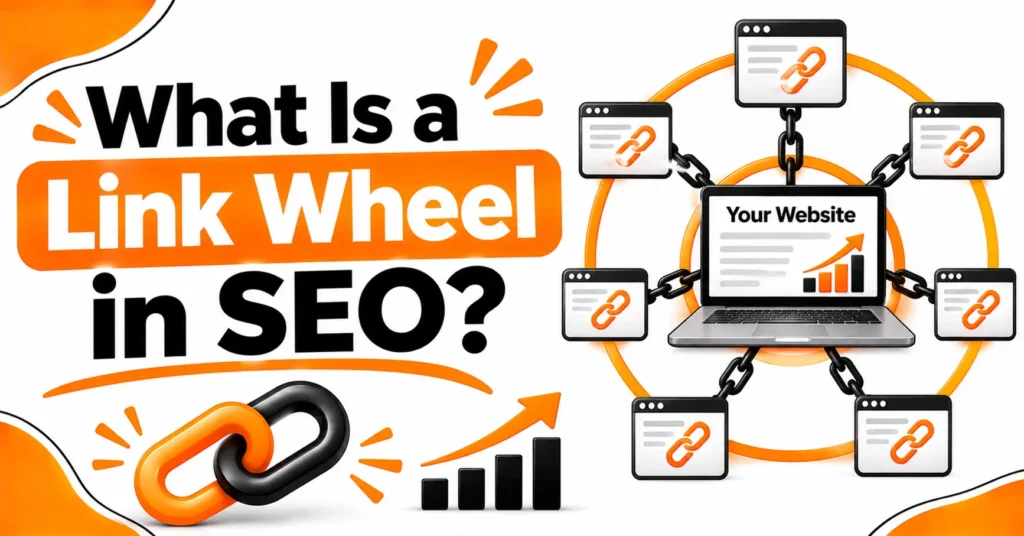
Understanding what is a link wheel is essential for website owners and SEO professionals exploring different link building strategies. A link wheel is a historical off-page SEO technique that connects multiple supporting websites through backlinks to direct authority toward a central target website.
Traditionally, this approach aimed to distribute link equity, strengthen backlink profiles, and improve organic search rankings. However, modern search engines have become more effective at identifying unnatural backlinks and manipulative linking patterns.
Learning how link wheels work, their structure, potential risks, and safer alternatives helps businesses make informed SEO decisions and develop sustainable strategies for building website authority and improving long-term search visibility.
What Is a Link Wheel?
A link wheel is a backlink network in which several supporting websites connect with one another and point links toward a central website. These connections traditionally form a circular structure intended to distribute link equity and increase the perceived authority of the target domain.
In traditional link-building campaigns, SEO professionals used blogs, article directories, Web 2.0 properties, and other publishing platforms to create supporting websites. Each property published content containing backlinks to the main website, while additional links connected the supporting properties.
The primary purpose was to create multiple pathways through which backlinks could influence search engine rankings. Although this technique became popular in earlier SEO practices, deliberately constructing websites and linking them together to manipulate ranking signals can violate modern search engine spam policies.
How Does a Link Wheel Work?
A traditional link wheel works through a central website and several interconnected supporting properties. Each supporting website publishes relevant content containing an external backlink to the target domain and may also link to another supporting website within the network.
For example, imagine an online marketing business that creates five supporting blogs covering SEO, content marketing, digital advertising, keyword research, and website optimization. Each blog links to the business website while also connecting to another blog, creating a circular backlink structure.
The intended outcome was to distribute link equity across the network and increase the number of backlinks pointing toward the target website. However, search engines do not automatically reward interconnected websites, and artificial links may be ignored or treated as link spam.
Understanding the Hub-and-Spoke Structure
The hub-and-spoke model is the foundation of a traditional link wheel. The hub represents the main website that an SEO campaign is attempting to promote, while the spokes represent supporting websites that provide external backlinks.
These supporting properties may contain articles, guides, resources, or industry-related information. Links between the spokes create the circular arrangement, while links pointing toward the hub are intended to influence its authority.
The structure is relatively simple to understand, but the existence of multiple connections does not guarantee that search engines will transfer ranking value through them.
How Link Equity and Link Juice Work?
Link equity, commonly called link juice in SEO discussions, refers to the ranking value that hyperlinks may pass between pages. Search engines use links to discover content, understand relationships, and evaluate signals associated with pages and websites.
However, not every backlink carries equal value. Relevance, editorial context, link placement, source quality, and other signals influence how search engines interpret external links.
Traditional link wheels attempted to distribute this value through interconnected properties. In modern SEO, artificially increasing the number of connections does not necessarily increase website authority or organic rankings.
Link Wheel Structure With a Practical Example
Consider a hypothetical website that sells digital marketing services. An older link-wheel campaign might involve five supporting properties, each publishing an article related to online marketing.
The first supporting property links to the central business website and the second property. The second links to the central website and the third property. This pattern continues until the final property connects back to the first, completing the circular arrangement.
This example illustrates the historical structure rather than recommending that businesses reproduce it. The important distinction is that a deliberately engineered network created to manipulate search rankings is different from independent publishers naturally referencing useful resources.
Traditional Link Wheel Diagram Explained
A basic link-wheel diagram contains one central website surrounded by several supporting websites. The supporting properties connect with one another, while individual links point toward the central destination.
The circular arrangement helps explain the concept visually. However, a diagram should not be confused with a legitimate modern backlink strategy because search engines evaluate the purpose and quality of linking relationships, not simply their geometric arrangement.
Different Types of Link Wheels
SEO practitioners historically experimented with several variations of link-wheel structures. These approaches differed in the number of supporting websites, the arrangement of backlinks, and the number of layers used to connect properties.
Basic Link Wheel
A basic link wheel consists of multiple supporting websites arranged in a circular pattern. Each website links to the main target and another supporting property, creating a network of interconnected backlinks.
It is the simplest historical example of this technique and is often used to explain how artificial link-building networks operate.
Hub-and-Spoke Link Wheel
A hub-and-spoke structure revolves around one central website connected to several supporting properties. Each supporting website acts as a source of external backlinks, and some variations include additional connections between the spokes.
The model can also describe legitimate information architecture and natural relationships between websites. Its SEO implications depend on whether the connections exist for genuine editorial reasons or are deliberately engineered to manipulate rankings.
Tiered Link Wheel
A tiered link wheel introduces multiple layers of supporting websites. The first tier contains properties that link more directly to the target website, while lower tiers point toward the first-tier properties.
Historically, the objective was to create additional backlink pathways and multiply the perceived authority of the central website. However, adding more layers can also introduce low-quality links, irrelevant content, and unnatural acquisition patterns.
Multi-Layered Link Wheel
A multi-layered link wheel expands the traditional structure by incorporating several interconnected groups of websites. These networks may involve blogs, publishing platforms, article directories, and other third-party properties.
Greater complexity does not automatically make a backlink strategy more effective or safer. Artificially expanding a network to manipulate rankings can increase exposure to search engine spam systems.
Why Did SEO Professionals Use Link Wheels?
Link wheels became popular when backlink quantity and link equity manipulation played a prominent role in many SEO campaigns. Practitioners believed that creating several supporting websites could increase the number of backlinks pointing toward a target domain.
Web 2.0 publishing platforms contributed to the popularity of this technique because they allowed users to create blogs and publish articles without purchasing separate hosting or developing independent websites.
SEO professionals also believed that interconnected supporting properties could distribute authority more efficiently than acquiring individual backlinks. However, modern search engines are better at evaluating link patterns and identifying attempts to manipulate ranking signals.
Are Link Wheels Safe for SEO?
The safety of a link wheel depends on the nature and purpose of the linking relationships. Multiple independent websites referencing one another is not automatically a violation of search engine guidelines.
Problems arise when businesses create interconnected websites primarily to manipulate search rankings, manufacture backlinks, or artificially inflate the authority of a target domain. Such arrangements can fall under manipulative link schemes.
Google’s Link Spam Policies
Google identifies links intended primarily to manipulate search rankings as link spam. Examples include excessive link exchanges, automated link creation, paid links that pass ranking credit without appropriate qualification, and low-value content created primarily to manipulate links.
A deliberately constructed link-wheel network can fall into this category when its purpose is to manufacture ranking signals rather than provide genuine value to readers.
Search engines may ignore the effects of these links or take further action when violations are identified. This means that creating a large backlink network does not guarantee improved search visibility.
Algorithmic Devaluation and Manual Actions
One important distinction is the difference between algorithmic treatment and manual action. Search engines can automatically recognize and neutralize the ranking effects of unnatural links without necessarily issuing a penalty.
A manual action occurs when a human reviewer determines that a website violates search spam policies. Depending on the issue, this may affect some pages or a larger portion of the website.
Website owners should therefore avoid assuming that every suspicious backlink causes a penalty. A proper investigation is necessary to understand whether the links are being ignored, whether rankings have declined for another reason, or whether a manual action exists.
Can Link Wheels Damage Your Backlink Profile?
An artificial backlink network can create an unnatural backlink profile when it contains excessive low-quality domains, irrelevant links, repeated commercial anchor text, and suspicious interlinking patterns.
These signals should be evaluated collectively rather than individually. For example, several websites sharing an owner or linking to the same business does not automatically indicate manipulation.
A backlink audit should examine the source websites, content relevance, link placement, acquisition history, anchor text distribution, and editorial purpose before determining whether action is necessary.
How to Identify a Link Wheel in a Backlink Profile
Identifying potentially manipulative backlink networks requires examining relationships between referring domains rather than looking at individual backlinks in isolation.
SEO professionals can use backlink analysis tools to investigate referring domains, anchor text distribution, link placement, and recurring connections between websites. The objective is to identify unusual patterns that may indicate artificial link acquisition.
Unnatural Interlinking Patterns
One potential warning sign is a group of unrelated websites repeatedly linking to one another while directing backlinks toward the same target domain.
If the connections appear coordinated, lack an editorial reason, and exist primarily to pass ranking credit, they deserve closer investigation.
Repeated Anchor Text Distribution
Anchor text describes the clickable wording used within a hyperlink. Natural editorial links often use varied language that reflects the destination page and the surrounding discussion.
A large number of identical commercial keywords appearing across interconnected websites may indicate an attempt to manipulate rankings. However, repeated anchor text alone is not sufficient evidence of a link scheme.
Low-Quality Supporting Websites
Supporting domains with thin content, excessive outbound links, unrelated topics, copied articles, and little independent value can be potential warning signs.
A useful backlink audit should assess whether a linking website serves a real audience and whether the backlink makes sense in its editorial context. Domain authority scores alone cannot establish whether a backlink is legitimate or valuable.
Unnatural Link Acquisition Patterns
A sudden increase in backlinks from interconnected websites, repeated links from similar publishing platforms, and unusually consistent anchor text may justify further investigation.
However, backlink growth can also occur naturally after a successful marketing campaign or content promotion. Understanding the source and context of new links is more important than treating every increase as suspicious.
Link Wheel vs. Natural Link Building
Both approaches involve external backlinks, but their objectives and acquisition methods are fundamentally different. Understanding this distinction helps businesses choose strategies that support long-term search visibility.
| Comparison factor | Artificial link wheel | Natural link building |
| Primary objective | Manipulate ranking signals | Earn genuine editorial references |
| Website relationships | Deliberately interconnected | Independent publishing relationships |
| Link acquisition | Artificially arranged | Earned through useful resources |
| Content purpose | May prioritize backlink placement | Prioritizes audience value |
| Anchor text | May be excessively optimized | Contextually relevant and varied |
| SEO risk | Potential link spam violation | Generally lower when genuinely earned |
| Long-term sustainability | Depends on artificial networks | Builds lasting credibility |
| Main focus | Backlink manipulation | Relevance, trust, and authority |
Natural link building focuses on creating resources that other websites genuinely want to reference. It encourages independent publishers, industry experts, and content creators to link because the information is relevant and useful.
Best Alternatives to Link Wheel Strategies
Businesses seeking sustainable SEO growth should prioritize legitimate backlink acquisition methods. These strategies focus on valuable content, genuine industry relationships, and editorial recognition rather than artificially interconnected websites.
Editorial Link Building
Editorial link building involves earning backlinks because publishers consider a resource useful, credible, or relevant to their audience. These links can strengthen online visibility while helping search engines discover important pages.
Publishing detailed guides, expert insights, original statistics, and industry resources can create opportunities for natural editorial references.
Digital PR Link Building
Digital PR combines content promotion, public relations, and media outreach to earn coverage from relevant publications. Businesses can share original research, industry trends, expert commentary, and useful data to attract editorial attention.
Successful campaigns can generate relevant backlinks, brand awareness, referral traffic, and stronger relationships with publishers.
Relevant Guest Posting
Guest posting involves contributing original and informative articles to publications that serve an appropriate audience. It allows businesses to demonstrate expertise, introduce useful information, and build professional relationships.
The emphasis should remain on editorial quality and audience relevance. Publishing large numbers of low-value articles solely to acquire backlinks is not a sustainable strategy.
Broken Link Building
Broken link building involves identifying outdated or unavailable resources on relevant websites and suggesting a suitable replacement.
A useful replacement should address the same subject and provide genuine value to the publisher’s audience. This makes the approach a practical way to support website maintenance while creating legitimate backlink opportunities.
Original Research and Linkable Assets
Original research, industry surveys, statistics, case studies, calculators, and comprehensive guides can attract attention from publishers and content creators.
These resources offer information that other websites may want to reference. Creating something genuinely useful gives businesses a stronger foundation for earning natural backlinks.
Content Marketing and Natural Link Acquisition
Content marketing supports link acquisition by publishing informative resources that answer audience questions and solve industry problems.
Promoting these resources through newsletters, relevant communities, professional relationships, and social channels can increase their reach. Over time, valuable content can generate organic references without relying on artificial backlink networks.
How to Build a Safe and Sustainable Backlink Strategy?
A modern backlink strategy should begin with understanding the target audience and identifying websites that publish relevant information. Businesses should focus on earning references from sources that have a genuine reason to discuss their products, services, research, or expertise.
The next step is developing useful content that deserves attention. Original insights, practical resources, detailed guides, and industry research provide stronger reasons for publishers to reference a website.
Outreach should be personalized and based on relevance rather than mass-produced link requests. Monitoring referring domains, evaluating anchor text, and reviewing new backlinks can help maintain a healthy backlink profile over time.
Should You Use a Link Wheel in 2026?
Businesses should avoid creating artificial backlink networks primarily to manipulate search engine rankings. Although understanding this historical technique is useful for SEO education and backlink analysis, it should not be the foundation of a modern link-building campaign.
Search engines increasingly emphasize the quality, relevance, and context of links rather than simply rewarding backlink quantity. A sustainable approach involves earning editorial references, publishing valuable resources, building industry relationships, and promoting content to relevant audiences.
The objective should be to develop a credible website that earns recognition because it provides useful information, not to manufacture an artificial network of interconnected domains.
Frequently Asked Questions
What is a link wheel in SEO?
A link wheel is a historical backlink-building technique in which several supporting websites connect to one another and point backlinks toward a central target website. It was traditionally used to distribute link equity and influence search engine rankings.
How does a link wheel work?
A traditional link wheel connects multiple supporting websites through external hyperlinks. Each supporting property points toward a central website and may link to another supporting property, creating a circular backlink structure.
Are link wheels considered black-hat SEO?
Link wheels can be considered black-hat SEO when websites are deliberately created and interconnected primarily to manipulate search rankings. Genuine editorial relationships between independent websites are different and should not automatically be treated as link schemes.
Can link wheels improve Google rankings?
There is no guarantee that link wheels improve Google rankings. Search engines may ignore artificial backlinks, and manipulative link-building practices can create search visibility risks.
Can Google penalize websites for link wheels?
Google can take action against websites involved in manipulative link schemes. Its automated systems may neutralize unnatural links, while more serious violations can result in manual actions.
What is the difference between a link wheel and a link pyramid?
A link wheel traditionally uses interconnected supporting websites arranged in a circular pattern. A link pyramid uses multiple backlink tiers organized hierarchically, with lower tiers pointing toward higher-tier properties. Both techniques have historically been associated with manipulative link-building campaigns.
Are Web 2.0 backlinks part of a link wheel?
Web 2.0 backlinks were commonly used in traditional link wheels because publishing platforms allowed users to create blogs and include external links. However, publishing on these platforms does not automatically make a backlink manipulative. Its purpose, context, and acquisition method matter.
How can you identify a suspicious link wheel?
Look for unusual interlinking patterns, repeated commercial anchor text, irrelevant supporting domains, thin content, and coordinated backlink acquisition. These indicators should be assessed together rather than treated as automatic proof of manipulation.
What are the safest alternatives to link wheels?
Editorial link building, digital PR, relevant guest posting, broken link building, original research, and content marketing are more sustainable approaches. They prioritize useful resources and genuine editorial relationships instead of artificial backlink networks.
Conclusion
Understanding what is a link wheel helps SEO professionals recognize an outdated backlink technique and evaluate its potential risks. While interconnected websites were historically used to manipulate link equity, modern search engines can identify and neutralize many unnatural linking patterns. Businesses should focus on editorial backlinks, digital PR, relevant guest posting, original research, and valuable content to build genuine website authority. A successful SEO strategy is not about creating the largest backlink network but earning relevant references that support long-term organic visibility and credibility.

James Robert
James Robert is a seasoned Off-Page SEO expert specializing in strategic link building, digital outreach, and authority growth for businesses aiming to improve search visibility and rankings. With over five years of hands-on experience, he helps brands strengthen their online presence through high-quality backlinks, niche-relevant placements, and ethical SEO practices aligned with Google’s guidelines. James’s core specialties include guest posting, blogger outreach, niche edits, brand mentions, and backlink profile optimization. He is highly skilled at building relationships with authoritative publishers and executing scalable outreach campaigns that drive long-term organic growth. As a contributor to leading marketing platforms, James regularly shares actionable insights on off-page SEO strategies, link acquisition, and sustainable ranking improvements, helping businesses achieve consistent and measurable SEO success.