Understanding what is a topical map is essential for building a successful SEO content strategy. Instead of publishing random articles around individual keywords, businesses need a structured approach that connects related subjects and answers users’ questions.
A topical map organizes main topics, supporting subtopics, and relevant search queries into a logical content framework. It helps improve topical authority, strengthen semantic SEO, identify content gaps, and create meaningful internal links between related pages.
By understanding search intent and organizing content into relevant clusters, website owners can develop comprehensive resources that provide genuine value to readers while improving their website’s relevance and long-term organic search visibility.
What Is a Topical Map in SEO?
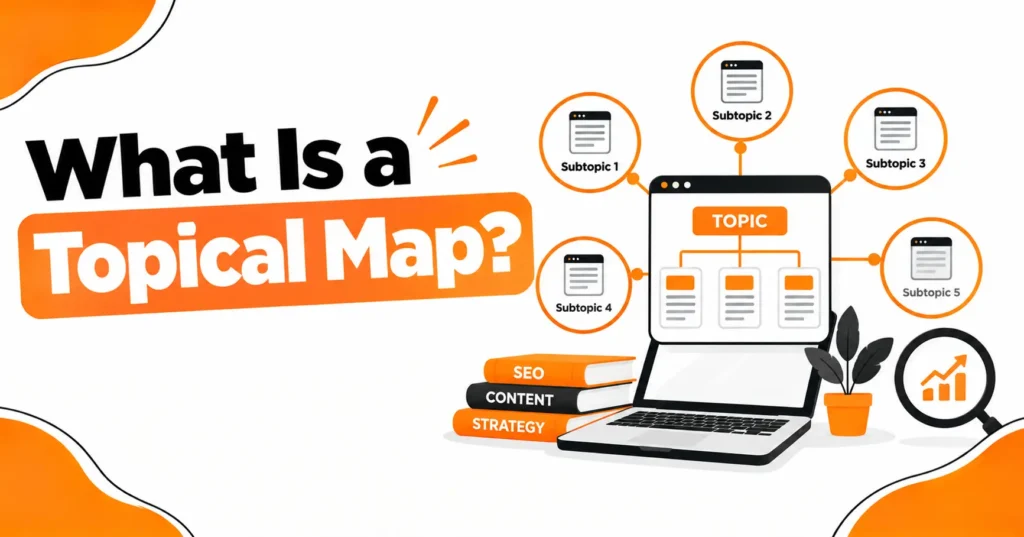
A topical map is a strategic content framework that organizes the subjects, subtopics, entities, and related search queries a website should cover within a particular niche. It establishes relationships between broad topics and specific content ideas, creating a structured representation of the website’s overall subject coverage.
In search engine optimization, a topical map works as a blueprint for planning, creating, and connecting website content. Instead of targeting isolated keywords, businesses can organize related subjects into meaningful categories and develop individual pages that address different user needs.
For example, an SEO website might have search engine optimization as its central subject, supported by technical SEO, link building, keyword research, on-page SEO, and content strategy. Each category can contain more focused articles that answer specific questions and explore related concepts.
The purpose is not to publish as many articles as possible. It is to build useful, relevant, and interconnected content that provides comprehensive coverage of the subjects important to your audience.
How Does a Topical Map Work?
A topical map works by breaking a broad subject into smaller categories and arranging them according to their relationships. The central topic represents the website’s primary area of focus, while core topics and supporting subtopics provide deeper coverage.
Each topic is evaluated according to its relevance, search intent, and content requirements. Some subjects deserve independent articles, while closely related questions can be answered within a single comprehensive page.
These pages are then connected through contextual internal links. This creates a logical content structure that helps visitors navigate related information and allows search engines to discover and understand connections between pages.
For example, an article about backlink quality can connect to resources covering link building strategies, guest posting, link audits, and outreach. These connections help create a more organized information structure.
Why Is a Topical Map Important for SEO?
Topical mapping helps businesses develop a focused content strategy based on their audience’s needs and the subjects relevant to their industry. It provides direction for content production while reducing unnecessary keyword targeting and disconnected publishing.
Building Topical Authority
Topical authority describes the expertise and depth a website demonstrates when covering a particular subject. Consistently publishing accurate, useful, and relevant information can help establish a stronger reputation within a niche.
A well-developed topical map identifies the important areas that deserve coverage. It helps website owners move beyond individual keyword rankings and create a collection of resources that addresses different aspects of their subject.
However, publishing more articles does not automatically establish authority. Content quality, relevance, accuracy, user satisfaction, and the overall usefulness of the website remain essential.
Improving Topical Relevance
Topical relevance refers to how closely a page or website relates to a particular subject. Covering connected concepts, related entities, and meaningful subtopics helps provide additional context.
For example, an article about technical SEO may naturally discuss crawling, indexing, website architecture, XML sitemaps, and page performance. These concepts contribute to a more complete explanation of the subject.
A topical map helps identify these relationships and ensures that supporting content contributes to the website’s primary focus.
Creating a Better Website Structure
A structured content architecture makes information easier to organize, access, and maintain. Broad categories can serve as pillar pages, while specific articles provide detailed explanations of individual topics.
This hierarchy improves website navigation and helps readers move between related resources. It also provides a clearer framework for organizing URLs, categories, and internal links.
Strengthening Internal Linking
Internal linking connects related pages through relevant contextual references. A topical map helps identify which articles should link to one another and how supporting content should connect to broader subject pages.
For example, a guide about guest posting can link to relevant resources about blogger outreach, backlink quality, anchor text, and link building strategies.
These connections improve content discoverability, help search engines find important URLs, and make the website more useful for visitors.
Discovering Content Gaps
Content gaps represent missing or insufficient information within a website’s existing coverage. A topical map makes these gaps easier to identify by comparing planned topics with published content.
You may discover that your website covers guest posting but lacks detailed information about outreach emails, editorial guidelines, link quality, and campaign evaluation.
Addressing relevant gaps helps create more complete content coverage without repeatedly publishing articles that serve the same purpose.
Aligning Content With Search Intent
Search intent represents the underlying reason behind a search query. Users may want to learn something, compare solutions, evaluate services, or complete an action.
Topical mapping helps organize content around these different needs. It also helps determine whether a keyword requires an educational guide, comparison article, tutorial, service page, or another content format.
This reduces the risk of publishing content that targets the right keyword but provides the wrong answer.
What Are the Main Components of a Topical Map?
A successful topical map contains several interconnected elements. Each component contributes to a more organized content strategy and helps define how different subjects relate to the central topic.
Central Entity and Source Context
The central entity is the primary subject or concept around which a website organizes its content. For an SEO-focused website, search engine optimization can serve as the central entity.
Source context describes the website’s broader purpose, audience, and business focus. For example, an SEO agency may focus on helping businesses improve organic visibility, while an educational SEO website may prioritize explaining optimization concepts.
These elements help maintain a consistent direction when selecting topics and deciding which subjects deserve coverage.
Central Search Intent
Central search intent describes the primary information or solution the website aims to provide within its niche. Understanding this purpose helps determine which content opportunities are most relevant.
A website targeting business owners may prioritize practical SEO strategies, technical solutions, and service-related information rather than covering every subject connected to digital marketing.
Core Topics and Outer Topics
Core topics are the main subject areas directly connected to the website’s primary focus. They usually represent the most important categories in its content architecture.
Outer topics are related subjects that provide additional context or connect the central topic to a wider knowledge area. They should still have a meaningful relationship with the website’s audience and objectives.
For example, link building is a core topic for an SEO website, while digital PR and online brand mentions may be supporting areas that expand its coverage.
Supporting Topics and Subtopics
Supporting topics explain narrower aspects of a broader subject. They allow websites to address specific questions, challenges, and informational needs.
Within a keyword research cluster, supporting topics might include keyword difficulty, search volume, long-tail keywords, competitor analysis, and keyword clustering.
Organizing these subjects into a hierarchy makes it easier to plan comprehensive content without creating unnecessary overlap.
Entities and Semantic Relationships
Entities are recognizable people, places, organizations, concepts, products, or other identifiable things. Semantic relationships describe how these entities and concepts connect.
For example, a page about technical SEO may discuss search engines, website crawlers, indexing, structured data, and XML sitemaps. These concepts help establish the context of the subject.
Understanding entity relationships helps content creators move beyond exact-match keywords and explain topics in a more complete and meaningful way.
Keywords and Search Intent
Keywords represent the phrases people use when searching for information. Search intent explains what they expect to accomplish through those searches.
A useful topical map combines both elements to determine the appropriate page structure, content format, and level of detail. This also helps prevent multiple pages from competing for the same search intent.
How to Create a Topical Map Step by Step
Creating an effective topical map requires research, planning, and an understanding of your audience. The following process helps turn a broad subject into an organized content strategy.
Step 1: Define Your Website’s Main Topic
Start by identifying the primary subject your website wants to cover. Consider your business model, products, services, target audience, and the problems your content should solve.
A clearly defined central topic helps maintain topical focus. It also prevents unrelated subjects from entering your content strategy simply because they have attractive search volumes.
Step 2: Understand Your Target Audience
Research the questions, challenges, and interests of your intended readers. Consider their knowledge level and the information they need at different stages of their decision-making process.
Beginners may need definitions and introductory tutorials, while experienced professionals may look for advanced techniques, technical explanations, and detailed comparisons.
Understanding these differences helps create content that satisfies actual audience needs.
Step 3: Conduct Comprehensive Keyword Research
Use keyword research to discover primary terms, secondary keywords, long-tail variations, and related search queries. Evaluate their relevance, search demand, competition, and potential business value.
Do not rely on search volume alone. A low-volume keyword may be highly valuable if it addresses a specific problem or attracts visitors who are likely to become customers.
Step 4: Discover Related Topics and Entities
Explore the concepts, entities, questions, and subtopics connected to your central subject. Analyze search suggestions, related queries, industry discussions, and existing content to uncover additional opportunities.
The goal is to understand the subject as a complete information network rather than collect a large number of unrelated keywords.
Step 5: Group Keywords According to Search Intent
Organize keywords based on the type of information users expect. Informational searches generally need educational articles, while commercial searches may require comparisons, reviews, and evaluation guides.
Keywords with similar search intent can often be targeted on the same page. However, queries that require different answers should be considered for separate URLs.
This step is particularly important for avoiding keyword cannibalization.
Step 6: Create Topic Clusters and Content Hierarchies
Group related topics into clusters around broader pillar subjects. Each cluster should cover a distinct area of your niche while maintaining a meaningful relationship with the central topic.
For example, a link building cluster might contain guest posting, blogger outreach, backlink analysis, broken link building, and digital PR.
A pillar page can introduce the broader subject and direct readers to supporting articles that explain individual strategies in greater detail.
Step 7: Perform a Content Gap Analysis
Compare your existing content with the topics discovered during research. Identify missing articles, incomplete explanations, outdated information, and important audience questions that remain unanswered.
Also review pages that target similar keywords and search intent. Some may need improvement, consolidation, or a clearer distinction rather than additional articles.
This process helps prioritize content that adds genuine value to the website.
Step 8: Map Keywords to Existing and New URLs
Assign a primary keyword, search intent, topic cluster, and content purpose to each planned URL. Record these details in a spreadsheet to maintain a clear overview of your content strategy.
Existing pages should be included alongside future content ideas. This prevents duplicate targeting and helps identify opportunities to improve pages that already receive organic traffic.
Step 9: Develop a Contextual Internal Linking Strategy
Connect pillar pages, supporting articles, and related resources through useful contextual links. Each link should provide additional information and help readers continue exploring the subject.
Use descriptive anchor text that accurately represents the destination page. Avoid forcing exact-match keywords into every link or creating unnecessary connections between unrelated subjects.
Step 10: Prioritize and Publish Content Strategically
Organize content opportunities according to topical relevance, audience demand, business potential, competition, and available resources.
Start with important pillar pages and supporting articles that address valuable user needs. Continue expanding the content structure while monitoring performance and updating existing resources.
A topical map should remain flexible as your industry, audience, and search behavior evolve.
Topical Map Example for an SEO Website
Consider an SEO website that publishes educational resources about search engine optimization and digital marketing. Its central topic is SEO, which can be divided into several major content clusters.
| Central topic | Core topic | Supporting topics |
| SEO | Link Building | Guest posting, backlink quality, link outreach, link audits |
| SEO | Technical SEO | Indexing, crawling, XML sitemaps, Core Web Vitals |
| SEO | On-Page SEO | Title tags, content optimization, internal linking |
| SEO | Keyword Research | Search volume, keyword difficulty, long-tail keywords |
| SEO | Content Strategy | Topical maps, content clusters, content gaps |
| SEO | AI SEO | AI search visibility, GEO, AI Overviews |
For example, the link building cluster can have a comprehensive pillar page explaining the fundamentals and strategies of link building. Supporting articles can cover individual methods, including guest posting, blogger outreach, backlink quality, and link audits.
The pillar page should link to relevant supporting resources, while those articles should link back to the broader guide and other useful pages. This creates a connected content structure that supports navigation and provides additional context.
Topical Map vs. Keyword Map vs. Topic Clusters
These concepts are closely related but serve different purposes within an SEO content strategy. Understanding their differences helps businesses organize their websites more effectively.
| Feature | Topical Map | Keyword Map | Topic Clusters |
| Main purpose | Organizes overall topical coverage | Assigns keywords to URLs | Groups related content |
| Primary focus | Semantic relationships | Keyword targeting | Content organization |
| Structure | Hierarchical topic framework | Keyword-to-page mapping | Pillar and supporting pages |
| Scope | Website-wide | Individual pages | Related content groups |
| Main benefit | Comprehensive topic planning | Reduces keyword overlap | Connects relevant articles |
A topical map provides the overall content blueprint, a keyword map assigns search terms to individual pages, and topic clusters organize related articles into manageable groups.
These methods work together to create a more focused and consistent website architecture.
Best Tools to Create a Topical Map
SEO tools can simplify keyword research, competitor analysis, topic discovery, and content planning. However, the quality of a topical map depends on how accurately you evaluate the information these tools provide.
Ahrefs can help discover keyword opportunities, examine competing content, and identify potential content gaps. Semrush provides keyword research, topic research, and competitive analysis features that support content planning.
Google Search Console helps identify the actual queries generating impressions and clicks for your website. Google Keyword Planner can provide keyword ideas and estimated search demand.
Google Sheets is useful for organizing topic hierarchies, keyword assignments, proposed URLs, search intent, and publishing priorities. AI tools can also assist with brainstorming related topics and grouping content ideas, but every suggestion should be reviewed for relevance, accuracy, and search intent.
Common Topical Mapping Mistakes to Avoid
One major mistake is creating content around every keyword without considering its relationship to the website’s central topic. This can produce an unfocused content strategy and attract visitors who are unlikely to benefit from the website.
Another common problem is creating multiple pages that satisfy almost identical search intent. This can lead to overlapping content, keyword cannibalization, and unnecessary maintenance.
Ignoring internal linking, publishing thin supporting articles, overlooking important content gaps, and relying entirely on automated topic suggestions can also weaken the overall structure.
Every page should have a clear purpose, provide useful information, and contribute to the website’s broader subject coverage.
How to Measure the Success of a Topical Map?
Measuring performance helps determine whether your content strategy is achieving its objectives. Google Search Console can track organic impressions, clicks, search queries, and keyword positions across individual pages and topic clusters.
Google Analytics 4 can provide additional information about organic engagement, visitor behavior, and conversions. You should also monitor content coverage, indexing, internal links, and the performance of important pillar pages.
Look beyond individual keyword rankings and evaluate whether your content is attracting relevant visitors and helping them find useful information. Remember that topical authority is not a single measurable Google ranking metric, and publishing more articles does not automatically guarantee better rankings.
Frequently Asked Questions
How Many Topics Should a Topical Map Contain?
There is no fixed number of topics required for an effective topical map. Its size depends on your niche, website goals, audience needs, and the depth of coverage required. Prioritize meaningful subjects instead of creating an unnecessarily large list of keywords.
Does a Topical Map Improve Google Rankings?
A topical map does not guarantee higher rankings or act as a direct Google ranking factor. However, it helps organize relevant content, identify missing information, strengthen internal linking, and build a more useful website structure. These improvements can support organic search performance.
Is a Topical Map the Same as a Content Plan?
No. A topical map organizes subjects and their relationships, while a content plan outlines how and when individual articles will be created and published. A topical map can serve as the foundation of a broader content plan.
Can AI Create a Topical Map?
AI tools can generate topic ideas, discover related concepts, group keywords, and organize content suggestions. However, human review is necessary to evaluate search intent, business relevance, keyword overlap, and content accuracy before publishing.
What Is the Difference Between Topical Authority and Topical Relevance?
Topical relevance describes how closely a page or website relates to a particular subject. Topical authority refers to the expertise and depth demonstrated through useful and consistent subject coverage. Both concepts contribute to a focused content strategy.
Should Every Topic Have a Separate URL?
No. Closely related keywords with the same search intent can often be covered within one comprehensive article. Separate URLs are more appropriate when subjects have distinct informational requirements and deserve independent coverage.
How Often Should You Update a Topical Map?
Review your topical map regularly as your website grows and audience needs change. Update topic priorities, identify new content opportunities, improve outdated articles, and review existing pages for overlapping search intent.
Can a Small Website Build Topical Authority?
Yes. A small website can develop strong subject coverage by focusing on a specific niche and publishing useful, interconnected content. It does not need hundreds of articles; it needs relevant information that serves its audience effectively.
Conclusion
A well-planned topical map provides a foundation for organizing website content, improving semantic relevance, and connecting related articles through strategic internal linking. By combining keyword research, search intent analysis, topic clustering, and content gap identification, businesses can develop a more comprehensive SEO strategy. Understanding what a topical map is allows you to move beyond isolated blog posts and build connected resources that genuinely help your audience. Focus on relevance, content quality, and consistent improvements to strengthen your website’s organic search presence.

James Robert
James Robert is a seasoned Off-Page SEO expert specializing in strategic link building, digital outreach, and authority growth for businesses aiming to improve search visibility and rankings. With over five years of hands-on experience, he helps brands strengthen their online presence through high-quality backlinks, niche-relevant placements, and ethical SEO practices aligned with Google’s guidelines. James’s core specialties include guest posting, blogger outreach, niche edits, brand mentions, and backlink profile optimization. He is highly skilled at building relationships with authoritative publishers and executing scalable outreach campaigns that drive long-term organic growth. As a contributor to leading marketing platforms, James regularly shares actionable insights on off-page SEO strategies, link acquisition, and sustainable ranking improvements, helping businesses achieve consistent and measurable SEO success.