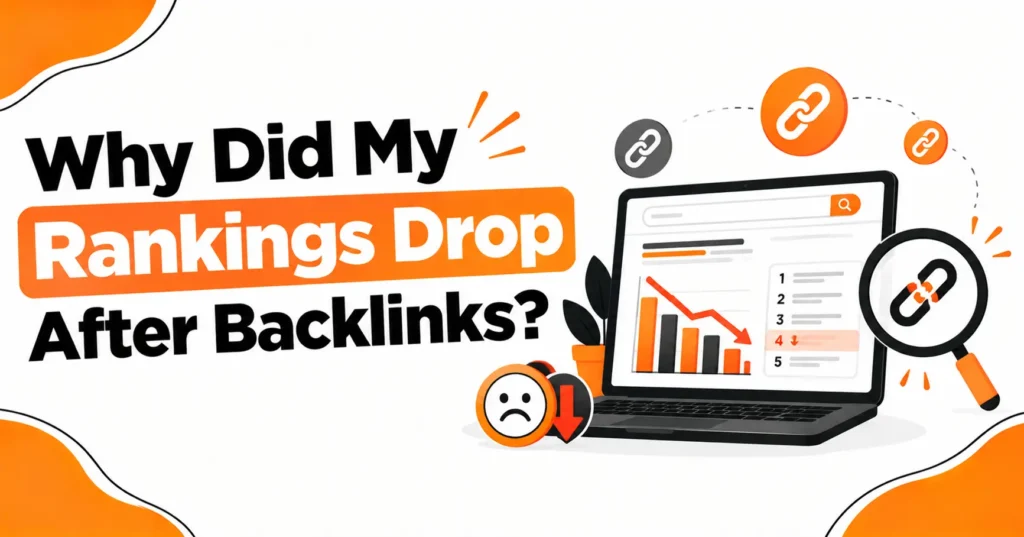
Building backlinks is an effective SEO strategy, but it does not always guarantee higher Google rankings. Sometimes, websites experience declining keyword positions, reduced organic traffic, or lost visibility after acquiring new links.
If you are wondering why did my rankings drop after backlinks, the problem may involve low-quality links, irrelevant referring domains, over-optimized anchor text, or unnatural link-building practices. However, backlinks are not always responsible for ranking declines.
Google algorithm updates, technical SEO issues, and content quality can also affect performance. Understanding your backlink profile, identifying toxic backlinks, and analyzing anchor text distribution can help uncover the real cause and guide an effective recovery strategy.
Why Did My Rankings Drop After Building Backlinks?
Backlinks help search engines discover content and understand how websites reference one another. However, their value depends on relevance, context, quality, and how naturally they are acquired. A website with thousands of backlinks does not automatically outperform a competitor with fewer but more meaningful editorial references.
When backlinks are acquired through manipulative practices, Google’s systems may ignore them or take action when its spam policies are violated. Rankings can also decline because of algorithm updates, content quality problems, technical SEO issues, or stronger competitors. Therefore, a ranking decline following link acquisition should be investigated carefully instead of immediately assuming that every new backlink is harmful.
11 Reasons Your Rankings Dropped After Getting Backlinks
1. You Acquired Low-Quality or Spammy Backlinks
Low-quality backlinks can come from link farms, automated directories, unrelated blogs, and websites created primarily to sell links. These placements often provide little editorial value and may indicate an artificial link-building campaign.
However, receiving a spammy backlink does not automatically mean your website will be penalized. Search engines can ignore or neutralize many unnatural links. The bigger concern is deliberately participating in link schemes designed to manipulate search rankings.
2. Your Backlinks Come From Irrelevant Websites
Topical relevance helps establish whether a backlink makes sense within its surrounding content. For example, a link to an SEO service from a digital marketing publication has a clearer contextual connection than a link placed on an unrelated website.
Irrelevant links are not automatically harmful, but acquiring large numbers of unrelated placements through artificial campaigns can create an unnatural pattern. Prioritize publications that cover subjects connected to your industry and provide genuine value to their readers.
3. Your Anchor Text Profile Is Over-Optimized
Anchor text gives search engines additional context about the linked destination. Problems can arise when a website repeatedly acquires exact-match commercial keyword anchors instead of receiving natural references.
For example, using the same keyword-rich anchor in dozens of paid guest posts may create an artificial pattern. A natural backlink profile can contain branded anchors, naked URLs, generic phrases, partial-match keywords, and descriptive text. There is no universal anchor text percentage that guarantees safety, so evaluate the overall pattern rather than following arbitrary ratios.
4. You Built Too Many Backlinks Too Quickly
A sudden increase in backlinks deserves investigation when many links appear through similar placements, repetitive anchors, or coordinated campaigns. Automated submissions and bulk link packages can create patterns associated with manipulative link acquisition.
However, rapid backlink growth alone does not cause a Google penalty. A viral article, successful digital PR campaign, or popular resource can naturally attract hundreds of backlinks within days. Focus on the origin, relevance, and acquisition method instead of treating backlink velocity as an isolated ranking factor.
5. Your Link-Building Strategy Violates Google’s Spam Policies
Buying dofollow backlinks primarily to manipulate rankings, participating in excessive reciprocal exchanges, and operating private blog networks can violate Google’s link spam policies. These practices attempt to influence search results through artificial recommendations rather than genuine editorial references.
Search engines may ignore manipulative links or issue a manual action when a website violates their policies. If your ranking decline followed a paid link-building campaign, examine the campaign’s methods and identify whether links were acquired through prohibited practices.
6. Your Website Was Affected by a Google Algorithm Update
Google regularly updates its ranking systems to improve the relevance and quality of search results. A core update or spam update can affect organic visibility even when your backlink profile has improved.
Compare your ranking history with confirmed update dates and examine whether the decline affected your entire website, specific landing pages, or particular keyword groups. If several unrelated pages experienced similar declines simultaneously, a broader ranking-system change may be more likely than an issue with one backlink campaign.
7. Your Content No Longer Matches Search Intent
Backlinks cannot compensate for content that fails to satisfy what users are searching for. If someone searches for a practical guide but your page offers only a general explanation, competitors with more useful and relevant information may gradually outperform it.
Review your content for missing information, outdated explanations, weak examples, and unanswered questions. Search intent, topical relevance, content usefulness, and information accuracy should remain central to your SEO strategy.
8. Your Competitors Have Built Stronger Websites
Search rankings are competitive, meaning your website can lose positions even when its own SEO performance remains relatively stable. Competitors may publish more comprehensive content, improve their internal linking, attract relevant editorial backlinks, or establish stronger topical authority.
Compare competing content to understand what has changed. Look for missing subtopics, better explanations, original research, stronger page structure, and more useful resources. Improving these areas can be more effective than acquiring additional backlinks without a clear strategy.
9. Technical SEO and Indexing Problems Are Affecting Rankings
Technical SEO problems can reduce search visibility even when your backlink profile is healthy. Incorrect canonical tags, accidental noindex directives, broken redirects, server errors, and crawling problems can prevent search engines from properly accessing or understanding important pages.
Check indexing status, crawl statistics, canonical configurations, and mobile performance. Also review internal links, page speed, and website architecture. A technical issue that appears around the same time as a link-building campaign can easily be mistaken for a backlink-related ranking problem.
10. You Lost Valuable Backlinks
Not every ranking decline comes from newly acquired links. Sometimes, your website loses previously earned backlinks that contributed to its search visibility.
Website redesigns, deleted articles, broken URLs, changed page addresses, and removed editorial references can cause valuable links to disappear. Monitor new and lost referring domains, investigate important lost links, and contact publishers when a genuine editorial reference can reasonably be restored.
11. Your Backlink Campaign Created Duplicate or Low-Value Content
Some link-building campaigns rely on publishing similar guest posts across multiple websites with little original information. When these articles provide minimal value, repeat the same topics, or exist primarily to place keyword-rich links, the campaign may generate little lasting SEO benefit.
The problem is not simply that guest posts cover similar subjects. It is the combination of weak editorial standards, repetitive content, artificial placements, and manipulative link patterns. Focus on original contributions that answer genuine audience questions and provide meaningful editorial value.
How to Identify Whether Backlinks Are Actually Hurting Your Rankings?
Before removing links or changing your SEO strategy, establish whether backlink acquisition is connected to the ranking decline. A structured investigation helps separate link-related concerns from algorithm updates, technical problems, and content weaknesses.
Compare Ranking Changes With Backlink Acquisition Dates
Start by identifying when your website experienced its first significant ranking decline. Use Google Search Console to compare clicks, impressions, average positions, and affected landing pages across appropriate date ranges.
Next, compare these changes with the dates of your backlink campaigns and newly discovered links. A decline that follows link acquisition deserves investigation, but timing alone does not prove that those backlinks caused the problem.
Analyze New and Lost Referring Domains
Use a backlink analysis platform to identify recently discovered and lost referring domains. Examine the websites, individual linking articles, contextual relevance, link placement, and overall editorial quality.
Do not judge backlink quality exclusively through third-party metrics such as Domain Authority or Domain Rating. These metrics can help with comparisons, but they are not Google’s official ranking scores and cannot independently establish whether a backlink is harmful.
Review Your Anchor Text Distribution
Examine whether your backlink profile contains an unusually high concentration of exact-match commercial keywords. Compare branded anchors, naked URLs, generic phrases, partial-match anchors, and descriptive keyword variations.
Look for repetitive patterns associated with paid placements, automated submissions, or coordinated link exchanges. The goal is to identify artificial acquisition practices rather than force your backlink profile into a predetermined anchor text ratio.
Investigate Suspicious Referring Domains
Examine whether suspicious websites have genuine content, identifiable editorial standards, real topical relevance, and meaningful reasons to reference your website. Be cautious of websites with excessive outbound commercial links, repetitive guest post content, and obvious link-selling patterns.
A low authority score alone is not sufficient evidence of a toxic backlink. Evaluate the actual website and linking page before deciding whether further action is necessary.
Check Google Search Console for Manual Actions
Open the Manual Actions report in Google Search Console to determine whether Google has identified a violation affecting your website. An unnatural links manual action requires a more direct recovery process than an ordinary ranking fluctuation.
If there is no manual action, do not automatically assume that your backlink profile is responsible. Google’s automated systems can ignore manipulative links without issuing a manual penalty, while completely unrelated issues can also reduce rankings.
How to Recover Rankings After a Backlink-Related Drop
Once you have identified the likely problem, focus on correcting the underlying issue instead of making unnecessary changes. A successful recovery strategy should address manipulative link acquisition, improve content quality, resolve technical problems, and monitor organic search performance.
Audit Your Entire Backlink Profile
Start with a complete backlink audit that separates naturally earned editorial references from suspicious or campaign-generated placements. Review referring domains, anchor text, link attributes, surrounding content, and acquisition patterns.
Pay particular attention to links acquired through automated services, private blog networks, and paid campaigns intended to manipulate search rankings. Document your findings so that you can distinguish genuine problems from ordinary low-quality links that search engines may already ignore.
Remove or Correct Manipulative Backlinks
If you identify links that were deliberately created through manipulative campaigns, stop acquiring similar placements. Where possible, contact website owners and request removal or appropriate correction of links that violate search policies.
Avoid contacting every website with a low authority score. Removing legitimate editorial references simply because a third-party tool labels them toxic can eliminate useful links without addressing the actual problem.
Use Google’s Disavow Tool Carefully
Google’s Disavow Links tool allows website owners to request that specific backlinks be disregarded when evaluating their websites. However, it is not a routine backlink cleanup tool, and most websites do not need to use it.
Consider disavowal when there is a considerable pattern of artificial or low-quality links and a manual action or likely manual action involving those links. Incorrect use can negatively affect search performance, so investigate thoroughly before submitting a disavow file.
Improve Content Quality and Search Intent
Review pages that lost organic visibility and identify whether their content fully satisfies the target search intent. Update outdated information, improve explanations, add practical examples, and cover important questions that readers expect answered.
Strengthen topical coverage through meaningful internal links between related articles. A well-organized website makes it easier for users to discover relevant information and helps search engines understand the relationship between your content.
Strengthen Technical SEO and Website Performance
Check for indexing errors, incorrect canonical tags, broken redirects, accidental noindex directives, and server availability problems. Make sure important pages can be crawled, rendered, and indexed correctly.
Review mobile usability, Core Web Vitals, internal linking, and website navigation. Although technical improvements do not guarantee an immediate ranking recovery, they help ensure that search engines can properly access and evaluate your content.
Build Relevant and Natural Backlinks
After addressing problematic link-building practices, focus on earning genuine editorial references. Original research, helpful resources, expert contributions, digital PR, and meaningful publisher relationships can create opportunities for relevant backlinks.
Prioritize the quality and editorial context of each placement instead of chasing high backlink counts. A sustainable link-building strategy should support your content and reputation rather than depend on artificial ranking manipulation.
Monitor Rankings and Organic Traffic
Track affected keywords, landing pages, impressions, clicks, and average positions through Google Search Console and a reliable rank-tracking platform. Monitor changes in referring domains and indexing status as well.
Avoid making multiple major SEO changes simultaneously because it becomes difficult to determine which improvements contributed to recovery. Give search engines time to recrawl and reassess your website before evaluating the results.
How to Prevent Future Ranking Drops From Link Building
A sustainable link-building strategy begins with selecting relevant websites and earning placements that provide genuine value to readers. Avoid automated backlink packages, manipulative link exchanges, and paid dofollow placements intended primarily to influence search rankings.
Maintain records of your outreach campaigns, acquired links, referring domains, and anchor text. Regular monitoring makes it easier to identify unusual acquisition patterns and investigate potential problems before they become part of a larger SEO issue.
Most importantly, remember that backlinks are only one part of organic search performance. High-quality content, strong internal linking, technical health, and topical relevance should support every link-building campaign.
How Long Does It Take to Recover Rankings After a Backlink Drop?
There is no guaranteed recovery timeline because the process depends on the actual cause of the decline. If Google was already ignoring spammy links, removing them may not produce a noticeable ranking improvement because those links were not contributing meaningful ranking value.
If your website received a manual action, you must correct the violations before submitting a reconsideration request. Recovery may take time, and improvements are not guaranteed. Continue monitoring your search performance and avoid repeating the practices that created the problem.
Frequently Asked Questions
Can bad backlinks cause Google rankings to drop?
Yes, manipulative link-building practices can contribute to ranking problems. Google may ignore spammy backlinks or issue a manual action when a website violates its spam policies. However, receiving ordinary low-quality backlinks does not automatically result in a penalty.
Can too many backlinks hurt SEO?
Having a large number of backlinks is not inherently harmful. Problems arise when links are generated through automated campaigns, artificial exchanges, or manipulative link schemes. Evaluate their quality, relevance, and acquisition methods instead of focusing exclusively on quantity.
Why are my rankings dropping despite getting quality backlinks?
Quality backlinks cannot guarantee improved rankings. Content relevance, search intent, competitor performance, technical SEO, and algorithm updates can all influence search visibility. Review these areas before assuming that your link-building strategy has failed.
Should I disavow all toxic backlinks?
No. Google generally recommends avoiding unnecessary disavowal. Consider using the tool when you have a substantial pattern of artificial or manipulative links and a manual action or likely manual action involving those links. Do not disavow links simply because a third-party tool assigns them a low quality score.
How do I know if backlinks are hurting my website?
Compare ranking changes with backlink acquisition dates, inspect new referring domains, review anchor text patterns, and check Google Search Console’s Manual Actions report. Also investigate content quality, algorithm updates, technical SEO, and competitor changes before identifying backlinks as the cause.
Does Google penalize websites for unnatural backlinks?
Google can issue manual actions against websites involved in unnatural link schemes. Its automated systems can also detect and neutralize manipulative links. Not every suspicious backlink results in a penalty, so the circumstances and link-building practices matter.
Should I stop building backlinks after losing rankings?
Stop manipulative link-building campaigns immediately, but you do not necessarily need to stop earning backlinks. Continue developing useful content and attracting relevant editorial references while investigating the reason behind your ranking decline.
Recovery depends on the underlying issue, the severity of the problem, and how quickly corrective actions are processed. There is no guaranteed timeline. Continue monitoring keyword positions, indexing, and organic traffic while addressing the actual cause.
Conclusion
If you are wondering why did my rankings drop after backlinks, investigate link quality, topical relevance, anchor text, and unnatural acquisition practices before making changes. Remember that algorithm updates, content problems, technical SEO, and competitor improvements can also affect rankings. Conduct a thorough backlink audit, correct genuine issues, improve your content, and focus on earning relevant editorial links. A balanced SEO strategy is the foundation of sustainable organic growth.

James Robert
James Robert is a seasoned Off-Page SEO expert specializing in strategic link building, digital outreach, and authority growth for businesses aiming to improve search visibility and rankings. With over five years of hands-on experience, he helps brands strengthen their online presence through high-quality backlinks, niche-relevant placements, and ethical SEO practices aligned with Google’s guidelines. James’s core specialties include guest posting, blogger outreach, niche edits, brand mentions, and backlink profile optimization. He is highly skilled at building relationships with authoritative publishers and executing scalable outreach campaigns that drive long-term organic growth. As a contributor to leading marketing platforms, James regularly shares actionable insights on off-page SEO strategies, link acquisition, and sustainable ranking improvements, helping businesses achieve consistent and measurable SEO success.