

B2B SaaS content marketing has become one of the most powerful growth engines for software companies targeting businesses worldwide. Unlike traditional marketing, SaaS buyers don’t make impulse decisions. They research deeply, compare solutions, and seek long-term value before committing. Content plays a critical role in guiding prospects through this journey.
From awareness to conversion and retention, well-planned content builds trust, demonstrates expertise, and positions a SaaS brand as the best solution to a specific problem. This guide explores how b2b saas content marketing works, why it matters, and how to implement it effectively for global audiences.
What Is SaaS Content Marketing?
What is SaaS content marketing? It is a marketing model that aims at designing and sharing quality, related, and informative materials to attract, convert, and retain users of Software-as-a-Service commodities.
SaaS content marketing focuses on unlike eCommerce or local services:
Education over promotion
Customer relationships in the long-term.
Product-led storytelling
Data-driven optimization
In the case of B2B SaaS brands, content is not merely a part of marketing; it is also a piece of the product experience.
The Difference between B2B SaaS Content Marketing.
The content marketing in B2B SaaS is different as compared to other content models because of the type of buyers and products.
Decision-makers are often:
Teams, not individuals
Very enlightened and critical.
Concentrated on ROI, scalability, and integration.
This implies that the content has to be more technical, in-depth and solution-focused. Short promotional content is inferior to case studies, whitepapers, in-depth blogs, and comparison guides.
The Content Role in the B2B SaaS Purchase Process.
The content accompanies all buyer funnel phases of SaaS.
Content at the awareness stage informs prospects of problems and opportunities. During the consideration stage, it describes solutions and makes comparisons. Content cultivates confidence at the decision stage with proof, testimonials, and demos.
Once it has been converted, content would still have a role in onboarding, retention and upselling.
Basic Building Blocks of B2B SaaS Content Marketing Strategy.
There are various elements that make a successful strategy and they all work together.
To begin with, it is necessary to conduct audience research. Relevance in content is achieved by understanding industries, line of work, problems, and triggers of decisions.
Second, content planning based on keywords matches the business objectives with the search requirements. This is used to attract high-intent traffic on a worldwide level.
Third, content distribution will get your work in the right distribution channels, such as organic search, email, social networks, and communities.
Best Types of Content to use in B2B SaaS.
There are various content types that are used in b2b saas content marketing.
Organic traffic and thought leadership best work with blog posts. Long-form guides are more useful in explaining complicated issues and they rank in competitive keywords.
Case studies are successful in the real world and are trusted. Enterprise buyers prefer whitepapers and ebooks to get in-depth and data.
Product tutorials, videos, and webinars help to engage and convert, particularly with complicated SaaS solutions.
SEO and B2B SaaS Content Marketing.
Scalable SaaS growth is made through search engine optimization. Content has a hard time reaching global audiences without SEO.
Best practices in SEO of SaaS are:
Buyer intent keyword research.
Internal product and blog page links.
Streamlined headings and organization.
Frequent revision to keep it up to date.
By integrating SEO and content objectives, SaaS businesses will be able to create high-quality leads every month.
The Creation of Topic Authority in SaaS Niches.
Topical authority is its reward with search engines. Successful SaaS brands do not publish random blogs but rather cluster content around their major themes.
As an illustration, a CRM SaaS can be sales automation-centered, lead management-oriented, and pipeline optimization-centered. Every subject matter has several interrelated articles.
This is a better strategy to enhance ranking, user feedback, and brand reputation.
Personalized Marketing to Multinational B2B.
Global SaaS corporations are forced to think of the differences in cultures, regions, and languages. Relevance and conversion rate are high with content personalization.
This includes:
Region-specific examples
Industry-focused use cases
Customized market tones.
Adapting the contents to the global audience even when publishing in English enhances the trust and reach.
Matching Content to Product-Led Growth.
A large number of SaaS firms have a product-led growth model. This is supported by content through educating users prior to and after sign-up.
Feature guides, use-case blogs, and tutorials assist users in enjoying value more quickly. This lowers the churn and lifetime value.
In b2b content marketing of saas, content is used to substitute the traditional sales discussion.
How to measure B2B SaaS Content Marketing Success.
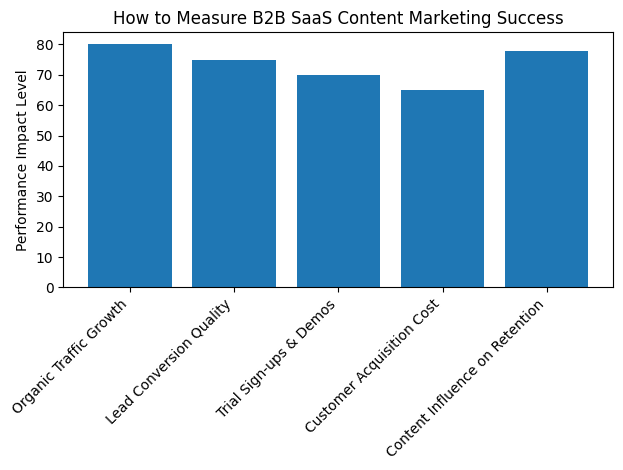
Success in content is not calculated by traffic. SaaS brands follow content-to-revenue metrics.
Some of the key performance indicators are:
Organic traffic growth
Conversion rates and the quality of leads.
Trial sign-ups and demos
Customer acquisition cost
Influence of content on retention.
These lessons aid in the improvement of strategy and prioritizing high-impact content.
SaaS Content marketing mistakes.
The first error is giving too much attention to product features as opposed to customer problems. The first thing content should deal with is the pain points.
The other problem is the lack of a clear strategy of publication. Random content can hardly have a consistent result.
Neglect of the principles of SEO and the inability to refresh old material also restricts long-term development.
B2B SaaS Content Marketing Scaling.
Since SaaS firms expand, the content should be scaled without compromising on quality. This involves documented procedures, editorial policies and performance monitoring.
She should use recycling of writing content in various formats to reach as many people as possible. One blog may be transformed into a webinar, a series of emails, and a social post.
Popularity is valued more than quantity on going international.
The Future of B2B SaaS Content Marketing.
The future is facts-based, individual and experience-centered. AI can be useful in research and optimization, but human judgment cannot be ignored.
The buyers want genuine, candid content that provides actual value. Competitors will not keep up with brands of SaaS that invest in quality content.
Conclusion
B2B SaaS content marketing is not a luxury, but a strategy of fundamental growth of software companies that work in international markets. Through education, search engine optimization, and customer value, SaaS brands are able to generate qualified leads, reduce sales cycles, and create long term relationships.
In its proper implementation, b2b saas content marketing turns out to be a long-term investment that generates traffic, conversions, and revenue long after implementation.
Frequently Asked Questions
What is SaaS content marketing?
SaaS content marketing is the practice of creating educational and value-driven content to attract, convert, and retain users for software-based products.
Why is content marketing important for B2B SaaS?
It helps build trust, educate decision-makers, generate qualified leads, and support long sales cycles common in B2B SaaS.
What type of content works best for B2B SaaS companies?
In-depth blogs, case studies, whitepapers, product tutorials, and SEO-focused guides perform best.
How long does it take to see results from SaaS content marketing?
Most SaaS companies see meaningful results within 3 to 6 months, with stronger ROI over the long term.
How does SEO support b2b saas content marketing?
SEO helps content rank globally, attract high-intent traffic, and generate consistent leads without relying solely on paid ads.
Featured Blogs

Analyzing Backlink Profiles: Key to Unlocking SEO Success
Analyzing backlink profiles has emerged as an important process in the enormous and continuously changing universe of search engine optimization...

Best Article Submission Sites for SEO
Search engine optimization (SEO) continues to evolve through ongoing strategic shifts. Frequent algorithm updates, changing user behavior, and emerging digital...

James Robert
James Robert is a seasoned Off-Page SEO expert specializing in strategic link building, digital outreach, and authority growth for businesses aiming to improve search visibility and rankings. With over five years of hands-on experience, he helps brands strengthen their online presence through high-quality backlinks, niche-relevant placements, and ethical SEO practices aligned with Google’s guidelines. James’s core specialties include guest posting, blogger outreach, niche edits, brand mentions, and backlink profile optimization. He is highly skilled at building relationships with authoritative publishers and executing scalable outreach campaigns that drive long-term organic growth. As a contributor to leading marketing platforms, James regularly shares actionable insights on off-page SEO strategies, link acquisition, and sustainable ranking improvements, helping businesses achieve consistent and measurable SEO success.