
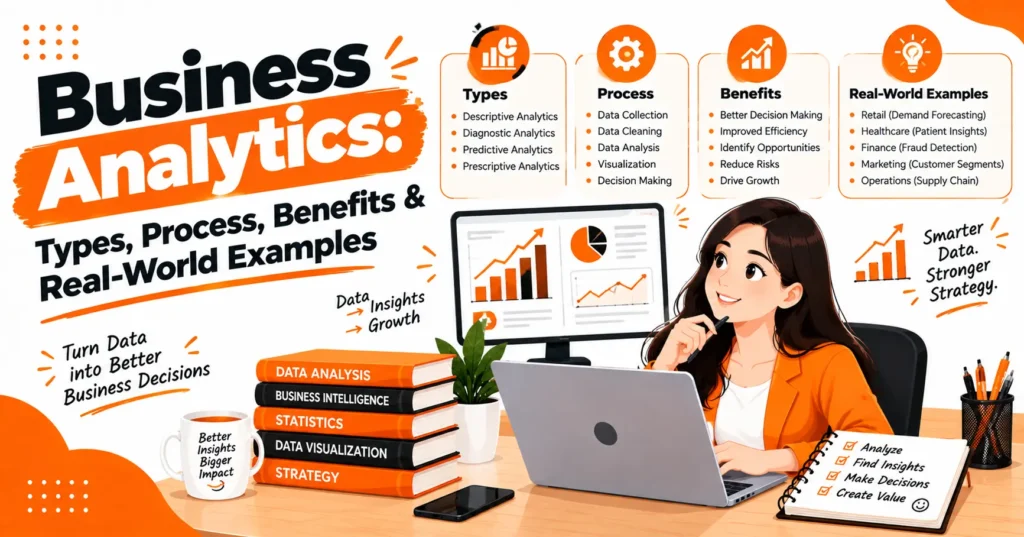
Businesses generate enormous amounts of information through sales, websites, customers, transactions, marketing campaigns, and daily operations. The challenge is turning that raw information into useful decisions. Business analytics provides a structured way to examine data, identify patterns, understand performance, and determine what actions can improve results.
Modern organizations use analytics to understand customer behavior, forecast demand, reduce costs, improve efficiency, and discover growth opportunities. From a small company tracking sales trends to an enterprise using machine learning for forecasting, data-driven analysis has become an important part of strategic planning and everyday decision-making.
What Is Business Analytics?
Business analytics is the process of examining business data with statistical analysis, data visualization, forecasting, and related techniques to produce actionable insights. These insights help organizations understand what is happening, why it is happening, what may happen next, and which actions could produce better outcomes.
Unlike simply collecting reports, analytics connects data with business objectives. It transforms information from databases, spreadsheets, customer platforms, financial systems, and other sources into evidence that managers can use when making operational and strategic decisions.
Why Is Business Analytics Important?
Organizations cannot make consistently informed decisions when important choices depend only on assumptions. Analytics provides measurable evidence that can reveal performance trends, customer preferences, operational problems, and potential risks.
For example, a retailer can examine purchasing behavior to identify popular products and seasonal demand. A marketing team can compare campaign performance, while a finance department can analyze expenses and revenue patterns. These insights can support better resource allocation and business planning.
How Does Business Analytics Work?
An effective analytics process usually starts with a clearly defined business question. Instead of collecting data without a purpose, organizations determine what they need to understand, such as declining sales, customer churn, rising operating costs, or changing market demand.
Relevant data is then collected, cleaned, organized, and analyzed. Analysts may use SQL, spreadsheets, statistical techniques, visualization platforms, or programming languages to identify meaningful patterns. The results are presented through reports or dashboards so decision-makers can understand the findings and take appropriate action.
What Are the Four Types of Business Analytics?
The four major types of analytics create a progression from understanding historical performance to recommending future actions. Descriptive, diagnostic, predictive, and prescriptive analytics each answer a different business question.
Understanding this framework is essential because organizations often need more than a report showing what happened. They may also need to understand the cause, anticipate future outcomes, and determine how to respond.
Descriptive Analytics
Descriptive analytics answers the question, “What happened?” It examines historical data and summarizes business performance through reports, dashboards, charts, and key performance indicators.
For example, a company may compare monthly revenue, website traffic, conversion rates, or product sales. This information provides a clear view of previous performance and establishes a foundation for deeper analysis.
Diagnostic Analytics
Diagnostic analytics asks, “Why did it happen?” It investigates relationships and patterns within data to identify possible causes behind a particular result.
Suppose sales decline significantly during one quarter. Diagnostic analysis could examine pricing, customer segments, advertising performance, product availability, regional trends, and competitor activity to determine which factors may have contributed to the decline.
Predictive Analytics
Predictive analytics focuses on the question, “What is likely to happen?” It uses historical information, statistical modeling, forecasting, and sometimes machine learning to estimate future outcomes.
Companies can use predictive models to forecast sales, anticipate customer churn, estimate demand, or identify potential risks. Predictions are not guarantees, but they can provide useful evidence for planning and resource allocation.
Prescriptive Analytics
Prescriptive analytics goes one step further by asking, “What should we do?” It evaluates possible actions and helps organizations determine which decisions may produce desirable outcomes.
For instance, an organization could use prescriptive models to evaluate pricing strategies, inventory levels, marketing budgets, or staffing decisions. This approach connects analytical insights directly with business action.
Business Analytics vs. Business Intelligence
Business intelligence and analytics are closely related, but they are not identical. Business intelligence traditionally focuses on reporting, dashboards, historical performance, and monitoring important business metrics.
Analytics generally extends beyond reporting by investigating patterns, predicting possible outcomes, and supporting more advanced decision-making. In practice, the two disciplines frequently overlap and can work together within a data-driven organization.
Business Analytics vs. Data Analytics
Data analytics is a broader discipline concerned with examining data to discover patterns, relationships, and insights. It can be applied to business, healthcare, science, government, education, and many other fields.
Business analytics applies analytical methods specifically to organizational challenges and business objectives. Its purpose is not simply to find patterns in data but to connect those findings with revenue, customers, operations, finance, marketing, strategy, or other business outcomes.
Business Analytics vs. Data Science
Data science combines statistics, programming, machine learning, data engineering, and other computational methods to extract knowledge from complex datasets. It can address both business and non-business problems.
Business analytics tends to place greater emphasis on business questions, performance measurement, decision-making, and actionable insights. However, modern analytics increasingly incorporates data science techniques, especially predictive modeling and machine learning.
What Tools Are Used for Business Analytics?
Analytics teams use different technologies depending on the size of the organization and the complexity of its data. Excel remains useful for calculations and smaller datasets, while SQL is widely used to retrieve and manipulate information stored in databases.
Visualization platforms can turn analytical results into interactive dashboards and reports. Programming languages such as Python and R support statistical analysis, automation, predictive modeling, and machine learning. Data warehouses and cloud analytics platforms can also provide centralized environments for managing large volumes of business information.
| Analytics Area | Common Methods | Business Purpose |
| Descriptive analytics | Reports, dashboards, KPIs | Understand past performance |
| Diagnostic analytics | Data exploration, correlation analysis | Identify possible causes |
| Predictive analytics | Forecasting, statistical models | Estimate future outcomes |
| Prescriptive analytics | Optimization, simulations | Evaluate possible actions |
| Data visualization | Charts, dashboards, interactive reports | Communicate insights |
| Machine learning | Classification, regression, clustering | Detect patterns and automate analysis |
Business Analytics Applications
Marketing teams use analytics to measure campaign performance, understand customer segments, evaluate conversion rates, and identify channels that generate meaningful results. Customer analytics can also reveal purchasing patterns and changing preferences.
Sales teams can analyze revenue trends, sales pipelines, customer value, and regional performance. Predictive models may help estimate future demand, while customer segmentation can help businesses understand which groups respond to particular products or offers.
Financial departments can analyze revenue, expenses, profitability, cash flow, and financial risk. Operations teams can use data to monitor productivity, identify bottlenecks, optimize resources, and improve processes.
Supply chain analytics can support inventory management, demand forecasting, supplier evaluation, and logistics planning. Human resources teams can analyze workforce trends, recruitment data, employee retention, and staffing requirements.
Real-World Example of Business Analytics
Imagine an online retailer experiencing lower profits despite stable sales. A simple sales report may show that revenue has remained relatively consistent, but deeper analysis can reveal that shipping expenses and product returns have increased.
Diagnostic analytics can investigate which products generate the highest return rates. Predictive analytics can estimate future returns based on historical customer and product information, while prescriptive analysis can evaluate possible changes to product descriptions, pricing, shipping policies, or inventory decisions.
This example demonstrates the progression from raw data to actionable insight. The value comes not from the data itself but from understanding the problem and using evidence to support a better decision.
Benefits of Business Analytics
One major advantage is improved decision-making. Managers can replace isolated assumptions with measurable evidence, making it easier to evaluate performance and identify opportunities.
Analytics can also improve operational efficiency by exposing bottlenecks, unnecessary costs, and underperforming processes. Organizations can use these findings to allocate resources more effectively and improve productivity.
Another benefit is better customer understanding. By examining customer behavior, businesses can identify preferences, purchasing patterns, engagement levels, and potential churn signals.
Analytics can also support revenue optimization, risk management, forecasting, competitive analysis, and long-term strategic planning. When insights are integrated into everyday operations, organizations can respond to changing market conditions more effectively.
Challenges of Business Analytics
Poor data quality can undermine even sophisticated analytical models. Incomplete records, duplicate information, inconsistent formats, and outdated datasets can produce misleading results.
Another challenge is data integration. Information may exist across separate CRM systems, financial platforms, spreadsheets, websites, and databases. Bringing these sources together requires appropriate processes and governance.
Organizations may also struggle with analytical skills, privacy requirements, security, and communicating technical findings to non-technical decision-makers. Successful analytics therefore requires both reliable technology and people who can translate complex findings into understandable business recommendations.
How AI Is Changing Business Analytics?
Artificial intelligence is expanding the capabilities of modern analytics by helping organizations process large datasets, identify patterns, automate repetitive tasks, and generate forecasts. Machine learning can continuously examine information and identify relationships that may be difficult to detect manually.
AI-powered analytics can also make insights more accessible through natural-language interfaces, automated summaries, anomaly detection, and intelligent recommendations. However, organizations still need accurate data, appropriate governance, human oversight, and clearly defined business objectives.
Skills Needed for Business Analytics
A strong analytics professional needs a combination of technical and business skills. Statistical reasoning helps analysts understand patterns and uncertainty, while data visualization helps them communicate findings clearly.
Knowledge of SQL, Excel, databases, analytics platforms, and programming can support practical data work. Business knowledge is equally important because an analyst must understand the organization’s goals before deciding which metrics, models, or insights actually matter.
Communication is another important skill. Even an accurate analysis has limited value if decision-makers cannot understand what the findings mean or how they relate to a business problem.
How to Build a Data-Driven Analytics Strategy
Organizations should begin with measurable business objectives rather than selecting technology first. A clear objective makes it easier to identify the required data, choose appropriate metrics, and determine how success will be evaluated.
The next step is establishing reliable data collection and management practices. After analysis, findings should be presented through understandable dashboards, reports, or recommendations. Organizations should then monitor outcomes and refine their analytical approach as new data becomes available.
Frequently Asked Questions
What is the main purpose of business analytics?
The main purpose is to transform business data into useful insights that support better decisions. It can help organizations understand performance, identify problems, forecast outcomes, and evaluate possible actions.
What are the four types of business analytics?
The four primary types are descriptive, diagnostic, predictive, and prescriptive analytics. They respectively address what happened, why it happened, what may happen, and what action could be considered.
Is business analytics the same as data analytics?
No. Data analytics is a broader discipline that can be applied to many fields, whereas business analytics focuses specifically on using data and analytical methods to solve organizational and commercial problems.
What tools are commonly used for business analytics?
Common tools and technologies include Excel, SQL, Python, R, data visualization platforms, dashboards, databases, data warehouses, statistical software, and machine learning technologies.
How does analytics help businesses make decisions?
Analytics provides evidence about performance, customer behavior, risks, trends, and potential outcomes. Decision-makers can use these insights to evaluate alternatives and make more informed strategic and operational choices.
Conclusion
Business analytics connects data with practical business decisions. By combining descriptive, diagnostic, predictive, and prescriptive approaches with visualization, statistical analysis, forecasting, and AI, organizations can understand performance, anticipate change, and identify opportunities. When supported by reliable data and clear objectives, it becomes a valuable foundation for more informed, measurable, and strategic business decision-making.

James Robert
James Robert is a seasoned Off-Page SEO expert specializing in strategic link building, digital outreach, and authority growth for businesses aiming to improve search visibility and rankings. With over five years of hands-on experience, he helps brands strengthen their online presence through high-quality backlinks, niche-relevant placements, and ethical SEO practices aligned with Google’s guidelines. James’s core specialties include guest posting, blogger outreach, niche edits, brand mentions, and backlink profile optimization. He is highly skilled at building relationships with authoritative publishers and executing scalable outreach campaigns that drive long-term organic growth. As a contributor to leading marketing platforms, James regularly shares actionable insights on off-page SEO strategies, link acquisition, and sustainable ranking improvements, helping businesses achieve consistent and measurable SEO success.