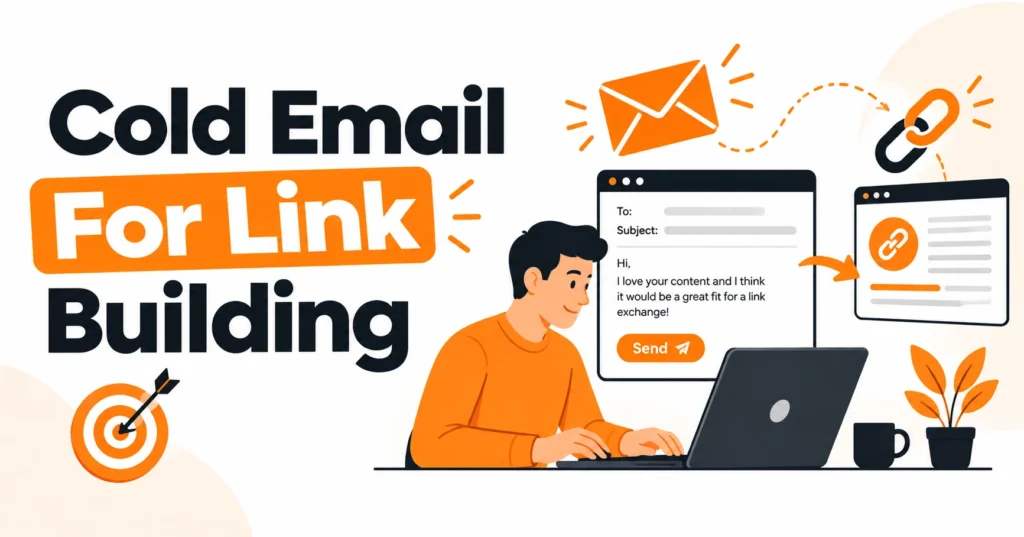
Cold email for link building is an effective SEO strategy for connecting with website owners, bloggers, and editors to earn relevant backlinks. Instead of waiting for other websites to discover your content, you can proactively reach out with valuable resources that support their audience.
However, successful outreach requires more than sending generic emails. You need to identify relevant prospects, write personalized messages, and offer genuine value that encourages recipients to consider your content.
By using effective link building outreach, targeted prospect research, and strategic follow-ups, you can improve response rates and build meaningful relationships. A well-planned backlink outreach campaign helps strengthen your website’s authority and supports long-term organic search growth.
What Is Cold Email for Link Building?
Cold email for link building is the process of contacting website owners, editors, publishers, or content managers without an existing relationship to suggest a relevant backlink opportunity. The opportunity might involve a useful resource, original research, a guest article, a broken link replacement, or a relevant addition to existing content.
Unlike mass promotional emails, effective backlink outreach focuses on editorial value. You explain why your resource is relevant to the recipient’s audience and allow them to decide whether it deserves inclusion. The objective is to build relationships and earn legitimate links, not simply increase the number of backlinks pointing to your website.
Why Is Cold Email Important for SEO?
Backlinks can help search engines discover content and understand relationships between websites. Relevant editorial links may also generate referral traffic, introduce your brand to new audiences, and support your broader search visibility.
A structured outreach campaign allows you to proactively connect useful content with publishers who cover related subjects. Instead of waiting for other websites to discover your resources, you can identify suitable opportunities and explain why your content deserves attention.
However, more backlinks do not automatically mean better rankings. Relevance, editorial quality, and the context of a link matter. Prioritize links that genuinely benefit readers rather than pursuing websites solely because they display high third-party authority scores.
How to Build a Successful Link-Building Outreach Strategy?
Define Your Campaign Goals?
Before contacting anyone, decide what you want your campaign to achieve. You might want to promote an original study, earn editorial mentions for a comprehensive guide, contribute an expert article, or attract relevant links to an important resource.
Your goal determines which websites you approach, what you offer, and how you measure success. A campaign promoting original research, for example, requires a different pitch from one proposing a guest contribution or suggesting a replacement for a broken resource.
Create Something Worth Linking To
Strong outreach begins with useful content. Original research, detailed tutorials, free tools, practical templates, expert insights, and comprehensive resources can give publishers a genuine reason to consider a link.
Review your content before launching a campaign. Make sure it answers a specific question, provides accurate information, and offers something useful beyond what readers can already find elsewhere. If the resource does not provide a clear benefit, improve it before investing time in outreach.
How to Find Quality Link-Building Prospects?
Research Relevant Websites and Articles
Start by identifying websites that publish content related to your subject, industry, or target audience. Look for educational articles, resource collections, industry publications, and pages where your content could provide additional context.
Competitor backlink analysis can reveal potential prospects, while search operators can help uncover relevant resource pages and guest contribution opportunities. Treat every discovery as a starting point rather than an automatic target. A website linking to another resource does not necessarily mean it will want yours.
Qualify Each Backlink Opportunity
Evaluate the website’s topical relevance, editorial standards, audience, organic traffic indicators, and the specific page you intend to approach. Check whether the content is maintained, whether outbound links are relevant, and whether your resource would improve the reader’s experience.
Third-party authority metrics can provide additional context, but they should not determine your decision alone. A smaller, highly relevant publication may offer a better opportunity than a large website with an unrelated audience. Focus on editorial fit and genuine value.
Find the Right Contact Person?
Once you have identified a suitable page, determine who is responsible for its content. Depending on the website, that person might be an editor, content manager, webmaster, publisher, or author.
Professional email-finding tools can help identify contact details, while email verification services can reduce invalid addresses. Verify the information before sending messages, and avoid collecting unnecessary personal data. Contacting the appropriate person makes your pitch more relevant and reduces wasted outreach.
How to Write an Effective Cold Email for Link Building?
A successful outreach email should be brief, specific, and easy to respond to. Use a clear subject line, open with a genuine observation about the recipient’s content, and explain why your resource is relevant to that particular page.
Your value proposition should focus on the recipient’s audience rather than your desire to obtain a backlink. Explain what the resource offers, provide the relevant URL, and end with a simple question. Avoid exaggerated claims, lengthy company introductions, and vague requests that require the recipient to guess what you want.
Cold Email Structure and Examples
| Email element | What to include | Common mistake |
| Subject line | A relevant, accurate description | Misleading clickbait |
| Opening sentence | A genuine reference to the recipient’s content | Generic praise |
| Value proposition | A specific benefit for readers | Talking only about your business |
| Resource URL | The relevant article, study, or tool | Sharing unrelated content |
| Call to action | One simple, polite question | Making several demands |
| Signature | Your real name and professional identity | Hiding who is contacting them |
Personalization should be meaningful. Mention a specific topic or section you have actually reviewed, and connect your resource to it. This demonstrates relevance more effectively than inserting a first name into a mass-produced template.
Cold Email Templates for Link Building
1. Resource Page Outreach
Subject: Resource suggestion for [topic]
Hi [First Name],
I was exploring resources about [topic] and found your page useful for readers researching this subject.
We recently published [resource name], which helps readers [specific benefit]. It may be a useful addition for people looking for more information about [related topic].
Would you be open to reviewing it?
Thanks,
[Your Name]
Use this template when your resource complements an existing collection. The strongest pitch explains precisely why the resource belongs there.
2. Guest Post Outreach
Subject: Article idea for [publication]
Hi [First Name],
I noticed that your content covers [specific subject], particularly [relevant topic].
I’d like to propose an original article about [proposed topic] that would help readers [specific outcome]. I can share an outline and a few key takeaways if the idea fits your editorial plans.
Would you be interested in considering the topic?
Best regards,
[Your Name]
Choose a topic that fits the publication’s audience and editorial standards. Avoid treating a guest contribution solely as a way to insert backlinks, and disclose any commercial arrangements where appropriate.
3. Broken Link Outreach
Subject: Possible broken resource on your page
Hi [First Name],
While reviewing your article about [topic], I noticed that the link to [resource] appears to be broken.
I have a resource covering [related subject] that might be useful if you’re updating the page: [URL].
I thought I’d share it in case it helps your readers.
Best,
[Your Name]
Verify the broken link before contacting the editor. Your replacement should address the same need as the original resource rather than merely point to your website.
4. Link Insertion Outreach
Subject: Additional resource for your article on [topic]
Hi [First Name],
I enjoyed reading your article about [topic], especially its discussion of [specific point].
We have published a resource that explains [relevant detail] and may help readers who want to explore that subject further.
Would you consider reviewing it as a possible reference for the relevant section?
Thank you,
[Your Name]
Suggest a link insertion only when the resource adds meaningful information. The editor should remain free to decline if the addition does not improve the article.
5. Unlinked Brand Mention Outreach
Subject: Reference for your mention of [brand or resource]
Hi [First Name],
I noticed your article mentions [brand, project, or resource]. Thanks for including it in your discussion.
For readers who want to learn more, this is the relevant resource: [URL]. Would you consider linking the mention to it if you feel that would be helpful?
Thanks for your time,
[Your Name]
Use this approach when a genuine mention exists and the proposed destination provides useful context. Never claim that someone mentioned your brand if they did not.
How to Follow Up Without Damaging Your Reputation?
Follow-ups can help when an editor misses your initial message, but excessive reminders may damage your reputation and reduce the likelihood of a positive response. A reasonable starting point is to send one brief follow-up after several business days and, if appropriate, one final reminder after another suitable interval.
| Timing | Message purpose | Recommended approach |
| Day 1 | Initial outreach | Introduce the opportunity and explain its value |
| Day 4–6 | First follow-up | Briefly restate the relevance of the resource |
| Day 9–12 | Final follow-up | Politely close the conversation |
These intervals are examples, not universal rules. Adjust them to the relationship, publication, and context. Stop immediately if the recipient declines, opts out, or asks you not to contact them again. Avoid sending repetitive messages simply to increase the number of follow-ups.
How to Improve Cold Email Deliverability?
Email deliverability affects whether your outreach reaches an inbox or is filtered as spam. Start by configuring your sending domain correctly and implementing SPF, DKIM, and DMARC authentication according to your email provider’s instructions.
Maintain clean contact lists, verify addresses, monitor bounce rates, and use accurate sender information. Avoid misleading subject lines, sudden increases in sending volume, and repetitive messages sent to poorly targeted lists. Email opens are an imperfect measurement because privacy features and automated systems can affect tracking.
Technical setup supports delivery, but it cannot compensate for irrelevant content or poor targeting. A well-configured email system should work alongside responsible sending practices and personalized outreach.
Best Tools for Cold Email Link Building
The most useful tools depend on your campaign’s size and objectives. Backlink analysis platforms help discover referring domains and competitor link opportunities. Email-finding and verification services help locate appropriate contacts and reduce invalid addresses.
Outreach platforms can organize prospects, manage follow-ups, and record responses, while SEO monitoring tools help you verify whether acquired links remain live. A spreadsheet may be sufficient for a small campaign, provided you maintain accurate records and track each prospect’s status.
Compare tools based on data accuracy, workflow compatibility, privacy requirements, reporting features, and cost. Automation should reduce repetitive work while preserving human review of the prospect, message, and opportunity.
How to Measure Link-Building Outreach Results?
Measure campaign performance across the complete funnel rather than focusing on the number of emails sent. Track delivery, replies, positive responses, acquired backlinks, and link retention to identify where your process needs improvement.
| Metric | Calculation | What it tells you |
| Delivery rate | Delivered emails ÷ emails sent × 100 | Whether messages are being accepted for delivery |
| Reply rate | Unique replies ÷ delivered emails × 100 | Whether recipients are engaging |
| Positive reply rate | Positive replies ÷ delivered emails × 100 | Whether the offer interests prospects |
| Link acquisition rate | Prospects generating links ÷ unique prospects contacted × 100 | How often outreach produces backlinks |
| Cost per acquired link | Total campaign cost ÷ links acquired | How efficiently resources are used |
| Live link rate | Live acquired links ÷ acquired links checked × 100 | How many acquired links remain live |
Define your metrics consistently, and distinguish a positive reply from an actual backlink placement. A recipient may express interest without publishing a link, while a published link may later be removed.
Segment your results by outreach method, content type, and prospect quality. If messages are delivered but ignored, reassess your targeting and value proposition. If replies are positive but placements are uncommon, examine your follow-up process, editorial fit, and the quality of the proposed resource.
Common Cold Email Link-Building Mistakes
Sending identical emails to unrelated websites is one of the most common mistakes. Generic messages overlook the recipient’s audience and make it difficult to explain why a particular resource deserves attention. Poor prospect research, irrelevant content, misleading subject lines, and excessive follow-ups can further weaken results.
Another mistake is pursuing links based exclusively on domain authority metrics. High scores do not guarantee relevance, editorial credibility, or SEO value. Similarly, sending more emails does not automatically improve campaign performance if the underlying offer is weak.
Avoid manipulative link schemes, fabricated personalization, and unsupported promises about ranking improvements. Build your campaign around useful resources, accurate communication, and editorially appropriate opportunities.
Best Practices for Sustainable Backlink Acquisition
Long-term link building works best when outreach supports a broader content strategy. Publish resources that answer real questions, provide original insights, or solve specific problems, then identify publishers whose audiences could benefit from them.
Respect editorial independence and follow applicable email marketing and privacy laws. Requirements vary by jurisdiction, recipient location, and message type, so understand the rules relevant to your campaign. Honor opt-out requests and avoid collecting or using contact data irresponsibly.
Google’s link spam policies also require attention. Paid links intended to manipulate rankings and other artificial link schemes can create risks. Where applicable, qualify paid placements with rel=”sponsored”; rel=”nofollow” may be appropriate in other circumstances. Focus on earning genuine editorial references instead of trying to manufacture ranking signals.
Frequently Asked Questions
What is the best cold email for link building?
The best email is concise, relevant, and personalized to a specific opportunity. It references the recipient’s content, explains how your resource benefits readers, and makes one clear request. The ideal message depends on whether you are proposing a resource, guest contribution, broken-link replacement, or another legitimate opportunity.
How many emails should I send per day?
There is no universal sending limit that guarantees safe or effective outreach. Your sending volume should reflect your provider’s policies, domain history, recipient expectations, authentication, and list quality. Start conservatively, monitor delivery and bounce signals, and prioritize relevance over volume.
How many follow-ups should I send?
One or two polite follow-ups are a reasonable starting point for many campaigns. Space them appropriately and stop when the recipient declines, opts out, or requests no further contact.
How can I find high-quality backlink opportunities?
Research relevant articles, resource pages, industry publications, and competitor backlink profiles. Evaluate topical relevance, editorial standards, audience fit, and the usefulness of your resource before contacting a website.
Does cold email directly improve Google rankings?
Cold email is an outreach method, not a direct Google ranking factor. It can help you earn relevant backlinks and referral traffic, but any SEO benefit depends on the quality and context of the resulting links and your website’s broader performance.
Can I automate cold email outreach?
Yes, outreach software can help manage prospect lists, schedule appropriate follow-ups, and record responses. However, automation should be paired with accurate research, meaningful personalization, responsible sending, and human review.
What should I do if nobody replies to my outreach emails?
First, verify that your messages are being delivered and that your contact information is accurate. Then review prospect relevance, subject lines, personalization, and the value of your offer. Test one change at a time and evaluate results across a sufficiently useful sample rather than drawing conclusions from a handful of emails.
Conclusion
Cold email for link building works best when relevant prospect research, useful content, personalized outreach, and respectful follow-ups come together in a measurable process. Focus on earning editorially appropriate backlinks, protecting email deliverability, and improving campaigns through reliable data. By prioritizing genuine value over mass emailing, you can build stronger publisher relationships, attract relevant referral traffic, and support sustainable SEO growth.

James Robert
James Robert is a seasoned Off-Page SEO expert specializing in strategic link building, digital outreach, and authority growth for businesses aiming to improve search visibility and rankings. With over five years of hands-on experience, he helps brands strengthen their online presence through high-quality backlinks, niche-relevant placements, and ethical SEO practices aligned with Google’s guidelines. James’s core specialties include guest posting, blogger outreach, niche edits, brand mentions, and backlink profile optimization. He is highly skilled at building relationships with authoritative publishers and executing scalable outreach campaigns that drive long-term organic growth. As a contributor to leading marketing platforms, James regularly shares actionable insights on off-page SEO strategies, link acquisition, and sustainable ranking improvements, helping businesses achieve consistent and measurable SEO success.