
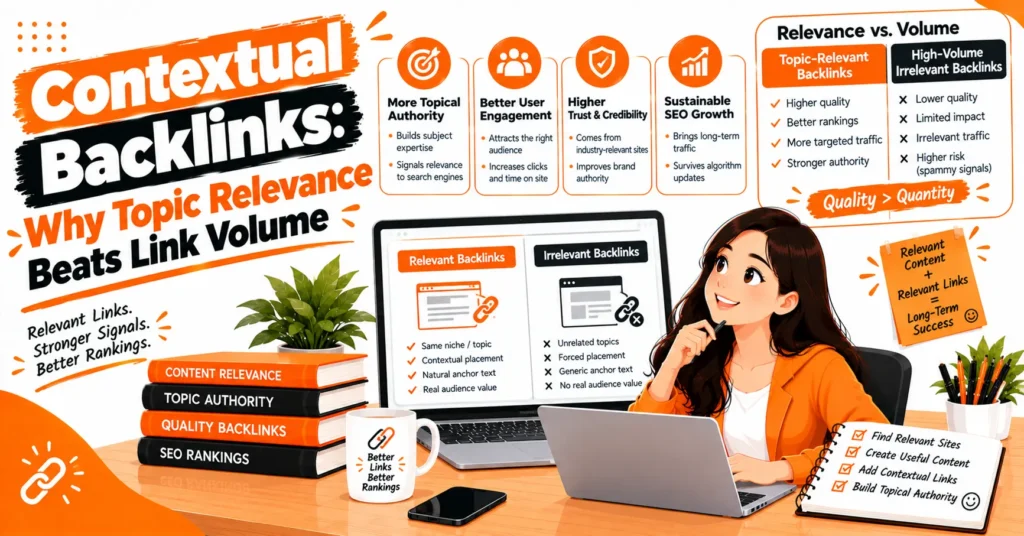
A 2024 State of Link Building survey of 113 SEO professionals found that 84.6% used relevance to assess backlink quality. This finding describes professional practice, not proof that one relevant link always outweighs a larger number of other links.
The practical lesson is that a link count cannot explain why a placement matters. A contextual backlink, meaning a link from another website placed within relevant content, should connect a reader’s question with a useful answer. That connection deserves attention before volume becomes your campaign’s main goal.
A Contextual Link Answers the Reader’s Next Question
A link can appear inside an article without fitting its subject. The surrounding paragraph may contain a passing keyword, but the destination may offer nothing that supports the discussion. This creates a contextual placement in appearance rather than a useful reference.
Imagine a food-packaging supplier receiving a link from an article about restaurant deliveries. The article discusses choosing containers, and the link leads to a guide explaining sizes and closure types. The reader has a clear reason to follow it.
Now imagine the same supplier appearing in an unrelated article about personal productivity. A sentence mentions lunch breaks and inserts a packaging link. The loose word association does not explain how the destination helps the reader.
Your assessment can start with a simple question: What would someone expect to learn after following this link? The surrounding sentence and destination page should support the same answer.
This test works because it checks the link’s purpose rather than its position. A link buried within relevant prose is not automatically useful, and a reference outside the main article can still serve a legitimate need.
Anchor text is the clickable wording of a link. Descriptive wording helps readers predict the destination. “Container size guide” gives clearer information than a repeated sales phrase that lists several product keywords.
Search engines can use links to discover pages and understand relevance. However, a useful connection does not guarantee ranking improvement. Your review should identify why the reference belongs before making assumptions about its search value.
Relevant Links Connect Content with Business Results
A link campaign can meet its numerical target while attracting the wrong visitors. Reports may show new placements, but the business receives few inquiries related to its services. The missing step is often a clear connection between the publication’s audience and the destination page.
For the packaging supplier, a restaurant operations article could reach people comparing delivery containers. A general giveaway page might attract visitors interested only in a free sample. Both could generate clicks, but those clicks represent different needs.
A shared brief with a performance-oriented SEO agency can define success through relevant readership, useful destination pages, and measurable customer actions. This gives the campaign a clearer purpose than collecting placements without considering who might use them.
Your brief can identify the reader, the question, and the next useful action. A restaurant manager comparing container dimensions might need a sizing guide first. A manager who already knows the specification may prefer a product page or a request for samples.
The best destination is therefore not always your homepage or your highest-value sales page. It is the page that fulfills the expectation created by the reference. A useful guide can then provide a clear route to related products.
This approach works because the visit continues the original discussion. Readers do not need to start their research again after arriving on your website.
The destination also needs to deliver what the source promises. If a reference describes a comparison guide, the page should explain the comparison criteria. A thin page containing only a sales form breaks that connection.
Business value remains separate from ranking value. A relevant reference can help someone discover your service even when its effect on search positions is unknown. Your reporting should preserve that distinction rather than claim that every useful visit proves a ranking benefit.
Page Context Matters More Than a Sitewide Label
A website’s broad category can mislead a quick placement review. A general-interest publication may contain a detailed article that fits your expertise. A narrowly focused website may publish shallow pages filled with unrelated commercial references.
For example, a business publication might explain the practical costs of takeaway operations. That article could legitimately cite a packaging specification guide. The website does not need to cover packaging exclusively for the reference to make sense.
A specialist food website could offer a weaker placement if its article contains disconnected paragraphs and no clear editorial purpose. A matching category label cannot repair poor content.
Two Placements with Different Reasons to Exist
In one hypothetical placement, a restaurant article explains how container dimensions affect packing decisions. It references the supplier’s guide at the point where readers need measurements.
In another, a short food article lists several products and adds links without explaining their differences. The supplier receives a mention, but the page gives readers little reason to explore it.
The first placement provides a stronger editorial explanation. That does not prove it will produce better rankings, but it gives your team a defensible reason to prioritize it.
Your review can examine the article’s main purpose, the surrounding passage, and the destination together. Nearby outbound links also provide context. Several useful references can support an article, while repeated unexplained commercial insertions may suggest a different purpose.
Relevance Does Not Replace Credibility
A relevant article still needs reliable information. If a packaging page makes unsupported claims about food safety or environmental performance, a topic match does not make it a good source.
The same caution applies to health, financial, and other sensitive subjects. Your team should consider whether the publisher checks important claims and identifies the people responsible for the content.
Third-party authority and traffic scores can provide background, but they remain estimates. They cannot establish editorial credibility or explain a particular placement’s purpose. A documented page review gives you more useful evidence than accepting or rejecting a website through one score.
Editorial Choice Separates Recommendations from Link Schemes
Topic relevance can make a manipulated link look natural. An article may discuss the correct subject and use smooth wording, yet the placement may exist mainly because someone paid for ranking credit. The content’s relevance does not resolve that relationship.
Suppose a writer discovers the packaging guide and references it because the measurements support an article. That is different from an arrangement requiring the writer to insert a specific sales phrase and preserve an unqualified link.
Your campaign should distinguish independent editorial references from advertising. The distinction helps you evaluate the placement honestly and choose the right expectations.
For an editorial contribution, the publisher should retain control over whether a link belongs and how the reference reads. Your team can offer accurate information and a useful resource without requiring a particular anchor phrase.
This works because the writer can match the reference to the reader’s need. Forced wording often interrupts the sentence and creates repeated patterns across otherwise unrelated articles.
A paid placement can still serve a legitimate advertising purpose. Paid links should use an appropriate qualification, such as rel=”sponsored” or rel=”nofollow”, under search-engine guidance. These HTML attributes describe the link relationship and help prevent advertising links from functioning as ordinary ranking endorsements.
Reader-facing disclosure has a separate role. It explains the commercial relationship to people. Link qualification and disclosure should not be treated as interchangeable.
The same care applies to existing articles. An editor may add a source because it improves the explanation. Purchasing an insertion solely to pass ranking credit creates a different arrangement, even if the paragraph reads naturally.
Your review should consider the purpose of the exchange, not just the page’s topic. Excessive reciprocal linking, automated placements, and repeated keyword-heavy references can undermine a campaign that appears relevant on the surface.
A Useful Link Report Goes Beyond Totals
Link totals can grow without representing more independent recommendations. One website may place a link in a template that appears across many pages. A report can count each appearance even though the references come from one publisher.
For example, a supplier might receive repeated footer links from a partner website and one detailed reference from a restaurant publication. The raw total makes the footer placements look larger. It does not describe the different reader value.
Your report can separate individual placements from referring websites. A referring website is a site containing at least one backlink to yours. This distinction explains whether growth comes from new publishers or repeated appearances on existing ones.
The report can also retain a short note for each important placement:
- The reader question that the reference supports.
- The destination page and its purpose.
- The editorial or advertising relationship.
- The date the live placement was checked.
These notes make quality review repeatable. They also prevent a placement from remaining marked as useful after the article or destination changes.
Referral visits show arrivals through another website. Relevant inquiries can indicate whether those visitors had needs your business could meet. Neither measure reveals the link’s isolated effect on rankings, but both help assess practical value.
When results disappoint, the next review can examine audience fit, the surrounding explanation, and the destination experience. A broken page or unclear next step may prevent a suitable reference from helping visitors.
A volume target can help plan workload, but it should sit beneath quality criteria. Topic relevance earns its priority because it gives readers a reason to follow a link and gives your team a reason to pursue it. More placements cannot replace that purpose.

James Robert
James Robert is a seasoned Off-Page SEO expert specializing in strategic link building, digital outreach, and authority growth for businesses aiming to improve search visibility and rankings. With over five years of hands-on experience, he helps brands strengthen their online presence through high-quality backlinks, niche-relevant placements, and ethical SEO practices aligned with Google’s guidelines. James’s core specialties include guest posting, blogger outreach, niche edits, brand mentions, and backlink profile optimization. He is highly skilled at building relationships with authoritative publishers and executing scalable outreach campaigns that drive long-term organic growth. As a contributor to leading marketing platforms, James regularly shares actionable insights on off-page SEO strategies, link acquisition, and sustainable ranking improvements, helping businesses achieve consistent and measurable SEO success.