
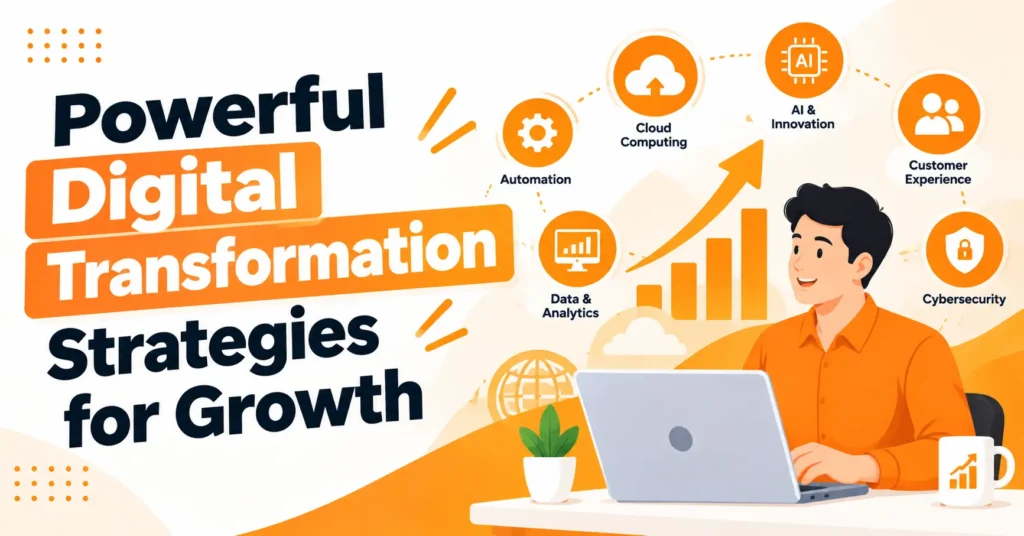
Businesses today need more than traditional methods to stay competitive, serve customers, and improve efficiency. Digital transformation strategies provide a structured approach to using technology while improving processes, employee capabilities, and business decisions.
From artificial intelligence and cloud computing to automation and data analytics, digital tools can help organizations respond faster to changing market demands. However, successful transformation is not simply about adopting new technology.
It requires clear goals, strong leadership, employee adoption, secure systems, and continuous improvement. A well-planned digital transformation roadmap helps businesses prioritize initiatives, manage change, measure results, and create lasting value.
Understanding these essential elements can make digital transformation more practical, measurable, and aligned with long-term business growth.
What Is Digital Transformation?
Digital transformation is the process of using digital technologies to fundamentally improve how an organization operates and creates value.
It can involve cloud computing, artificial intelligence, automation, data analytics, connected devices, digital platforms, and modern enterprise software.
However, technology is only one part of the transformation. Successful organizations also redesign inefficient processes, develop employee skills, improve data management, and establish a culture that supports continuous innovation.
Why Is Digital Transformation Important?
Customer expectations have changed dramatically. People increasingly expect fast communication, personalized services, convenient digital experiences, and immediate access to information.
Businesses also need to respond faster to competitors, economic changes, new regulations, and emerging technologies. Modern digital capabilities can improve operational efficiency while helping organizations identify opportunities that traditional processes may miss.
A strong transformation program can support revenue growth, reduce repetitive work, improve customer satisfaction, strengthen decision-making, and create more flexible operations.
Digitization vs. Digitalization vs. Digital Transformation
These three concepts are related but not identical. Digitization means converting physical information into a digital format, such as turning paper records into electronic documents.
Digitalization uses digital technology to improve an existing process. For example, replacing manual approvals with an automated workflow is digitalization.
Digital transformation is broader. It can change the processes, operating model, customer experience, organizational structure, products, services, and business strategy itself.
Understanding this distinction helps organizations avoid confusing technology adoption with genuine transformation.
The Four Core Pillars of Digital Transformation
The strongest digital transformation strategies bring together four connected pillars: people, processes, technology, and data. Treating transformation as a technology-only project can create expensive systems without achieving meaningful business change.
People and Digital Culture
Employees are responsible for adopting new processes and technologies. Without employee support, even technically successful projects can struggle to deliver their expected value.
Organizations should provide relevant training, communicate the purpose of transformation, involve employees in implementation, and give teams opportunities to develop new digital skills.
Processes and Operations
Transformation creates an opportunity to examine how work actually gets done. Manual approvals, duplicate data entry, disconnected applications, and unnecessary steps can slow down operations.
Process optimization should come before automation. Automating a poor process may simply make an inefficient workflow run faster.
Technology and Infrastructure
Technology provides the infrastructure required for modern operations. Cloud platforms, artificial intelligence, automation, APIs, CRM systems, ERP platforms, collaboration tools, and digital applications can support different transformation objectives.
Technology selection should always be connected to a specific business requirement. The newest solution is not automatically the right solution.
Data and Analytics
Data allows organizations to understand customers, monitor operations, forecast demand, identify problems, and measure results.
A data-driven transformation requires more than collecting information. Organizations also need data governance, integration, quality controls, security, and analytics capabilities that turn information into useful business decisions.
12 Digital Transformation Strategies for Modern Businesses
1. Align Technology With Business Goals
The first strategy is to define what the organization wants to accomplish. Technology should support measurable objectives rather than becoming the objective itself.
Businesses may focus on improving productivity, reducing costs, increasing revenue, improving customer satisfaction, accelerating product development, or creating new digital services.
2. Assess Digital Maturity
A digital maturity assessment establishes a realistic starting point. Organizations should examine their existing technology, processes, data, employee capabilities, customer experience, cybersecurity, and leadership readiness.
The assessment can reveal capability gaps and help decision-makers prioritize initiatives according to business impact rather than assumptions.
3. Create a Customer-Centered Strategy
Customers should remain central to transformation planning. Organizations can examine every stage of the customer journey to identify friction, delays, unnecessary steps, and opportunities for personalization.
CRM systems, digital self-service, analytics, omnichannel communication, and automation can improve customer interactions when they are designed around genuine customer needs.
4. Modernize Legacy Systems
Legacy applications can create security issues, data silos, integration problems, and operational inefficiencies. Replacing everything simultaneously, however, may introduce significant cost and disruption.
A phased modernization strategy can focus first on systems with the greatest business impact. APIs, integration platforms, cloud migration, and modular architecture can help organizations modernize progressively.
5. Adopt Cloud Computing
Cloud technology can provide scalable infrastructure, flexible resources, remote accessibility, and faster deployment. It can also make it easier to integrate modern digital services.
Cloud migration still requires careful planning. Security, compliance, application dependencies, data governance, performance, and long-term costs should be considered before moving workloads.
6. Apply Artificial Intelligence and Automation
Artificial intelligence can support forecasting, customer service, personalization, fraud detection, content analysis, decision support, and intelligent automation.
Automation is particularly valuable for repetitive, rules-based activities. Organizations should identify processes where automation can produce measurable improvements instead of implementing AI simply because it is a current trend.
7. Build a Data-Driven Organization
Data should become part of everyday decision-making. Businesses can use analytics and business intelligence to understand performance, customer behavior, operational bottlenecks, and emerging opportunities.
Creating reliable data pipelines, centralized information environments, governance policies, and accessible dashboards can make data more useful across departments.
8. Strengthen Cybersecurity
Digital expansion can increase the number of systems, users, applications, and connected devices that need protection. Security therefore needs to be incorporated into transformation from the beginning.
Identity management, access controls, encryption, employee awareness, monitoring, vulnerability management, and incident response should form part of the digital operating model.
9. Develop Digital Skills
A technology investment cannot deliver its full value if employees do not have the skills to use it effectively. Skills gaps can slow adoption and increase resistance.
Reskilling and upskilling programs should be connected to actual business needs. Organizations can combine internal training with specialist hiring and external expertise where necessary.
10. Build Agile and Flexible Operations
Traditional organizations may struggle when decisions move slowly through multiple approval layers. Agile approaches can help teams test ideas, gather feedback, and adapt initiatives more quickly.
Small experiments can reduce risk because organizations can validate assumptions before committing substantial resources to large-scale implementation.
11. Integrate Digital Systems
Disconnected software creates data silos and forces employees to move information manually between applications. System integration can create a more connected digital environment.
APIs, integration platforms, shared data environments, and modern architecture can help different systems communicate while improving visibility across the organization.
12. Establish Continuous Improvement
Transformation should not be treated as a project that ends after software deployment. Businesses need to monitor performance, review customer feedback, analyze KPIs, and continuously improve their digital capabilities.
Regular optimization allows organizations to adapt as technology, markets, customer expectations, and business priorities change.
How to Build a Digital Transformation Strategy?
Building an effective transformation plan starts with understanding the current state. Leaders should examine business processes, technology infrastructure, organizational capabilities, customer experiences, data, and existing digital initiatives.
The next step is to define measurable objectives and identify opportunities. Each proposed initiative should have a clear business case, owner, expected outcome, estimated resources, and measurement framework.
Prioritization is essential because attempting too many initiatives simultaneously can spread resources too thin. High-impact, achievable projects can provide early evidence of value while larger transformation programs develop.
A Practical Digital Transformation Roadmap
A transformation roadmap turns strategic goals into manageable stages. It should show what needs to happen, who owns each initiative, what resources are required, and how success will be measured.
| Stage | Purpose | Key Focus | Example Measurement |
| Assessment | Understand the current state | Maturity and capability review | Digital maturity |
| Strategy | Define direction | Goals and priorities | Goal alignment |
| Prioritization | Select initiatives | Impact, cost, risk | Business case |
| Pilot | Test solutions | Small-scale implementation | Adoption |
| Implementation | Deploy at scale | Technology and processes | Efficiency |
| Measurement | Evaluate outcomes | KPIs and ROI | Business impact |
| Optimization | Improve performance | Continuous improvement | KPI growth |
A roadmap should remain flexible. New information from pilots, customers, employees, and performance data may require priorities to change.
How to Choose the Right Digital Technologies?
Choosing technology begins with the problem rather than the product. Organizations should first identify the process or customer challenge they want to solve.
For example, slow customer support may require CRM improvements and AI-assisted service, while fragmented operational information may require system integration and better data architecture.
Technology decisions should consider scalability, security, integration, usability, implementation complexity, employee adoption, vendor support, and total cost of ownership.
Digital Transformation Technologies
Modern transformation programs can combine several technologies. Cloud computing provides flexible infrastructure, while artificial intelligence can support prediction, automation, and decision-making.
Data analytics helps organizations identify patterns and performance trends. IoT can connect physical assets, while APIs and integration technologies help different applications exchange information.
ERP and CRM systems can modernize core operations and customer management. Cybersecurity technologies protect these connected environments and help organizations manage digital risk.
The Role of Leadership in Digital Transformation
Leadership alignment is one of the most important factors in transformation. Executives need to communicate why change is necessary and connect individual initiatives to broader business objectives.
Transformation also requires clear ownership. Teams should understand who makes decisions, who manages implementation, who measures performance, and who is responsible for resolving obstacles.
When leadership treats transformation as an organization-wide priority rather than an isolated IT project, different departments are more likely to work toward shared objectives.
Change Management and Employee Adoption
One of the biggest challenges in transformation is resistance to change. Employees may worry about new responsibilities, unfamiliar software, changing workflows, or job security.
Change management should therefore begin before implementation. Clear communication, training, employee participation, leadership support, and feedback channels can make adoption easier.
Employees should understand not only what is changing but also why the change matters and how it can improve their work.
Measuring Digital Transformation Success
The success of digital transformation strategies should be measured through business outcomes rather than technology deployment alone.
Useful KPIs can include operational costs, process completion time, customer satisfaction, employee productivity, digital adoption, revenue growth, automation rates, system availability, retention, and return on investment.
The right metrics depend on the transformation objective. A customer experience initiative may focus on satisfaction and retention, while an automation project may focus on processing time, error reduction, and cost savings.
Digital Transformation Challenges
Organizations can face several obstacles during transformation. Legacy systems may limit integration, while poor data quality can weaken analytics and decision-making.
Other challenges include limited budgets, unclear objectives, skills shortages, cybersecurity risks, employee resistance, weak leadership alignment, unrealistic timelines, and difficulty measuring return on investment.
Recognizing these issues early allows businesses to build mitigation plans rather than discovering major obstacles after implementation has begun.
How to Overcome Digital Transformation Challenges?
A practical approach is to divide complex transformation programs into smaller initiatives. Each initiative should have a clear objective, owner, timeline, budget, risk assessment, and measurement framework.
Organizations should also create feedback loops. Regular reviews can reveal whether an initiative is delivering expected results and whether resources should be adjusted.
Training, communication, leadership sponsorship, and employee involvement are particularly important when transformation changes established workflows.
Digital Transformation for Small Businesses
Small businesses do not need to replicate the technology environment of large enterprises. They can begin with practical solutions that address immediate operational problems.
Cloud software, digital payments, CRM automation, analytics dashboards, online customer service, workflow automation, and collaboration tools can provide useful starting points.
The focus should remain on business value. A simple automation that saves employees several hours each week may provide more value than an expensive platform with features the business does not need.
Digital Transformation for Enterprises
Enterprise transformation is usually more complex because large organizations often operate across multiple departments, locations, applications, and business units.
A successful enterprise program may require cloud migration, legacy modernization, data integration, cybersecurity, process redesign, employee reskilling, governance, and change management.
Phased implementation can reduce disruption while allowing leadership to evaluate results before expanding transformation initiatives across the organization.
Digital Transformation Examples
A retailer might use customer analytics and AI-powered recommendations to personalize online shopping experiences. A manufacturer could combine IoT sensors with predictive maintenance to identify equipment problems before failures occur.
A professional services company might automate administrative workflows and introduce a centralized CRM system. A financial organization could modernize customer onboarding through digital identity verification and automated document processing.
These examples demonstrate an important principle: the technology varies according to the business problem.
How to Calculate Digital Transformation ROI?
Return on investment should connect transformation spending with measurable financial or operational outcomes. Businesses can compare implementation and ongoing costs against savings, additional revenue, productivity improvements, or other measurable benefits.
Not every benefit will immediately appear as direct revenue. Faster processes, improved customer retention, reduced errors, stronger compliance, and improved employee productivity can also contribute to long-term business value.
A clear business case should therefore include both financial and operational metrics.
What Makes a Digital Transformation Strategy Successful?
Effective digital transformation strategies share several characteristics. They begin with business needs, use technology purposefully, involve employees, establish measurable objectives, and provide leadership ownership.
They also remain flexible. Transformation is an ongoing journey, so organizations need to learn from implementation, respond to changing customer expectations, and continuously improve their digital capabilities.
Frequently Asked Questions
What are digital transformation strategies?
Digital transformation strategies are structured plans for using digital technology, redesigned processes, data, and organizational capabilities to improve business performance and create better customer and employee experiences.
What are the four pillars of digital transformation?
The four commonly used pillars are people, processes, technology, and data. Together, they provide the organizational and technical foundation needed for sustainable transformation.
How do you create a digital transformation strategy?
Begin by assessing digital maturity and identifying business problems. Define measurable objectives, prioritize initiatives, select suitable technologies, create a roadmap, pilot important projects, measure outcomes, and scale successful solutions.
What technologies are used in digital transformation?
Common technologies include artificial intelligence, cloud computing, automation, data analytics, IoT, CRM, ERP, APIs, cybersecurity platforms, collaboration software, and digital experience technologies.
What are the biggest digital transformation challenges?
Common challenges include resistance to change, legacy systems, skills shortages, limited resources, cybersecurity risks, data silos, poor integration, unclear objectives, and weak leadership alignment.
How can businesses measure digital transformation?
Businesses can use KPIs such as productivity, operating costs, customer satisfaction, digital adoption, process completion time, automation rates, revenue growth, system performance, retention, and ROI.
How long does digital transformation take?
There is no standard timeline. A focused process improvement may take weeks or months, while a large organization-wide transformation can take several years. Scope, complexity, resources, technology, and organizational readiness all affect the timeline.
Is digital transformation only for large companies?
No. Small and medium-sized businesses can also benefit from digital transformation. They can begin with affordable cloud applications, automation, analytics, digital customer service, CRM, and other solutions that address specific business needs.
Conclusion
The most effective digital transformation strategies connect business objectives with people, processes, data, and technology. By assessing digital maturity, prioritizing high-value initiatives, managing organizational change, selecting suitable technologies, and measuring meaningful outcomes, businesses can create a transformation roadmap that delivers sustainable efficiency, stronger customer experiences, and long-term digital growth.

James Robert
James Robert is a seasoned Off-Page SEO expert specializing in strategic link building, digital outreach, and authority growth for businesses aiming to improve search visibility and rankings. With over five years of hands-on experience, he helps brands strengthen their online presence through high-quality backlinks, niche-relevant placements, and ethical SEO practices aligned with Google’s guidelines. James’s core specialties include guest posting, blogger outreach, niche edits, brand mentions, and backlink profile optimization. He is highly skilled at building relationships with authoritative publishers and executing scalable outreach campaigns that drive long-term organic growth. As a contributor to leading marketing platforms, James regularly shares actionable insights on off-page SEO strategies, link acquisition, and sustainable ranking improvements, helping businesses achieve consistent and measurable SEO success.