
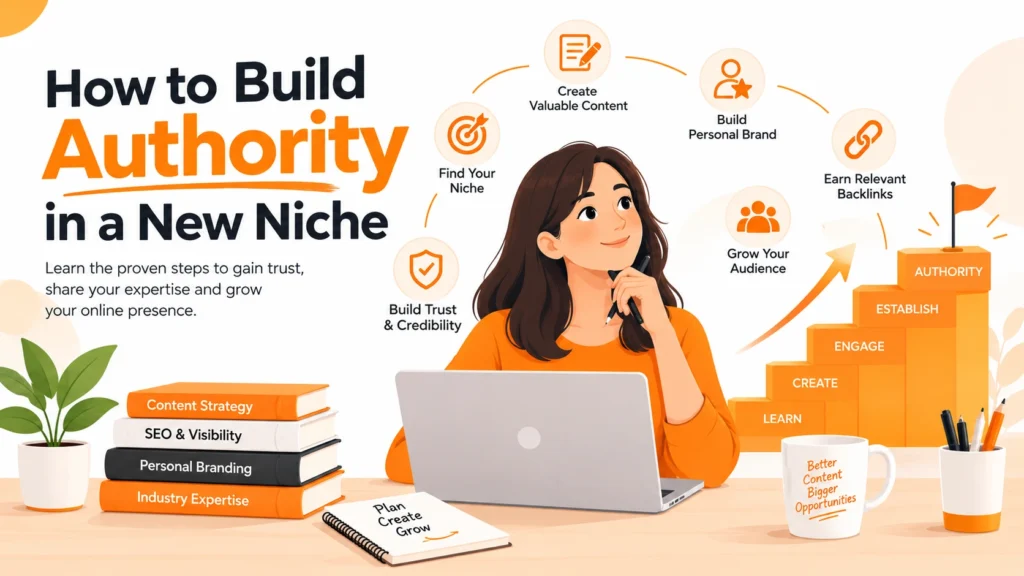
Building a reputation in an unfamiliar industry takes time, consistency, and a clear strategy. Understanding how to build authority in a new niche starts with identifying your target audience, learning its challenges, and creating valuable content that solves real problems.
Even without years of experience, you can establish credibility by researching reliable sources, sharing practical insights, and demonstrating your knowledge through real-world examples.
A strong content marketing strategy, effective personal branding, and genuine industry relationships can help you earn trust and stand out from competitors.
By developing topical authority, publishing helpful resources, and earning relevant backlinks, you can strengthen your online presence, attract organic traffic, and build lasting recognition.
What Is Niche Authority?
Niche authority is the reputation you develop by consistently demonstrating useful knowledge, reliable judgment, and a clear understanding of a particular subject. An authoritative professional helps people solve problems, while an authoritative website provides relevant, trustworthy information across related topics.
Niche authority overlaps with topical authority, industry expertise, and thought leadership, but each concept has a different emphasis. Topical authority relates to a website’s depth and relevance in covering a subject. Personal authority comes from the knowledge, experience, and credibility associated with an individual or brand. Both can contribute to a stronger digital presence, although neither automatically guarantees higher search rankings.
Why Is Building Authority Important?
People are more likely to engage with a business or creator when they believe the information provided is useful and trustworthy. A recognizable reputation can support customer confidence, professional relationships, referral traffic, and long-term audience growth.
From an SEO perspective, comprehensive content, clear internal linking, and relevant external recognition can help search engines discover and understand your resources. More importantly, a strong reputation encourages people to return, share your work, and recommend your expertise when others need reliable information.
1. Choose a Specific Niche You Can Develop Expertise In
The first step in learning how to build authority in a new niche is choosing a subject that offers meaningful opportunities to help a defined audience. Competing in a broad market can be difficult when established businesses already have extensive resources and recognition. Specializing in a smaller area gives you a clearer direction and helps distinguish your expertise.
For example, instead of covering all of digital marketing, you might focus on link building for small businesses, content strategy for local companies, or SEO for independent online stores. Evaluate your interests, current skills, audience demand, competition, and ability to create useful resources before choosing your specialization.
How to Find the Right Sub-Niche?
Start by identifying the people you want to serve and the problems they need to solve. Research their frequently asked questions, common frustrations, purchasing decisions, and knowledge gaps. Then examine whether you can provide information, practical guidance, or services that address those needs more effectively.
A useful niche sits at the intersection of audience demand, your ability to develop expertise, and a clear opportunity to provide value. You do not need to select a subject with no competition. You need a specific angle that allows you to serve your audience with greater relevance and depth.
2. Build Expertise Even If You Are Starting From Zero
You can begin building credibility without years of experience, but you should never pretend to possess knowledge or qualifications you do not have. Develop your understanding through reputable research, structured learning, practical exercises, and conversations with knowledgeable professionals.
Apply what you learn through small projects and document the process. Explain what you tested, what worked, what failed, and what you would change next time. This approach allows you to demonstrate growing competence while giving readers something more valuable than generic advice.
Develop Your Own Point of View
Expertise is not simply repeating information that already exists. As your knowledge grows, compare different approaches, identify recurring mistakes, and explain why particular methods work in specific situations.
Support your conclusions with evidence and acknowledge uncertainty when appropriate. An original, well-supported perspective helps your content stand out and gives readers a reason to remember your work.
3. Understand Your Audience Before Creating Content
Authority grows when your work consistently addresses the problems your audience actually faces. Before planning articles or social media posts, research what people want to learn, which challenges prevent them from making progress, and what information they struggle to find.
Use keyword research, search suggestions, customer conversations, industry communities, and relevant discussions to identify these needs. Pay attention to search intent: someone looking for a definition needs a different answer from someone comparing solutions or following a step-by-step tutorial.
Identify Content Gaps and Search Opportunities
Analyze the subjects already covered in your niche and look for missing explanations, outdated recommendations, weak examples, or unanswered questions. These gaps can help you prioritize content that delivers a distinct benefit.
Target relevant long-tail keywords when they reflect specific audience needs. Instead of producing another broad article about SEO, for example, you could explain how a new business can evaluate link-building opportunities without a large budget. Specific, useful answers can attract the right audience and establish a clearer area of specialization.
4. Build a Content Strategy That Demonstrates Topical Authority
A deliberate content strategy helps you cover a subject comprehensively without publishing disconnected articles. Start with a central pillar page that explains a major topic, then create supporting articles addressing important subtopics, practical questions, common mistakes, and advanced considerations.
For a website focused on SEO, the central topic might cover search engine optimization, with supporting content about keyword research, technical SEO, content optimization, internal linking, and link building. Connect these pages through relevant internal links so readers can move naturally between related resources.
Publish Content That Provides Genuine Value
Different content formats serve different purposes. Detailed guides teach processes, tutorials demonstrate specific tasks, comparisons help readers evaluate alternatives, and case studies show how strategies work in practice. Original research, expert interviews, and practical templates can provide additional value when they suit your resources and audience.
Prioritize accuracy, clarity, and usefulness over article length alone. Support important claims with credible sources, explain unfamiliar concepts, and include examples that help readers apply the advice. Review existing content regularly and update it when the information becomes outdated or new evidence changes the recommended approach.
5. Optimize Your Website for Semantic SEO
Semantic SEO involves organizing and explaining content so its meaning, relationships, and relevance are clear to readers and search engines. Using related terms naturally can improve topical coverage, but repeating keywords without adding information does not make an article more authoritative.
Include relevant concepts such as niche authority, topical authority, industry expertise, content marketing, personal branding, audience trust, and organic search visibility where they genuinely fit. Write descriptive titles and headings, use concise URLs, and provide a useful meta description that accurately summarizes the page.
Strengthen Internal Linking and Website Structure
Organize related resources into logical categories and link between pages whenever doing so helps readers. Use descriptive anchor text that tells people what they can expect from the destination page.
Make sure important content is accessible through crawlable links and that your site does not contain unnecessary navigation barriers. A clear structure supports content discovery and helps visitors understand how individual articles contribute to your broader expertise.
6. Establish a Consistent Personal Brand
Your personal brand helps people understand who you are, which audience you serve, and what makes your perspective useful. Develop a clear value proposition and maintain consistent messaging across your website, professional profiles, and other relevant platforms.
Create an accurate author biography that describes your background, areas of focus, and relevant experience. If you are new to the industry, be transparent about your learning process and demonstrate your knowledge through the quality of your work rather than unsupported claims.
Become Recognizable for a Specific Subject
Publish thoughtful insights, explain industry developments, and share lessons from projects or research. Focus on subjects closely related to your specialization instead of attempting to comment on every trend.
Over time, this consistency can help people associate your name with a particular problem or area of expertise. A recognizable identity also makes it easier for potential collaborators, customers, and publishers to understand when your contributions may be valuable.
7. Build Trust With Evidence, Case Studies, and Social Proof
Trust is central to long-term authority. Readers need reasons to believe your recommendations are accurate, relevant, and responsibly presented. Support important claims with reliable evidence, explain your methodology when necessary, and distinguish verified results from personal opinions or assumptions.
As you gain experience, publish genuine case studies that describe the challenge, process, results, and lessons learned. With appropriate permission, include authentic testimonials and customer feedback. If you are still developing your portfolio, demonstrate your skills through sample projects, transparent experiments, and carefully documented research rather than inventing results.
8. Earn Relevant Backlinks and Industry Recognition
Relevant backlinks can help search engines discover your content and may contribute to its visibility in search results. They can also introduce your work to new audiences. However, the strongest long-term approach is to earn links and mentions through useful contributions, credible information, and genuine professional relationships.
Develop resources worth referencing, such as original research, practical tools, detailed guides, or useful industry analysis. Connect with relevant publishers and professionals, offer informed commentary, and contribute guest articles when you have something valuable to share with their audience.
Avoid Manipulative Link-Building Tactics
Do not rely on paid links intended to manipulate rankings, automated link schemes, or irrelevant link exchanges. These tactics can create risk without building a genuine reputation.
Focus on relevance, editorial quality, and the value of the relationship. A meaningful mention from a respected source in your field can be more useful for reaching the right audience than numerous unrelated links.
9. Grow Your Audience Through Consistent Content Promotion
Publishing excellent content does not guarantee that people will discover it. Create a distribution strategy that reaches your intended audience through relevant communities, email newsletters, professional networks, and suitable social platforms.
Repurpose substantial articles into short tutorials, explanatory videos, newsletter editions, or educational posts. Adapt the message to each format rather than sharing identical promotional messages everywhere. Participate in conversations by answering questions and providing useful information before promoting your own resources.
Build Relationships Beyond Social Media Followers
An engaged audience is more valuable than a large but disconnected following. Encourage meaningful discussions, respond to relevant feedback, and create opportunities for readers to continue learning through newsletters or other direct channels.
As relationships develop, people may return to your resources, recommend your work, and introduce you to potential collaborators. These outcomes help strengthen your professional reputation independently of any single social platform.
10. Measure Progress and Refine Your Strategy
Building authority is a long-term process, so evaluate progress using several meaningful indicators. Google Search Console can show which queries generate impressions and clicks, while analytics tools can help you understand engagement, returning visitors, and conversions.
Monitor relevant referring domains, industry mentions, qualified inquiries, and the performance of your most important content. No single third-party authority score accurately represents your complete reputation or guarantees search rankings.
Use the data to make practical improvements. If a page receives impressions but few clicks, review its title and search-result description. If visitors cannot find the information they need, improve its structure, examples, or topical coverage. Update content when there is a genuine reason to improve its accuracy or usefulness.
A 90-Day Roadmap to Build Authority in a New Niche
A structured roadmap turns your strategy into manageable work. During the first 30 days, select your niche, research your audience, analyze search intent, define your positioning, and map your initial content clusters. Establish your website or professional profile and identify the most important questions your first resources should answer.
During days 31–60, publish your core content, create supporting articles, improve internal linking, and begin sharing your resources with relevant communities. During days 61–90, build industry relationships, seek appropriate editorial opportunities, review search performance, and improve pages based on available evidence. Treat this schedule as a starting framework rather than a promise of rankings within three months.
Common Mistakes That Prevent Authority Building
One of the biggest mistakes is choosing an overly broad niche and publishing shallow content on too many unrelated subjects. Another is copying existing advice without adding practical examples, original analysis, or a useful perspective. These approaches make it harder for readers to understand why your work deserves attention.
Avoid keyword stuffing, fabricated expertise, manipulative backlinks, and the assumption that publishing more articles automatically creates authority. Focus instead on useful information, consistent specialization, trustworthy evidence, and continuous learning. Sustainable progress comes from making your resources more valuable, not simply increasing their quantity.
Frequently Asked Questions
There is no universal timeline. You may begin earning recognition within months by consistently contributing useful information and building relationships, but developing substantial expertise, audience trust, and organic search visibility can take much longer. Results depend on competition, your experience, content quality, and available resources.
Yes. Start by learning from reliable sources, practicing relevant skills, and documenting what you discover. Be transparent about your current knowledge and avoid claiming qualifications you do not possess. As you gain practical experience, strengthen your content with original examples and verified results.
Niche authority refers broadly to credibility and recognition within a specialized market or subject. Topical authority usually describes a website’s depth and relevance in covering a particular topic. The concepts overlap, but neither guarantees high search rankings.
There is no fixed number of articles required. The appropriate amount depends on the complexity of the topic and the questions your audience needs answered. A focused collection of comprehensive, well-connected resources can be more useful than dozens of repetitive posts.
Relevant, editorially earned backlinks can support content discovery, referral traffic, and SEO visibility. However, links alone do not prove expertise or guarantee rankings. Combine ethical link earning with helpful content, strong site architecture, and genuine industry participation.
Evaluate organic impressions and clicks, relevant referring domains, industry mentions, audience engagement, repeat visits, and qualified leads. Use these indicators together to understand progress instead of relying on a single authority score.
Conclusion
Building authority requires focused expertise, helpful content, a recognizable identity, and genuine relationships. Choose a specific audience, solve its problems, demonstrate your knowledge with credible evidence, and improve your strategy using real performance data. Understanding how to build authority in a new niche gives you a practical foundation for earning trust, growing your online reputation, and developing sustainable organic visibility over time.

James Robert
James Robert is a seasoned Off-Page SEO expert specializing in strategic link building, digital outreach, and authority growth for businesses aiming to improve search visibility and rankings. With over five years of hands-on experience, he helps brands strengthen their online presence through high-quality backlinks, niche-relevant placements, and ethical SEO practices aligned with Google’s guidelines. James’s core specialties include guest posting, blogger outreach, niche edits, brand mentions, and backlink profile optimization. He is highly skilled at building relationships with authoritative publishers and executing scalable outreach campaigns that drive long-term organic growth. As a contributor to leading marketing platforms, James regularly shares actionable insights on off-page SEO strategies, link acquisition, and sustainable ranking improvements, helping businesses achieve consistent and measurable SEO success.