
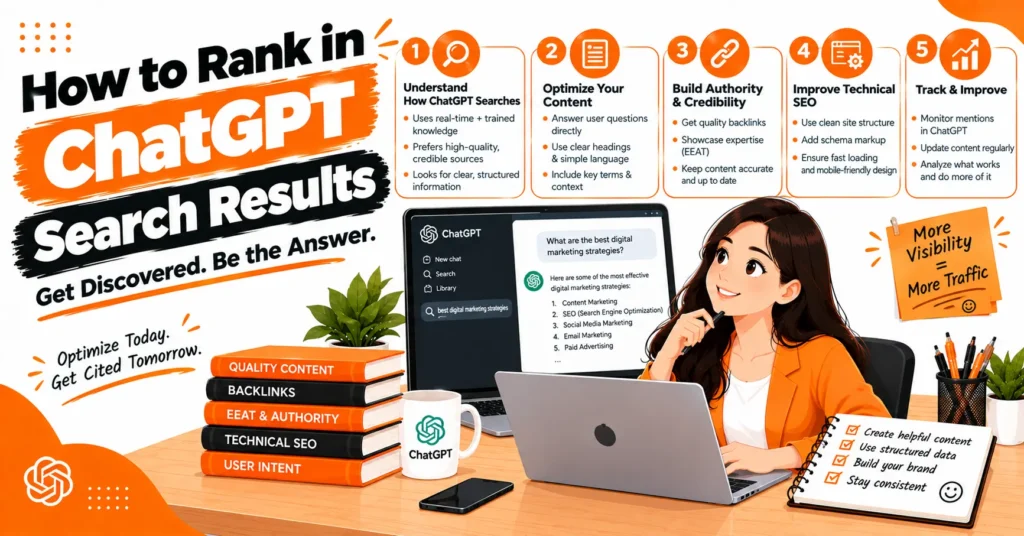
ChatGPT is changing how people search for information, compare products, and discover businesses online. Instead of opening multiple websites, users can ask questions and receive conversational answers supported by relevant web sources.
This shift creates new opportunities for businesses and publishers to reach audiences through AI-powered search.
Learning how to rank in ChatGPT search results requires more than adding AI-related keywords to your website. You need technically accessible pages, helpful content, clear answers, credible information, and a recognizable online presence.
These elements help make your content easier to discover and more useful when an AI-powered search experience looks for relevant information.
Whether you run a business website, manage a blog, or provide SEO services, optimizing for ChatGPT can complement your existing organic search strategy.
This guide explains how to improve crawler access, optimize content, build topical authority, strengthen brand credibility, and measure your AI search visibility without relying on unsupported ranking shortcuts.
What Is ChatGPT Search Optimization?
ChatGPT search optimization is the process of improving a website’s eligibility and usefulness as a source in ChatGPT’s web search experiences. It combines technical SEO, content optimization, semantic relevance, and brand authority to make information easier to discover and understand.
This approach overlaps with Generative Engine Optimization (GEO) and Answer Engine Optimization (AEO). Traditional SEO focuses on organic search visibility, GEO emphasizes visibility in generative AI responses, and AEO focuses on providing clear answers to specific questions.
However, ChatGPT does not use a publicly documented, universal website ranking formula. Your content may appear for one question but not another because relevance, available sources, query wording, and retrieval decisions can differ. The goal is to increase your chances of being discovered and cited, not to guarantee a particular position.
How Does ChatGPT Search Find Websites?
ChatGPT Search can retrieve information from the web to answer questions and provide links to relevant sources. When a user asks about a specific topic, the system may use web search to identify useful pages and incorporate information from those sources into its response.
Website discovery, crawling, indexing, retrieval, and citation are distinct processes. A crawler may access your page without that page necessarily appearing in an answer. Similarly, a technically accessible website still needs relevant, useful information to be considered for a particular query.
OpenAI uses OAI-SearchBot to help surface websites in ChatGPT Search. GPTBot has a separate purpose related to potential model training, while ChatGPT-User can fetch webpages in response to specific user actions. Understanding these distinctions helps website owners configure access correctly.
How to Rank in ChatGPT Search Results With Technical SEO?
Technical SEO creates the foundation for AI search visibility. If important pages are blocked, inaccessible, incorrectly canonicalized, or difficult to retrieve, your content may have fewer opportunities to appear in search experiences.
Start by auditing your most valuable URLs. Check HTTP status codes, canonical tags, robots directives, XML sitemaps, internal links, redirects, and server accessibility. Make sure important public pages return successful responses and do not contain accidental noindex directives.
Next, inspect your robots.txt file and confirm that OAI-SearchBot can access the content you want discovered. If your website uses a content delivery network, firewall, or bot-protection service, check whether legitimate crawler requests are being blocked or challenged.
Technical accessibility does not guarantee a citation, but it removes avoidable barriers that can prevent your pages from being discovered. Recheck the configuration after making changes rather than assuming that publishing an updated robots.txt file resolves every crawling problem.
Allow OAI-SearchBot Through Robots.txt
OAI-SearchBot is the crawler specifically associated with surfacing websites in ChatGPT Search. If your objective is to make public website content eligible for search discovery, review your existing robots.txt directives and avoid unintentionally blocking this user agent.
A basic example of an explicit allow rule is shown below:
User-agent: OAI-SearchBot
Allow: /
This is an illustrative rule, not a complete replacement for your existing robots.txt file. Preserve necessary directives for other crawlers, review conflicting rules, and verify that your server and security configuration permit the crawler to reach the intended pages.
Allowing OAI-SearchBot and allowing GPTBot are separate decisions. You can permit search crawling while restricting GPTBot if that matches your content policies. Also remember that robots.txt controls crawler access; it does not protect confidential information. Use authentication and appropriate access controls for private content.
Create Content That Directly Answers User Questions
Helpful, answer-focused content is one of the most important parts of a sustainable AI search strategy. Your article should resolve the reader’s main question quickly and provide enough context to explain why the answer matters.
Start with a clear introduction that addresses the search intent. Follow it with practical instructions, examples, limitations, and related questions. Avoid vague statements, lengthy introductions, and paragraphs that repeat the same idea without adding useful information.
For example, a guide about ChatGPT SEO should explain how crawler access works, how to improve content clarity, why credible information matters, and how to measure citations. Simply repeating the phrase “AI search optimization” does not answer the reader’s practical questions.
Use descriptive headings, short paragraphs, and natural language. Make each section useful on its own while ensuring the complete article covers the subject comprehensively.
Use NLP and Semantic SEO to Improve Relevance
Semantic SEO helps search systems interpret a page by connecting its main topic with relevant concepts, entities, and supporting information. Instead of forcing one keyword into every section, cover the related subjects that naturally belong in the article.
For a page targeting how to rank in ChatGPT search results, useful concepts include ChatGPT Search, OAI-SearchBot, Generative Engine Optimization, AI search visibility, website crawlability, topical authority, structured data, brand mentions, and referral analytics.
Place these terms where they add context. Discuss crawler access in the technical SEO section, brand credibility in the authority section, and referral traffic in the measurement section. This creates meaningful semantic relationships without sacrificing readability.
LSI is commonly used in SEO to describe related keyword ideas, but it should not be treated as a proven modern ranking technique. You do not need to use every related term. Prioritize comprehensive answers, natural wording, and genuine relevance over keyword density.
Demonstrate Experience, Expertise, and Trustworthiness
Credible content gives readers a reason to trust your recommendations. Demonstrating experience, expertise, authoritativeness, and trustworthiness supports overall content quality, although these qualities should not be presented as a guaranteed ChatGPT ranking formula.
Provide clear authorship, accurate author biographies where appropriate, and reliable evidence for important claims. Explain technical recommendations in enough detail for readers to understand how to apply them safely and effectively.
Original research, firsthand testing, case studies, and practical examples can distinguish your content from generic articles that repeat familiar advice. If you publish performance data, explain the methodology, timeframe, and limitations rather than making unsupported promises.
Keep business information accurate and make your website’s purpose clear. Consistent branding, transparent editorial practices, and useful contact information can strengthen reader confidence while supporting your broader digital presence.
Build Topical Authority With Relevant Content
Topical authority develops when a website consistently publishes useful information around a connected subject. One article may answer a specific question, but a well-organized collection can address the wider needs of readers interested in SEO and AI-powered search.
For example, create supporting articles about technical SEO for AI search, Generative Engine Optimization, ChatGPT citations, semantic content optimization, crawler permissions, and AI referral analytics. Link these pages together with descriptive anchor text that accurately reflects each destination.
Avoid publishing multiple articles that target nearly identical keywords without offering distinct value. Instead, give every page a clear purpose and connect related articles through a logical internal linking structure. This helps readers navigate your resources and gives search systems more context about your site’s content.
Earn Relevant Backlinks and Brand Mentions
Relevant backlinks and editorial mentions can contribute to traditional SEO, referral traffic, and brand discovery. They also help establish your business’s presence in its industry when they come from credible, contextually related sources.
Focus on publishing original research, contributing useful expert insights, developing valuable resources, and building relationships with relevant industry publications. These approaches create stronger reasons for other websites to reference your content.
Avoid buying large volumes of low-quality links or creating artificial brand mentions in an attempt to manipulate AI responses. There is no publicly confirmed formula connecting a specific number of backlinks or mentions to guaranteed ChatGPT citations.
Treat off-page SEO as part of a broader strategy for credibility, organic visibility, and business growth rather than a shortcut to AI search rankings.
Optimize Page Structure and Structured Data
Clear page structure makes content easier to navigate and understand. Use one descriptive H1 heading, logical H2 sections, and H3 headings where additional detail is necessary. Keep headings specific so readers can quickly identify the information each section contains.
Structured data, also called schema markup, provides machine-readable information about a webpage. Depending on the content, relevant schema types may include Article, Organization, and Breadcrumb markup. Ensure the structured data accurately reflects information visible on the page.
Schema markup does not guarantee ChatGPT citations or improved AI search rankings. Avoid adding irrelevant schema types simply to target AI systems. Clear content, accurate metadata, accessible HTML, and useful internal links remain essential.
Also check that important information is not hidden behind unnecessary interaction barriers or rendered in ways that prevent relevant systems from accessing it. For JavaScript-heavy websites, verify that the main content is available in the rendered page.
Improve Website Discoverability and Indexability
Publishing an article is only the first step. Your website needs a clear structure that helps search systems discover important URLs and understand how pages relate to one another.
Maintain an updated XML sitemap, use descriptive URLs, connect relevant articles with internal links, and resolve broken pages or unnecessary redirect chains. Ensure that preferred URLs use appropriate canonical tags and that important pages are not accidentally excluded from indexing.
Search performance tools can help identify technical problems affecting broader discoverability. Review indexing reports, crawl errors, and page accessibility when investigating why a page receives little organic traffic.
These improvements do not guarantee inclusion in ChatGPT answers, but they strengthen your website’s technical foundation and help you identify problems that may limit visibility across search channels.
How to Rank in ChatGPT Search Results: Important Factors
No public checklist guarantees a citation in ChatGPT Search. However, the following comparison summarizes the main areas to address when building a comprehensive AI search optimization strategy.
| Optimization area | What to improve | Main benefit |
| Crawler access | Review OAI-SearchBot permissions | Enables eligible content to be crawled |
| Technical SEO | Fix status codes, canonicals, and crawl errors | Reduces technical barriers |
| Content quality | Answer questions accurately and completely | Improves usefulness and relevance |
| Semantic optimization | Cover related entities and concepts naturally | Clarifies the subject and context |
| Trust and expertise | Provide evidence, authorship, and original insights | Strengthens reader confidence |
| Internal linking | Connect related articles logically | Improves navigation and discovery |
| Structured data | Implement relevant, accurate schema | Adds machine-readable context |
| Brand authority | Earn legitimate editorial mentions and references | Supports credibility and discoverability |
| Measurement | Track citations, referrals, and outcomes | Helps guide ongoing improvements |
These areas work together rather than functioning as independent guarantees. Prioritize technical issues that prevent access, then improve the quality and relevance of your content before expanding into more advanced optimization efforts.
Does Traditional SEO Help With ChatGPT Search?
Traditional SEO remains a valuable foundation for AI search visibility. Both search engines and AI-powered search experiences benefit from accessible webpages, relevant information, clear organization, and useful content.
Keyword research helps identify user questions, technical SEO supports discovery, and internal links help organize related information. Credible references, original insights, and relevant backlinks can also contribute to a stronger overall online presence.
However, ranking well in Google does not guarantee that a page will be cited in ChatGPT. Likewise, appearing in an AI-generated response does not automatically improve conventional search rankings. These channels overlap, but their outcomes should be evaluated separately.
The best approach is to maintain a strong traditional SEO strategy while adding crawler-access checks, AI citation monitoring, and referral traffic analysis.
Measure ChatGPT Search Visibility and Referral Traffic
AI search visibility should be measured through repeatable observations rather than a single test. ChatGPT responses can vary depending on the wording of a question, the available sources, and the context of the search.
Start by monitoring referral traffic in your analytics platform. Where available, examine visits originating from ChatGPT, landing pages, engagement, conversions, and revenue-related outcomes. OpenAI adds the utm_source=chatgpt.com parameter to ChatGPT referral URLs, which can help identify traffic from these visits.
You can also test a consistent set of relevant questions and record whether your brand or pages are cited. Track the query, date, cited URL, competing sources, and response context to identify patterns over time.
Combine these observations with organic search performance, technical audits, and indexing reports. This gives you a broader view of website health and helps distinguish meaningful improvements from temporary changes in AI responses.
Common Mistakes That Limit ChatGPT Visibility
One common mistake is assuming that keyword repetition, mass-produced articles, or adding an llms.txt file will automatically improve visibility. None of these actions guarantees a citation. Focus instead on accessible pages and content that provides genuine value.
Another mistake is confusing OAI-SearchBot with GPTBot. These crawlers serve different purposes, so blocking one does not automatically block the other. Review your crawler directives and security configuration before making changes.
Thin content, unsupported claims, outdated advice, irrelevant backlinks, and poorly organized pages can also reduce the usefulness of your website. Publishing more articles will not necessarily improve performance if they fail to answer distinct questions.
Finally, avoid treating AI search optimization as a replacement for traditional SEO. A sustainable strategy combines technical accessibility, content quality, credibility, and consistent measurement.
A Step-by-Step Strategy for Better AI Search Visibility
Begin with a technical audit of your most important pages. Verify that OAI-SearchBot can access eligible public content, check canonical tags and robots directives, and investigate any firewall or server restrictions.
Next, improve your existing articles. Answer the primary question early, cover related user questions, add practical examples, and support important claims with reliable evidence. Use descriptive headings and natural semantic keywords rather than forcing exact-match phrases into every section.
Then strengthen your content architecture with relevant internal links and complementary articles. Develop original resources that demonstrate your expertise, and earn legitimate editorial references that reinforce your brand’s presence in its industry.
Finally, measure results consistently. Review technical health, organic traffic, ChatGPT referral visits, and citation patterns. Use these observations to update content, resolve access issues, and prioritize the changes most likely to improve your website’s usefulness and discoverability.
Frequently Asked Questions
How long does it take to appear in ChatGPT Search?
There is no guaranteed timeframe. Discovery and citation depend on accessibility, relevance, available sources, and retrieval decisions. A technical improvement can remove a barrier, but it does not guarantee when or whether your page will appear.
How do I get my website cited by ChatGPT?
Make your public content accessible to OAI-SearchBot, publish clear and accurate information, organize pages logically, and build a credible online presence. Monitor relevant queries over time to understand when your content is being cited.
Does ChatGPT use Google or Bing to find websites?
ChatGPT Search can retrieve web information through its search capabilities, but it is not accurate to assume that every response relies exclusively on one search engine. Focus on technical accessibility and relevant, useful content instead of relying on a single discovery pathway.
Does adding llms.txt improve ChatGPT rankings?
An llms.txt file is not an established requirement for ChatGPT Search visibility, and adding one does not guarantee citations. Prioritize crawler access, content quality, clear page structure, and technical SEO.
Do backlinks help with ChatGPT search visibility?
Relevant backlinks can support traditional SEO, referral traffic, and broader brand discovery. However, there is no publicly confirmed rule establishing that a particular number or type of backlinks guarantees ChatGPT citations.
Conclusion
Improving AI search visibility requires a technically accessible website, helpful content, credible information, relevant authority, and consistent performance measurement. There is no guaranteed ranking formula, so prioritize improvements that benefit readers and support reliable discovery. Ultimately, how to rank in ChatGPT search results comes down to making your website a useful, trustworthy, and accessible source for the questions your audience wants answered.

James Robert
James Robert is a seasoned Off-Page SEO expert specializing in strategic link building, digital outreach, and authority growth for businesses aiming to improve search visibility and rankings. With over five years of hands-on experience, he helps brands strengthen their online presence through high-quality backlinks, niche-relevant placements, and ethical SEO practices aligned with Google’s guidelines. James’s core specialties include guest posting, blogger outreach, niche edits, brand mentions, and backlink profile optimization. He is highly skilled at building relationships with authoritative publishers and executing scalable outreach campaigns that drive long-term organic growth. As a contributor to leading marketing platforms, James regularly shares actionable insights on off-page SEO strategies, link acquisition, and sustainable ranking improvements, helping businesses achieve consistent and measurable SEO success.