

A marketing strategy and marketing plan help businesses turn broad goals into focused, measurable marketing activities. Although the terms are often used interchangeably, they serve different purposes.
A marketing strategy defines the overall direction by identifying the target audience, positioning, competitive advantage, and long-term objectives. A marketing plan transforms that direction into practical campaigns, timelines, budgets, and measurable marketing objectives.
Understanding the difference can help businesses choose the right marketing channels, allocate resources effectively, and improve campaign performance.
When both work together, companies can create consistent messaging, reach the right customers, track key marketing KPIs, and adapt their approach as markets, customer behavior, and business priorities change.
What Is a Marketing Strategy?
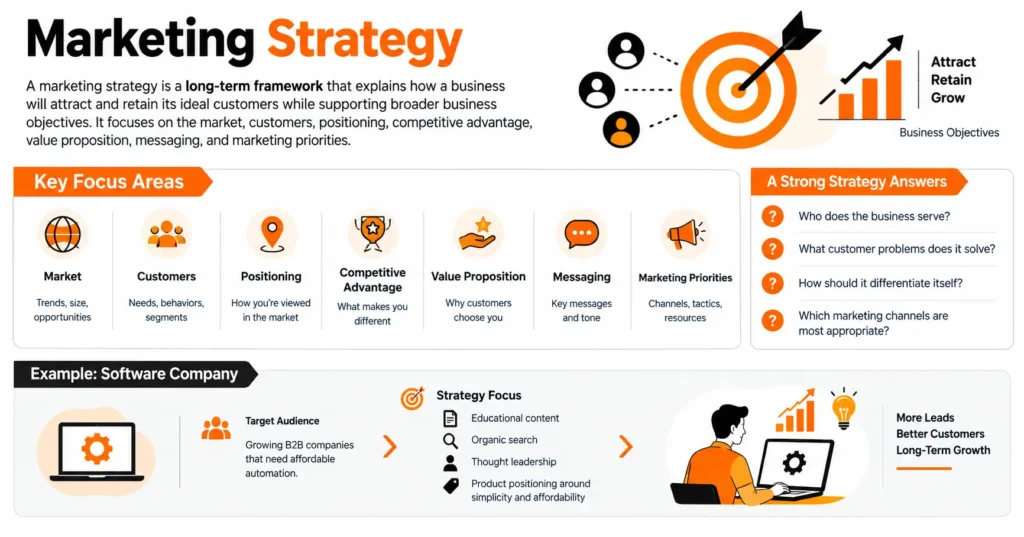
A marketing strategy is a long-term framework that explains how a business will attract and retain its ideal customers while supporting broader business objectives. It focuses on the market, customers, positioning, competitive advantage, value proposition, messaging, and marketing priorities.
A strong strategy answers important questions about who the business serves, what customer problems it solves, how it should differentiate itself, and which marketing channels are most appropriate.
For example, a software company may decide to target growing B2B companies that need affordable automation. Its strategy could focus on educational content, organic search, thought leadership, and product positioning around simplicity and affordability.
What Is a Marketing Plan?
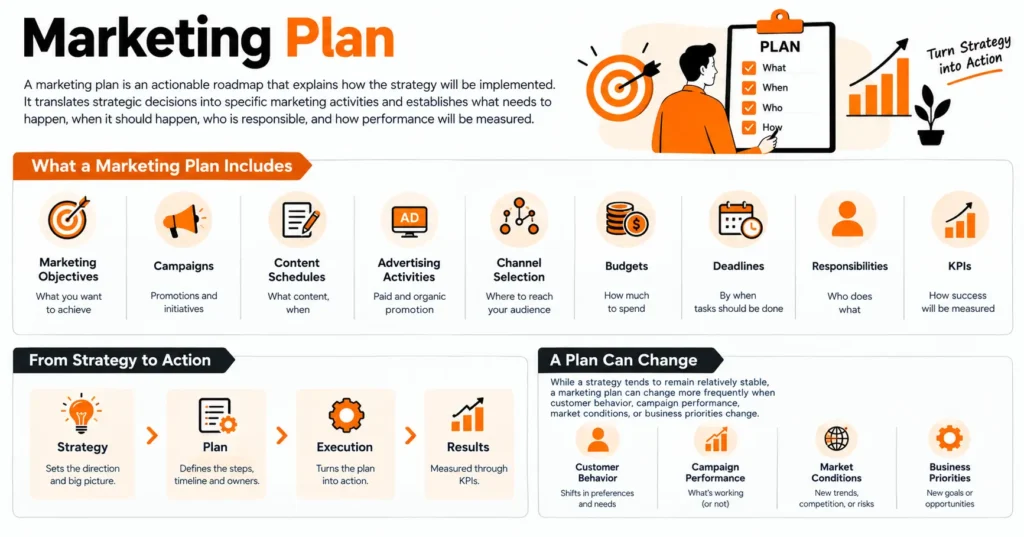
A marketing plan is an actionable roadmap that explains how the strategy will be implemented. It translates strategic decisions into specific marketing activities and establishes what needs to happen, when it should happen, who is responsible, and how performance will be measured.
A plan can include marketing objectives, campaigns, content schedules, advertising activities, channel selection, budgets, deadlines, responsibilities, and key performance indicators.
While a strategy tends to remain relatively stable, a marketing plan can change more frequently when customer behavior, campaign performance, market conditions, or business priorities change.
Marketing Strategy and Marketing Plan: What’s the Difference?
The main difference between a marketing strategy and marketing plan is their purpose. A strategy defines the overall direction, while a plan explains how that direction will be executed.
| Marketing Strategy | Marketing Plan |
| Defines overall direction | Defines execution |
| Focuses on long-term priorities | Focuses on specific activities |
| Identifies the target market | Organizes campaigns and channels |
| Establishes positioning | Establishes timelines |
| Defines competitive advantage | Allocates budget and resources |
| Guides marketing decisions | Assigns responsibilities |
| Measures strategic outcomes | Tracks campaign performance |
| Changes less frequently | Can be updated regularly |
Think of the strategy as the destination and the plan as the route. Without a destination, marketing activities can become disconnected. Without a route, even a strong strategic idea may never become reality.
Which Comes First: Strategy or Plan?
The marketing strategy normally comes before the marketing plan. Businesses first need to understand their market, customers, goals, positioning, and competitive environment before deciding which activities to implement.
Once those strategic decisions are established, the marketing team can create an actionable roadmap. This makes it easier to select appropriate channels, set realistic objectives, determine budgets, and establish performance indicators.
The process can be viewed as:
Business goals → Marketing strategy → Marketing plan → Campaigns → Tactics → Measurement → Optimization
This sequence keeps execution connected to the company’s broader objectives.
Why Is a Marketing Strategy Important?
Without a clear strategy, businesses may invest in marketing activities simply because competitors are using them or because a particular channel appears popular. That approach can waste time and money without producing meaningful business results.
A strategic approach provides consistency. It helps teams understand the target audience, communicate a clear value proposition, prioritize marketing channels, and create campaigns that support specific business objectives.
It also provides a framework for making decisions when resources are limited. Instead of trying every available channel, businesses can concentrate on the activities most likely to reach their ideal customers.
Why Is a Marketing Plan Important?
A marketing plan transforms strategic thinking into organized action. It gives the marketing team a clear understanding of priorities, deadlines, budgets, responsibilities, and expected outcomes.
Without a plan, even a strong strategy can remain theoretical. Teams may understand what they want to accomplish but lack a coordinated process for executing campaigns and measuring progress.
A well-designed plan also improves accountability. When activities and KPIs are clearly defined, businesses can identify what is working, what needs improvement, and where resources should be redirected.
What Are the Main Components of a Marketing Strategy?
An effective strategy begins with business and marketing goals. These goals should connect marketing activities with broader outcomes such as revenue growth, customer acquisition, market expansion, brand awareness, or customer retention.
Market research is another essential component. Businesses need to understand customer needs, purchasing behavior, industry trends, competitors, and market opportunities before developing their positioning.
A complete strategy should also define the target audience, buyer personas, value proposition, competitive advantage, brand positioning, messaging, marketing objectives, and priority channels.
What Are the Main Components of a Marketing Plan?
A marketing plan takes those strategic elements and converts them into an execution framework. It usually defines specific marketing objectives, campaigns, channels, activities, budgets, schedules, responsibilities, and KPIs.
Content calendars, advertising schedules, social media activities, email campaigns, SEO initiatives, promotional offers, and lead-generation campaigns can all become part of the plan.
The plan should also include a process for reviewing performance. Marketing is rarely static, so businesses need to use performance data to refine campaigns and adjust their activities.
How Do Marketing Goals and Objectives Work Together?
Marketing goals describe the broader outcome a business wants to achieve, while marketing objectives make that outcome specific and measurable.
For example, increasing online visibility may be a marketing goal. A measurable objective could be to increase qualified organic traffic by a defined percentage within a specific period.
Effective objectives should be realistic, measurable, relevant to business priorities, and connected to a timeframe. This gives marketing teams a clear standard for evaluating progress.
How Does the Target Audience Influence Marketing Strategy?
A marketing strategy becomes much stronger when it is based on a clear understanding of the target audience. Businesses need to know who their ideal customers are, what problems they experience, what influences their purchasing decisions, and which information they trust.
Buyer personas can help organize this information. They may include demographic characteristics, business needs, pain points, motivations, objections, preferred channels, and purchasing behavior.
Audience research also influences messaging and content. A technical B2B audience may respond well to detailed guides, case studies, research, and webinars, while a consumer audience may prefer visual content, short videos, promotions, or social media interactions.
How Do Positioning and Value Proposition Fit In?
Positioning explains how a business wants customers to perceive its product or service compared with alternatives. A strong position gives the company a recognizable place in the market.
The value proposition explains why customers should choose the business. It connects the company’s offering with a specific customer need or desired outcome.
When positioning and value proposition are clear, marketing messages become more consistent across websites, advertisements, social media, email, content, and sales materials.
Marketing Channels, Campaigns, and Tactics
Marketing channels are the platforms businesses use to communicate with their audiences. These may include search engines, websites, social media, email, paid advertising, events, partnerships, content platforms, and other digital or offline channels.
A campaign is a focused marketing initiative designed to achieve a particular objective. Tactics are the individual actions used to execute that campaign.
For example, SEO may be a marketing channel, an organic lead-generation initiative may be a campaign, and publishing optimized educational articles may be one of its tactics.
Keeping these concepts separate prevents businesses from confusing individual activities with their overall strategy.
How to Create a Marketing Strategy
Start by identifying the business objectives that marketing needs to support. Then research the market, competitors, customer needs, industry trends, and opportunities.
Next, define the target audience and develop buyer personas. Establish the value proposition, competitive positioning, brand messaging, marketing objectives, and priority channels.
The strategy should provide enough direction to guide decisions without becoming unnecessarily restrictive. Customer behavior and market conditions can change, so strategic priorities should be reviewed when new information becomes available.
How to Create a Marketing Plan?
Once the strategy is established, convert its priorities into specific and measurable marketing objectives. Decide which channels and campaigns will support those objectives and determine the resources required.
Create a realistic timeline for content, campaigns, promotions, advertising, and other activities. Assign responsibilities so that every important task has clear ownership.
Finally, define KPIs and reporting methods. A good marketing plan should make it possible to determine whether activities are generating traffic, leads, conversions, revenue, engagement, or other meaningful outcomes.
Marketing Strategy and Marketing Plan Example
Consider an online business that sells project management software to small and medium-sized companies.
Its marketing strategy could focus on reaching operations managers through educational content, organic search, email marketing, and industry-focused resources. The business may position its product as an easy-to-use solution for teams that need better project visibility without complicated software.
Its marketing plan could then schedule four SEO articles per month, one downloadable guide, weekly email content, social media promotion, and a targeted lead-generation campaign.
The strategy determines the audience, positioning, and direction. The plan determines the activities, schedule, resources, and measurements used to execute that direction.
What KPIs Should a Marketing Plan Track?
Marketing KPIs should reflect the objectives established by the strategy. Tracking too many metrics can create unnecessary complexity, so businesses should focus on indicators that demonstrate meaningful progress.
Common performance measurements include organic traffic, qualified leads, conversion rate, customer acquisition cost, revenue, marketing ROI, engagement, email performance, advertising efficiency, and customer retention.
For SEO campaigns, marketers may also monitor keyword visibility, search traffic, conversions, and lead quality. The important point is to connect marketing metrics with actual business outcomes.
How Should Businesses Manage Marketing Budgets?
A marketing budget should be connected to business objectives rather than divided equally among every available channel. Resources should be allocated according to audience behavior, expected outcomes, historical performance, and strategic priorities.
Businesses can start with controlled investments and increase spending in channels that demonstrate strong performance. Underperforming activities should be reviewed rather than automatically receiving the same budget.
Budget planning should also account for content production, software, advertising, creative work, analytics, staff resources, and other implementation costs.
Common Marketing Strategy and Planning Mistakes
One common mistake is starting with tactics before defining a strategy. Publishing content or launching advertisements without knowing the target audience and desired outcome can produce inconsistent results.
Another mistake is creating unrealistic marketing objectives. Goals should reflect available resources, market conditions, competition, and the time required for different channels to produce results.
Businesses can also struggle when they fail to measure performance. Without reliable data, it becomes difficult to understand which activities generate meaningful results and where marketing resources should be invested.
Finally, treating the marketing plan as a permanent document can limit growth. Plans should be reviewed and adjusted as campaigns generate new information.
How Do Strategy and Planning Improve Over Time?
Marketing should operate as a continuous cycle rather than a one-time project. Businesses create strategic priorities, develop a plan, execute campaigns, measure performance, and use the results to improve future decisions.
Performance data can reveal new customer needs, profitable channels, ineffective campaigns, and opportunities that were not visible during the original planning process.
This creates a feedback loop in which marketing becomes increasingly focused and efficient. Strategic decisions become informed by real customer and campaign data instead of assumptions alone.
Marketing Strategy vs Marketing Plan vs Marketing Campaign
These three concepts operate at different levels of marketing.
The strategy defines the overall direction and explains who the business wants to reach, how it should compete, and what it wants to accomplish. The plan organizes the resources, activities, timelines, and KPIs required to execute that direction.
A campaign sits within the plan and usually has a narrower objective. For example, a business could have a long-term strategy for B2B growth, a quarterly marketing plan supporting that strategy, and a specific content campaign designed to generate qualified leads.
Understanding this hierarchy helps marketing teams maintain consistency from high-level business objectives down to individual promotional activities.
How Small Businesses Can Use Both?
Small businesses do not need complicated documents to benefit from strategic marketing. A simple strategy can define the ideal customer, primary business goal, value proposition, positioning, and most important marketing channels.
The plan can then turn those priorities into a manageable schedule. Instead of trying to maintain every social network or marketing channel, a small business can focus on the activities most likely to produce useful results.
This approach helps limited teams use their time and budget more efficiently while maintaining a clear connection between marketing activity and business growth.
Frequently Asked Questions
Is a marketing strategy the same as a marketing plan?
No. A marketing strategy establishes the overall direction, target audience, positioning, objectives, and priorities. A marketing plan explains how those decisions will be implemented through specific activities, campaigns, budgets, timelines, and KPIs.
Which comes first, a marketing strategy or marketing plan?
The strategy generally comes first because it establishes the direction that the plan needs to support. Once strategic priorities are clear, the business can determine which activities, channels, resources, and timelines are appropriate.
What should a marketing strategy include?
A marketing strategy commonly includes business goals, market research, target audience, buyer personas, competitive analysis, value proposition, positioning, messaging, marketing objectives, and channel priorities.
What should a marketing plan include?
A marketing plan can include marketing objectives, campaigns, channels, content activities, budgets, timelines, responsibilities, KPIs, reporting processes, and optimization methods.
Can a business have a marketing plan without a strategy?
A business can create a plan without a formal strategy, but doing so can lead to disconnected activities and inefficient resource allocation. Strategic direction helps ensure that marketing activities support meaningful business objectives.
Conclusion
A successful marketing strategy and marketing plan work together to connect business goals with practical marketing execution. The strategy establishes the target audience, positioning, value proposition, objectives, and direction, while the plan turns those decisions into campaigns, channels, budgets, timelines, and measurable actions. By continuously measuring results and refining both strategic priorities and marketing activities, businesses can build a more focused, adaptable, and effective path toward sustainable growth.

James Robert
James Robert is a seasoned Off-Page SEO expert specializing in strategic link building, digital outreach, and authority growth for businesses aiming to improve search visibility and rankings. With over five years of hands-on experience, he helps brands strengthen their online presence through high-quality backlinks, niche-relevant placements, and ethical SEO practices aligned with Google’s guidelines. James’s core specialties include guest posting, blogger outreach, niche edits, brand mentions, and backlink profile optimization. He is highly skilled at building relationships with authoritative publishers and executing scalable outreach campaigns that drive long-term organic growth. As a contributor to leading marketing platforms, James regularly shares actionable insights on off-page SEO strategies, link acquisition, and sustainable ranking improvements, helping businesses achieve consistent and measurable SEO success.