

A marketing technology roadmap gives businesses a clear plan for selecting, integrating, and optimizing the tools that support modern marketing. As companies adopt CRM platforms, marketing automation, analytics, customer data platforms, and AI, managing a growing MarTech stack can become complicated.
Without a structured strategy, businesses may face disconnected systems, duplicated tools, poor data quality, rising costs, and inconsistent customer experiences. A well-designed roadmap connects business goals with the right technology, processes, and customer journey requirements.
It helps marketing teams identify technology gaps, prioritize investments, improve data integration, and measure results. With the right approach, organizations can build a scalable MarTech ecosystem that improves efficiency, personalization, decision-making, and long-term marketing performance.
What Is a Marketing Technology Roadmap?
A marketing technology roadmap is a strategic plan that outlines how an organization’s marketing technology ecosystem will evolve over a defined period.
It connects business goals with technology capabilities, platforms, data, integrations, processes, people, budgets, and performance metrics.
A roadmap is different from a MarTech stack. The stack is the collection of tools a company currently uses, while the roadmap explains how that ecosystem should be improved over time.
It can identify technology gaps, redundant platforms, integration requirements, implementation phases, and future capabilities.
The most effective roadmaps are business-led rather than tool-led. Instead of starting with “Which software should we buy?”, they start with “What business problem are we trying to solve?”
Why Is a MarTech Roadmap Important?
Marketing technology has become increasingly complex. Businesses can choose from platforms for customer relationship management, marketing automation, analytics, content, advertising, personalization, customer data, experimentation, and AI.
More technology does not automatically produce better marketing. A company can have dozens of platforms and still struggle with incomplete customer data, poor reporting, disconnected workflows, and low software adoption.
A strategic roadmap helps create alignment between marketing goals and technology investments. It also gives marketing, sales, IT, data, and leadership teams a shared view of priorities, dependencies, costs, and expected outcomes.
What Does a Modern MarTech Stack Include?
A modern MarTech ecosystem typically consists of several interconnected layers. The exact combination depends on the organization’s size, industry, customer journey, marketing maturity, budget, and business model.
| MarTech Component | Primary Role | Typical Capabilities |
| CRM | Manage customer and prospect relationships | Contact management, pipelines, lead tracking |
| CDP | Unify customer information | Profiles, identity resolution, segmentation |
| Marketing Automation | Automate campaigns and workflows | Lead nurturing, triggers, lifecycle campaigns |
| CMS | Manage digital content | Websites, landing pages, publishing |
| Analytics | Measure performance | Reporting, dashboards, attribution |
| Personalization | Improve customer experiences | Dynamic content, recommendations |
| Advertising Technology | Manage paid acquisition | Audience activation, campaign management |
| AI & Machine Learning | Add intelligence and automation | Prediction, generation, optimization |
| Integration Layer | Connect systems | APIs, data synchronization, workflows |
These technologies should not exist as isolated applications. Their value increases when data and processes can move reliably between them.
Start With Business Goals Before Choosing Technology
The first step in building a strong roadmap is defining what marketing needs to accomplish. Goals might include increasing qualified leads, improving conversion rates, reducing customer acquisition costs, increasing retention, accelerating campaign execution, or creating a more consistent customer experience.
Once the objective is clear, identify the capability required to achieve it. For example, improving lead nurturing may require behavioral segmentation and marketing automation rather than simply adding another CRM.
This business-first approach prevents technology purchases from becoming disconnected experiments. It also makes it easier to evaluate ROI because every major investment has a clear purpose.
How to Build a Marketing Technology Roadmap?
Building a marketing technology roadmap starts with a detailed assessment of the current state. Document the platforms currently in use, their primary functions, integrations, owners, costs, data sources, adoption levels, and business dependencies.
Next, identify gaps and overlaps. Look for missing capabilities, duplicate functionality, disconnected databases, manual processes, unused features, and systems that prevent teams from getting a complete view of customers.
Customer journey mapping should then connect technology to real interactions. Examine how prospects and customers move from awareness to consideration, conversion, onboarding, retention, and advocacy.
Identify where data is captured, where automation is possible, and where customers experience friction.
The final stage is prioritization. Initiatives should be evaluated according to business impact, cost, complexity, dependencies, risk, scalability, data readiness, and time to value.
Conduct a MarTech Stack Audit
A MarTech audit provides the baseline for the roadmap. Without an accurate picture of the existing stack, businesses can easily purchase technology they already have or overlook systems that need modernization.
Review each platform’s purpose, users, features, integration capabilities, cost, performance, adoption, and relationship to other systems. Also examine whether the platform contributes to a measurable marketing or business outcome.
The audit should identify four broad categories: technology to keep, technology to improve, technology to consolidate, and technology that may eventually be retired. This creates a clearer path toward stack optimization and reduces unnecessary technology complexity.
Build a Strong Customer Data Foundation
Customer data sits at the center of an effective marketing technology ecosystem. CRM records, website behavior, email interactions, purchases, advertising engagement, product usage, and other signals can provide valuable insight into customer needs and intent.
A customer data platform can help unify information from different sources and create more complete customer profiles. Identity resolution can connect interactions across channels, while first-party and zero-party data can support more reliable personalization and audience segmentation.
Data quality is equally important. Duplicate records, inconsistent fields, missing information, and disconnected databases can undermine analytics and automation regardless of how advanced the technology stack appears.
Connect Your Marketing Technology Ecosystem
Integration is one of the most important parts of a modern MarTech strategy. CRM, CDP, marketing automation, CMS, analytics, advertising platforms, and other systems need reliable methods for exchanging information.
APIs, native integrations, middleware, webhooks, and data pipelines can help synchronize information between platforms. The appropriate architecture depends on the organization’s systems, data volume, technical requirements, and security needs.
Strong integration reduces manual data entry and creates more consistent customer experiences. It also allows marketers to respond to customer behavior faster and measure how interactions across channels contribute to business outcomes.
Map Technology to the Customer Journey
Technology should support the customer journey rather than operate separately from it. Start by identifying important stages such as awareness, consideration, conversion, onboarding, retention, and expansion.
At each stage, determine what customer information is available, which interactions take place, what action the business wants to encourage, and which technology supports that interaction.
This approach can reveal important gaps. A company may have excellent lead-generation technology but weak onboarding automation, or sophisticated analytics but limited personalization. Customer journey mapping helps prioritize technology according to actual customer needs.
Use Marketing Automation to Scale Operations
Marketing automation allows teams to execute repeatable processes without manually managing every interaction. It can support lead nurturing, customer onboarding, email campaigns, behavioral triggers, lifecycle communications, and internal workflows.
Automation becomes more effective when it is connected to reliable customer data. Behavioral signals can trigger relevant communications, while customer attributes can determine segmentation and messaging.
The objective is not to automate everything. Good automation removes repetitive work while preserving opportunities for human interaction where judgment, creativity, or relationship-building is important.
Build Personalization Into the Strategy
Personalization can use customer attributes, behavioral signals, purchase history, preferences, and engagement data to create more relevant experiences.
It can appear across websites, email, advertising, product experiences, and customer journeys. Dynamic content, audience segmentation, recommendations, and next-best-action models can all support personalization.
However, personalization depends on data quality and governance. Using inaccurate or outdated information can create irrelevant experiences, while excessive personalization can raise privacy and trust concerns.
Where Does AI Fit Into MarTech?
Artificial intelligence is becoming an increasingly important capability within the marketing technology ecosystem. AI can assist with content generation, audience analysis, predictive modeling, customer segmentation, personalization, campaign optimization, and marketing operations.
Generative AI can accelerate content and creative workflows, while predictive AI can identify patterns in customer behavior and estimate outcomes such as conversion or churn. AI-powered analytics can also help teams identify trends that may be difficult to discover manually.
AI should be introduced according to business use cases rather than technology hype. Strong data foundations, human oversight, security, privacy, governance, and measurable objectives should guide AI adoption.
How to Prioritize MarTech Investments
Not every technology initiative should be implemented immediately. Prioritization prevents teams from spending limited resources on projects that provide little business value.
Evaluate initiatives using factors such as business impact, customer impact, implementation effort, cost, technical dependencies, data readiness, risk, scalability, and time to value.
A useful roadmap separates foundational initiatives from growth initiatives and experimental opportunities. Foundational work may include data quality or integration, while growth initiatives might involve automation or personalization.
Experimental projects such as emerging AI capabilities can be tested when the underlying foundation is ready.
How to Choose the Right MarTech Tools
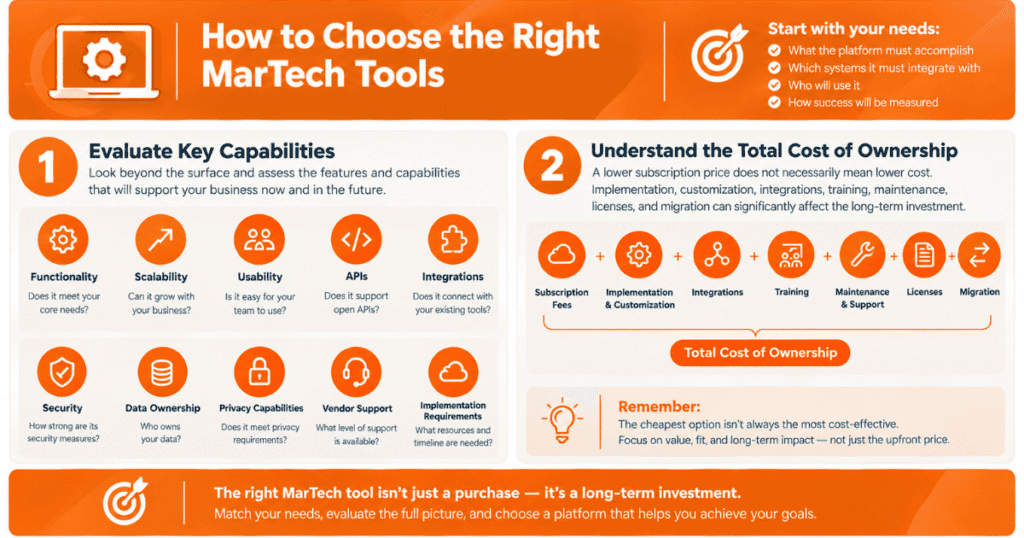
Technology selection should begin with requirements rather than vendor features. Define what the business needs the platform to accomplish, which systems it must integrate with, who will use it, and how success will be measured.
Consider functionality, scalability, usability, APIs, integrations, security, data ownership, privacy capabilities, vendor support, implementation requirements, and total cost of ownership.
A lower subscription price does not necessarily mean lower cost. Implementation, customization, integrations, training, maintenance, licenses, and migration can significantly affect the long-term investment.
How to Build a Three-Year MarTech Roadmap
A three-year roadmap provides enough time to establish foundational capabilities while gradually introducing more advanced technology.
Year One: Build the Foundation
The first year should focus on stability and visibility. Audit the existing MarTech stack, improve data quality, establish clear measurement, fix critical integrations, strengthen CRM processes, and create governance standards.
The goal is to create a reliable foundation that future automation, personalization, analytics, and AI capabilities can build upon.
Year Two: Connect and Scale
The second year can focus on connecting systems and expanding marketing capabilities. Organizations may increase marketing automation, improve customer journey orchestration, strengthen segmentation, connect additional data sources, and introduce more sophisticated personalization.
At this stage, adoption becomes particularly important. Teams need appropriate training, processes, ownership, and performance measurement to ensure new capabilities are actually used.
Year Three: Optimize and Innovate
The third year can focus on advanced analytics, AI, experimentation, predictive insights, intelligent personalization, and continuous optimization.
The objective is to make the technology ecosystem more responsive and efficient while maintaining strong governance and measurable business outcomes.
Make the Roadmap Resilient to Budget Changes
A roadmap should not assume that budgets will remain unchanged for several years. Economic conditions, business priorities, leadership decisions, and technology costs can all affect available resources.
Prioritize investments that create standalone value and avoid unnecessary dependencies between future phases. Maintain a clear distinction between essential infrastructure, strategic improvements, and optional experiments.
Regularly reassess costs, vendor contracts, utilization, and expected returns. This allows teams to adjust priorities without abandoning the overall marketing technology strategy.
Prevent MarTech Sprawl and Technology Debt
MarTech sprawl occurs when organizations accumulate too many overlapping, disconnected, or underused platforms. Over time, this can increase costs and create integration complexity.
Regular technology audits can identify redundant functionality, unused licenses, duplicate customer records, disconnected workflows, and tools that no longer support current business requirements.
Technology rationalization should be based on business needs rather than an arbitrary target for reducing the number of platforms. A smaller stack is not automatically better if removing a system creates new operational or customer experience problems.
Measure MarTech ROI and Performance
Technology should ultimately be evaluated by the outcomes it enables. Useful metrics can include conversion rate, customer acquisition cost, marketing-sourced revenue, pipeline contribution, retention, engagement, and campaign performance.
Operational metrics can provide additional insight. Data completeness, workflow automation, feature adoption, platform usage, time-to-launch, and hours saved can reveal whether teams are getting practical value from their technology.
A strong measurement framework creates a continuous feedback loop. Performance data can inform future investments, reveal underused capabilities, and identify areas where the stack needs optimization.
MarTech Governance, Privacy, and Security
As marketing systems collect and activate more customer information, governance becomes increasingly important. Organizations need clear rules for data access, consent, retention, security, ownership, and acceptable use.
Privacy should be considered when designing the technology architecture rather than added after implementation. This is especially important when using first-party data, personalization, customer profiles, and AI systems.
AI governance also deserves attention. Teams should establish appropriate controls around data usage, human oversight, transparency, security, and the types of decisions that automated systems are allowed to influence.
Common MarTech Roadmap Mistakes
One common mistake is purchasing software before understanding the business problem. Another is focusing on individual tools while ignoring data architecture, integrations, customer journeys, and adoption.
Organizations can also underestimate implementation effort. Migration, customization, training, change management, testing, and integration can require significant resources beyond the initial software purchase.
Other problems include excessive technology duplication, unrealistic timelines, weak measurement, poor governance, and failure to retire outdated systems. A successful roadmap considers people, processes, data, and technology together.
How Often Should a MarTech Roadmap Be Updated?
A marketing technology roadmap should be reviewed regularly because business priorities, customer expectations, budgets, and technology capabilities change.
Quarterly reviews can assess progress, performance, spending, adoption, new requirements, and emerging opportunities. A deeper annual review can reassess the overall technology architecture and strategic direction.
Treat the roadmap as a living document rather than a fixed three-year checklist. This provides enough structure for long-term planning while allowing the organization to respond to changing circumstances.
MarTech Roadmap Template
A practical roadmap should make every initiative easy to understand and evaluate.
| Initiative | Business Goal | Required Capability | Tech | Dependency | Owner | Timeline | Cost | KPI |
| CRM optimization | Improve lead management | Leadintelligence | CRM | Data quality | Marketing Ops | Q1 | Medium | Lead conversion |
| Data integration | Unify customer data | Data synchronization | CDP/API | System access | Data Team | Q2 | High | Data complete |
| Automation | Improve nurturing | Workflow automation | Automation platform | CRM integration | Marketing | Q2–Q3 | Medium | MQL-to-SQL |
| Personalize | Improve engagement | Audience segmentation | Personalize platform | Customer profiles | Growth Team | Q3 | Medium | Conversion rate |
| AI analytics | Improve decisions | Predictive insights | AI/analytics | Clean data | Analytics | Q4 | Medium | Forecast accuracy |
This format makes it easier to connect every technology initiative with its business purpose, dependencies, investment, ownership, timeline, and measurable result.
Frequently Asked Questions
What is a marketing technology roadmap?
A marketing technology roadmap is a strategic plan for developing and improving a company’s MarTech ecosystem. It connects business goals with technology capabilities, implementation priorities, integrations, budgets, and KPIs.
How do you create a MarTech roadmap?
Start by defining business objectives and auditing the existing stack. Then map customer journeys, identify capability gaps, assess data and integrations, prioritize initiatives, select appropriate technology, establish timelines, and define measurable outcomes.
What should a MarTech roadmap include?
It should include business objectives, existing technology, capability gaps, customer journeys, data architecture, integrations, technology priorities, implementation phases, ownership, budgets, governance, and performance metrics.
What is the difference between a MarTech stack and a roadmap?
A MarTech stack is the collection of marketing technologies a business uses. A roadmap explains how that stack should evolve to support future business and marketing requirements.
How long should a MarTech roadmap be?
There is no universal timeframe. A one-year roadmap can work for tactical improvements, while a three-year roadmap can provide a broader strategic direction. The important point is to review and update the plan as business requirements change.
Conclusion
A successful marketing technology roadmap connects business objectives with customer data, technology, integrations, people, and measurable outcomes.
By building a strong foundation, controlling MarTech sprawl, adopting AI thoughtfully, improving customer journeys, and continuously measuring performance, businesses can create a scalable technology ecosystem that supports long-term marketing growth.
This version is deliberately structured around search intent rather than keyword repetition, while keeping the focus keyword naturally distributed across the introduction, core sections, roadmap discussion, and conclusion.

James Robert
James Robert is a seasoned Off-Page SEO expert specializing in strategic link building, digital outreach, and authority growth for businesses aiming to improve search visibility and rankings. With over five years of hands-on experience, he helps brands strengthen their online presence through high-quality backlinks, niche-relevant placements, and ethical SEO practices aligned with Google’s guidelines. James’s core specialties include guest posting, blogger outreach, niche edits, brand mentions, and backlink profile optimization. He is highly skilled at building relationships with authoritative publishers and executing scalable outreach campaigns that drive long-term organic growth. As a contributor to leading marketing platforms, James regularly shares actionable insights on off-page SEO strategies, link acquisition, and sustainable ranking improvements, helping businesses achieve consistent and measurable SEO success.