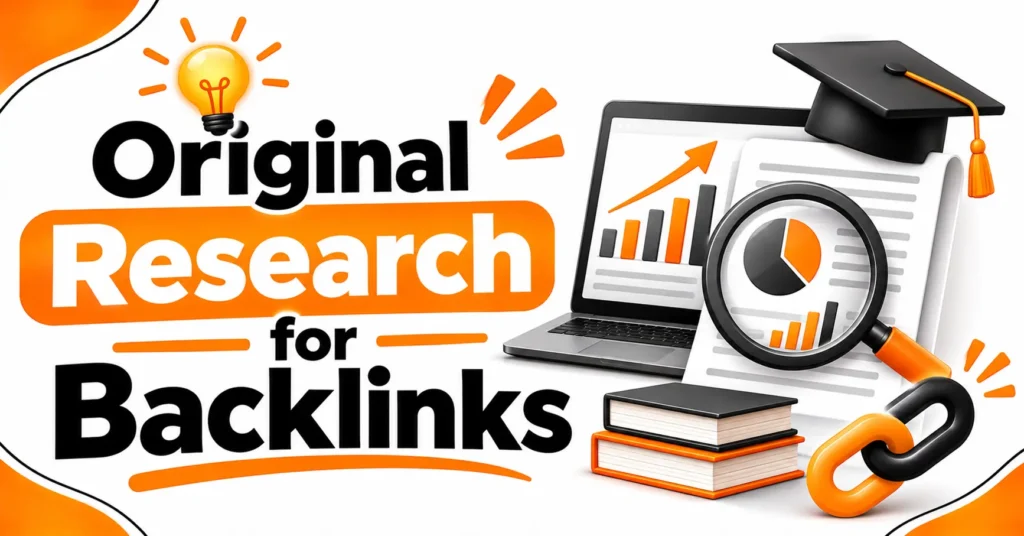
Original research for backlinks is an effective SEO strategy that helps businesses earn high-quality links by publishing unique data, industry insights, and valuable findings. Instead of relying only on traditional outreach, businesses can create research that journalists, bloggers, and industry experts naturally want to reference.
By conducting surveys, analyzing trends, publishing original statistics, and sharing data-driven insights, you can develop link-worthy content that attracts relevant editorial backlinks. A well-planned research campaign also strengthens industry authority and improves brand visibility.
Whether you run a small business or an established website, investing in research-based link building can create sustainable backlink opportunities and support long-term organic growth.
What Is Original Research in SEO?
Original research in SEO involves collecting, analyzing, or producing new information that provides insights beyond what is already available online. It can include surveys, experiments, industry benchmarks, customer studies, proprietary statistics, and detailed case studies.
Unlike ordinary informational articles that summarize existing knowledge, original research provides evidence that other content creators can use in their own publications. For example, a digital marketing agency could survey 250 business owners about their SEO challenges and publish the findings as an industry report.
When the information is useful, credible, and relevant, other websites may reference the study as a supporting source. These editorial citations can generate natural backlinks while positioning the research publisher as a valuable industry resource.
Why Original Research Is a Powerful Link-Building Strategy
Publishers regularly need reliable information to support their articles. Unique findings provide something that general educational content often cannot: new evidence, interesting statistics, and information that readers cannot easily find elsewhere.
Research also creates multiple opportunities for content promotion. A single study can become a detailed report, infographic, social media campaign, presentation, and collection of supporting articles.
Unique Data Creates a Reason to Link
Most websites publish similar information about popular industry topics. Original findings give publishers a fresh perspective that helps their content stand out.
For example, a study revealing how small businesses allocate their digital marketing budgets could provide valuable information for business publications, marketing professionals, and industry bloggers.
Research Builds Topical Authority and Credibility
Publishing accurate studies demonstrates knowledge of your subject. When your website consistently provides useful data and transparent research, it can become a recognizable source of industry information.
However, authority is not established through backlinks alone. Research quality, accurate sourcing, relevant expertise, and a consistent publishing history all contribute to credibility.
Statistics Make Content More Valuable
Specific statistics help writers explain trends and support arguments. A well-presented finding can be referenced in several different types of content, creating opportunities for relevant editorial backlinks.
For instance, research about website conversion rates could attract citations from e-commerce guides, marketing reports, and business strategy articles.
Research Can Generate Long-Term Backlinks
A useful industry report may continue attracting links long after its original publication. This is especially true when the research covers evergreen subjects or provides benchmarks that remain useful over time.
Updating the study with recent information can preserve its value and create additional opportunities for publishers to reference it.
Types of Original Research That Attract Backlinks
Different research formats appeal to different audiences. The best choice depends on your industry, available resources, and the information your target publishers need.
| Research type | Example | Potential audience |
| Industry surveys | Business marketing challenges | Industry publications |
| Original statistics | Average website performance | Bloggers and journalists |
| Benchmark studies | Conversion rates by industry | Business websites |
| Customer research | Purchasing behavior trends | Consumer publications |
| SEO experiments | Results of technical SEO improvements | SEO professionals |
| Case studies | Results from a marketing campaign | Agency and business blogs |
| Expert interviews | Insights from industry professionals | Niche publications |
Industry Surveys and Customer Research
Surveys are an effective way to collect proprietary information directly from customers, professionals, or business owners.
You could investigate common content marketing challenges, preferred communication channels, purchasing decisions, or changes in customer behavior. The responses can reveal patterns that are valuable to publishers.
Keep questions clear and neutral, define your target audience, and explain how participants were selected. A survey becomes more useful when its methodology is transparent.
Original Statistics and Data Studies
Data studies examine information to identify trends, comparisons, and meaningful patterns. Businesses can analyze internal records, public datasets, customer information, or industry-specific metrics to produce new findings.
For example, an analysis of publishing frequency across different industries could reveal how content production varies between business sectors.
Industry Benchmark Reports
Benchmark reports compare performance across businesses, industries, or time periods. They help readers understand typical performance and identify opportunities for improvement.
Popular subjects include website traffic, conversion rates, customer acquisition costs, marketing budgets, email engagement, and content performance.
A useful benchmark study should clearly explain its data sources, measurement period, and calculation methods.
SEO Experiments and Case Studies
SEO experiments examine how specific website improvements affect measurable performance. You could investigate internal linking changes, page speed improvements, content updates, or technical optimization.
Document the original conditions, changes implemented, observation period, and results. Avoid claiming that one change caused a ranking improvement when other factors may have influenced the outcome.
Expert Interviews and Industry Reports
Expert interviews provide practical insights that numerical data may not capture. Conversations with experienced professionals can reveal industry challenges, emerging trends, and strategies worth investigating.
Combining expert opinions with survey results and statistical analysis can produce a more informative research report.
How to Conduct Original Research for Backlinks
A successful research campaign begins with a clear question and a reliable methodology. The objective is not simply to collect information but to discover something useful that other people will want to reference.
Step 1: Find a Research Topic With Link Potential
Start by identifying subjects that matter to your industry. Look for frequently discussed questions, outdated statistics, information gaps, and topics where publishers need stronger evidence.
Analyze popular industry discussions and examine which types of research attract attention. Look for opportunities to update old findings, investigate overlooked questions, or compare information from different sources.
For example, instead of publishing another general article about SEO trends, conduct a study examining the most common technical SEO problems affecting small business websites.
Step 2: Define Your Research Question
A clear research question keeps your study focused and prevents unnecessary data collection.
Rather than investigating a broad topic such as digital marketing, narrow the scope to a measurable question such as how businesses divide their marketing budgets between organic search, paid advertising, and social media.
Your question should be relevant to your target audience and capable of producing useful findings.
Step 3: Identify Your Target Audience and Sample
Determine who can provide the information needed for your research. Depending on the topic, participants might include customers, business owners, marketing managers, SEO professionals, or industry specialists.
Select a sample that reflects the population you want to understand. Record the number of participants and explain any limitations.
A larger sample does not automatically guarantee better research. Participant relevance, selection methods, and response quality also matter.
Step 4: Collect Reliable Data
Choose a collection method that matches your research question. Surveys, interviews, website analytics, customer records, public datasets, and controlled experiments can all provide useful information.
For survey-based research, avoid leading questions that encourage particular answers. For data studies, check the accuracy, completeness, and relevance of the information before analyzing it.
Always record the source, collection date, and any transformations applied to the data.
Step 5: Analyze and Verify Your Findings
After collecting information, examine it for meaningful trends, differences, and unexpected results.
Use spreadsheets or statistical tools to calculate averages, percentages, distributions, and comparisons. Verify important calculations and investigate unusual results before including them in the final report.
Clearly separate measured findings from interpretations or recommendations. This makes the research more trustworthy and useful.
Step 6: Document Your Research Methodology
A transparent methodology allows readers to understand how your conclusions were reached.
Explain the research period, participant selection, sample size, data sources, questions, analytical methods, and limitations. If you use publicly available information, provide appropriate attribution.
This is particularly important for research involving industry comparisons or statistical claims. Publishers are more likely to trust information when they can understand how it was produced.
Step 7: Present Findings in an Accessible Format
Organize your findings around the most important discoveries. Lead with interesting results and support them with clear explanations.
Use charts, graphs, comparison tables, and highlighted statistics to make the report easier to understand. Include the complete methodology and supporting information for readers who want to investigate further.
A visually clear report is easier for publishers to evaluate and reference.
How to Conduct Original Research on a Small Budget?
Research does not require an expensive agency or a large team. Smaller businesses can create useful studies by combining existing business information with affordable data collection methods.
Customer feedback, website analytics, support questions, sales records, and internal performance reports can reveal useful research opportunities. You can also distribute surveys through email lists, professional communities, and relevant online groups.
Public datasets are another valuable resource. They can help you investigate industry patterns without collecting every data point yourself. However, explain the original source and distinguish your own analysis from previously published information.
The most important factor is the quality of the research question and methodology, not the size of the budget.
How to Publish Research That Earns Editorial Backlinks?
A research report should be published as a dedicated resource rather than hidden inside a general blog article.
Create a research landing page with a descriptive title, introduction, publication date, methodology, key findings, supporting statistics, and visualizations. Make the most important information easy to locate.
Include an explanation of the study’s limitations and provide clear attribution for external datasets. Where appropriate, offer downloadable charts or visual assets that publishers can use with proper credit.
Your research page should also be technically accessible. Use a descriptive URL, relevant internal links, a clear heading structure, and appropriate indexing settings. Ensure that important findings are available in readable text rather than existing only inside images or downloadable files.
How to Promote Original Research and Earn Backlinks?
Publishing research is only the beginning. Effective promotion connects your findings with the journalists, editors, bloggers, and industry professionals who may find them useful.
Identify Relevant Publishers and Journalists
Research websites that regularly cover your subject. Look for articles discussing similar questions, industry reports, statistics, and emerging trends.
Prioritize publishers whose audiences genuinely match your research. A relevant publication with a smaller audience may offer a more valuable editorial opportunity than an unrelated website with impressive SEO metrics.
Find Articles Using Outdated Statistics
Search for articles that reference older research or statistics. If your study provides more recent and reliable information, contact the publisher and explain why your findings could improve the article.
Your research must offer genuine additional value. A newer publication date alone is not sufficient reason for someone to replace an existing source.
Write Personalized Research Outreach Emails
An effective outreach email explains the research finding, its relevance, and why the recipient’s audience might benefit from it.
Example outreach email:
Subject: New Research on [Industry Topic]
Hi [Name],
I recently published a study examining [specific research topic]. One interesting finding was [mention a relevant statistic or discovery].
Since you’ve covered related industry topics, I thought this research might provide useful additional information for your readers.
The full study includes the methodology, findings, and supporting data here: [Research URL].
I hope you find it useful.
Best regards,
[Your Name]
Avoid generic requests demanding a backlink. Present the information professionally and let the publisher decide whether it deserves a citation.
Use Digital PR to Expand Research Visibility
Digital PR helps distribute research to publications and media outlets that cover your industry. A compelling statistic, unexpected discovery, or relevant industry trend can provide a strong reason for journalists to discuss your findings.
Prepare a concise research summary, identify the most newsworthy results, and make supporting evidence available. If appropriate, offer interviews with the people responsible for conducting the study.
Repurpose Research Into Multiple Content Formats
One research project can support several promotional assets. Turn important findings into infographics, social media posts, expert commentary, presentations, and supporting blog articles.
You can also develop guest articles that explain individual findings in greater detail. These formats introduce your research to different audiences and create additional opportunities for publishers to discover it.
How to Find Research-Based Backlink Opportunities
Competitor backlink analysis helps identify the subjects and resources that already attract editorial links in your industry.
Examine competitors’ most-linked pages and identify studies, statistics, and reports that receive citations. Look at the websites linking to those resources and determine whether they might also find your research useful.
Pay attention to referring domains, linking page relevance, anchor text, and the context surrounding each link. These details help distinguish meaningful editorial opportunities from low-quality backlink sources.
You can use backlink analysis platforms to identify new and lost links, compare competing research assets, and monitor the performance of your campaign.
Remember that third-party authority metrics are estimates, not direct Google ranking factors. A relevant editorial link from a trusted industry publication can be more valuable than several unrelated links from websites with higher numerical scores.
How to Measure the Success of Original Research Campaigns
Measuring results helps determine whether your research is attracting the right attention and contributing to your wider SEO strategy.
Track new referring domains, acquired backlinks, linking page relevance, anchor text, referral traffic, and organic visibility. Compare results against your research publication and promotion dates to understand how different activities contribute to performance.
Also monitor brand mentions, social engagement, research page visits, and inquiries from potential partners. These indicators provide a broader picture of how your research is performing beyond backlink totals.
Set realistic expectations because backlinks are not guaranteed. The outcome depends on research quality, audience interest, promotion, competition, and publisher decisions.
Common Mistakes to Avoid When Creating Original Research
One major mistake is publishing information without a meaningful research question. A report that simply repeats common industry statistics offers little reason for other websites to reference it.
Poor sampling methods, biased survey questions, inaccurate calculations, and unsupported conclusions can also weaken credibility. Always explain the limitations of your findings and avoid presenting assumptions as proven facts.
Another mistake is expecting backlinks immediately after publication. Even excellent research may need sustained promotion before the right publishers discover it.
Finally, avoid purchasing links or using misleading claims to manufacture authority. The purpose of research-driven link building is to earn genuine editorial references by providing information that improves other people’s content.
How to Keep Original Research Relevant Over Time
Research can lose relevance when industry conditions change or new information becomes available. Review important studies periodically and identify statistics that need updating.
For recurring reports, publish annual or quarterly editions using consistent measurement methods. This makes it possible to compare findings across different periods and identify meaningful changes.
Preserve previous editions when appropriate and explain what has changed in each update. Accurate, accessible, and regularly maintained research can remain a valuable resource for readers and publishers.
Frequently Asked Questions
What is original research for backlinks?
Original research for backlinks involves collecting unique data, conducting experiments, or producing new industry insights that other websites may reference. These editorial references can generate natural backlinks to the original research.
Why does original research attract backlinks?
Original research offers unique statistics, evidence, and findings that publishers may not find elsewhere. When these insights support an article or improve its usefulness, writers and journalists may cite the original source.
What types of research generate the most backlinks?
Industry surveys, proprietary statistics, benchmark reports, SEO experiments, customer studies, and detailed case studies can all attract backlinks. The most effective format depends on audience demand, research quality, and promotional efforts.
Can small businesses create original research?
Yes. Small businesses can use customer feedback, internal analytics, online surveys, interviews, and publicly available datasets to produce useful studies without a large research budget.
How much data is needed for original research?
There is no universal sample size. The appropriate amount depends on the research question, target population, methodology, and confidence required. Always disclose the sample size and limitations.
Conclusion
Original research for backlinks helps businesses earn meaningful editorial links by providing information that publishers genuinely want to reference. Start with an important industry question, collect reliable data, document your methodology, and publish findings in an accessible format. Then promote the research through personalized outreach and digital PR while monitoring the quality of acquired backlinks. Focus on originality, credibility, and practical value rather than chasing link numbers. A well-planned research campaign can strengthen your website’s reputation, attract relevant publishers, and support sustainable organic growth.

James Robert
James Robert is a seasoned Off-Page SEO expert specializing in strategic link building, digital outreach, and authority growth for businesses aiming to improve search visibility and rankings. With over five years of hands-on experience, he helps brands strengthen their online presence through high-quality backlinks, niche-relevant placements, and ethical SEO practices aligned with Google’s guidelines. James’s core specialties include guest posting, blogger outreach, niche edits, brand mentions, and backlink profile optimization. He is highly skilled at building relationships with authoritative publishers and executing scalable outreach campaigns that drive long-term organic growth. As a contributor to leading marketing platforms, James regularly shares actionable insights on off-page SEO strategies, link acquisition, and sustainable ranking improvements, helping businesses achieve consistent and measurable SEO success.