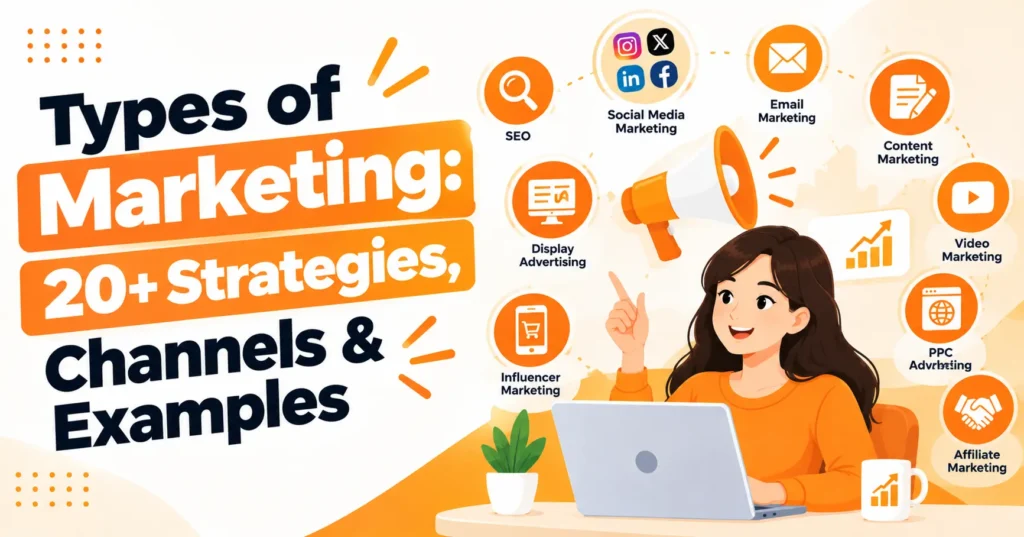
Marketing helps businesses connect with the right audience, communicate value, and turn interest into meaningful action. Today, there are many types of marketing available, from traditional advertising to modern digital strategies.
Businesses can use content marketing, social media marketing, email marketing, and search engine optimization to attract, engage, and retain customers. The right approach depends on factors such as the target audience, industry, budget, and business goals.
Some strategies focus on brand awareness, while others are designed for lead generation, sales, or customer loyalty.
Understanding different marketing methods makes it easier to build a balanced strategy that reaches customers across multiple channels and creates a stronger, more consistent customer experience.
What Is Marketing?
Marketing is the process of identifying customer needs, communicating a product or service’s value, and building relationships with a target audience. It includes research, positioning, pricing, promotion, distribution, customer experience, and performance measurement.
Modern marketing combines creativity with data. Businesses study consumer behavior and market trends to determine what customers need, where they spend time, and which messages are most likely to encourage meaningful action.
What Are the Main Types of Marketing?
There is no single universal list because marketing can be classified in different ways. It can be organized by channel, audience, objective, customer relationship, or communication method.
The broadest classification separates marketing into traditional marketing and digital marketing. Within these categories are specialized approaches such as SEO, content marketing, social media marketing, email marketing, influencer marketing, public relations, direct marketing, and account-based marketing.
Traditional Marketing
Traditional marketing uses offline channels to communicate with potential customers. Television, radio, newspapers, magazines, billboards, direct mail, brochures, and face-to-face events are common examples.
These channels can be useful when businesses need broad exposure or want to reach audiences in specific geographic areas. Traditional campaigns can also work alongside digital campaigns to create a consistent brand message.
Digital Marketing
Digital marketing uses websites, search engines, social networks, email, mobile devices, online advertising, and other internet-based channels. It allows businesses to reach highly specific audiences and measure many aspects of campaign performance.
Digital marketing can support every stage of the customer journey, from initial awareness to consideration, conversion, retention, and advocacy. Analytics also makes it easier to identify which campaigns generate valuable results.
Content Marketing
Content marketing focuses on creating useful and relevant material for a target audience. Blog posts, guides, case studies, videos, podcasts, ebooks, webinars, and research reports can all support a content strategy.
The objective is not simply to publish more content. Effective content answers customer questions, solves problems, demonstrates expertise, and creates reasons for people to continue engaging with a brand.
Search Engine Optimization
Search engine optimization, or SEO, improves a website’s visibility in unpaid search results. Keyword research, search intent, technical SEO, helpful content, internal linking, page experience, and authority development are important parts of the process.
SEO can attract people when they are actively searching for information, solutions, products, or services. Because organic visibility can continue generating traffic after content is published, SEO is often used as a long-term customer acquisition strategy.
Search Engine Marketing
Search engine marketing, commonly associated with paid search advertising, helps businesses appear prominently for relevant searches through advertising platforms. Advertisers can target keywords, locations, audiences, devices, and other parameters.
SEM can provide faster visibility than organic search. However, campaign performance depends on factors such as keyword selection, ad relevance, landing-page quality, bidding strategy, budget, and conversion tracking.
Pay-Per-Click Marketing
Pay-per-click marketing allows advertisers to pay when users click on their advertisements. Search ads are one of the most common applications, although PPC can also be used across other advertising platforms.
PPC is particularly useful when a business wants measurable traffic and conversions. Effective campaigns continuously test targeting, advertisements, landing pages, and audience segments.
Social Media Marketing
Social media marketing uses social platforms to build awareness, engagement, relationships, and conversions. Businesses can publish organic posts, participate in conversations, collaborate with creators, and run paid campaigns.
Successful social media marketing is usually audience-focused rather than purely promotional. Educational content, demonstrations, customer stories, short videos, discussions, and interactive posts can help brands create stronger engagement.
Email Marketing
Email marketing provides a direct communication channel with subscribers, prospects, and customers. Newsletters, promotional emails, welcome sequences, abandoned-cart messages, product updates, and automated campaigns are common examples.
Segmentation and personalization can make email communication more relevant. Businesses can use email to nurture leads, encourage repeat purchases, distribute content, and strengthen customer relationships.
Influencer Marketing
Influencer marketing involves working with creators or influential individuals who have an established audience. A campaign may involve product demonstrations, reviews, sponsored content, tutorials, or recommendations.
Audience relevance is more important than follower count alone. A creator with a trusted and highly focused audience can provide valuable exposure when their community closely matches the brand’s target market.
Affiliate Marketing
Affiliate marketing is a performance-based model in which partners promote a company’s products or services and receive compensation for qualifying results.
Affiliates may include bloggers, creators, publishers, comparison websites, or niche communities. Tracking systems allow businesses to connect partner activity with sales, leads, or other conversions.
Video Marketing
Video marketing uses video to educate, demonstrate, entertain, or persuade customers. Tutorials, product demonstrations, interviews, testimonials, webinars, explainers, and short-form videos are widely used formats.
Video can make complicated subjects easier to understand while providing opportunities for storytelling. It can also support SEO, social media, email marketing, paid advertising, and product marketing.
Mobile Marketing
Mobile marketing targets people through smartphones and other mobile devices. SMS, mobile applications, push notifications, mobile websites, and mobile advertising can all form part of a campaign.
A strong mobile strategy requires more than simply making a desktop website responsive. Pages should load quickly, forms should be easy to complete, and messages should be designed around the way people use mobile devices.
Direct Marketing
Direct marketing communicates with specific customers or prospects without relying entirely on broad public advertising. Email, SMS, direct mail, catalogs, and targeted promotional offers are examples.
Because direct campaigns can be linked to specific audiences and actions, businesses can often measure responses more easily. Personalization and segmentation can improve relevance and reduce wasted communication.
Public Relations Marketing
Public relations focuses on communication, media exposure, reputation, and relationships with the public. Press releases, interviews, media stories, events, thought leadership, and expert commentary can support PR efforts.
PR differs from paid advertising because credibility and third-party exposure can play an important role. It can complement content marketing, social media, and brand-building campaigns.
Event Marketing
Event marketing uses conferences, trade shows, workshops, seminars, webinars, exhibitions, and other experiences to connect businesses with audiences.
Events can support several objectives at once, including networking, product education, lead generation, relationship building, and brand awareness. They are particularly valuable when customers benefit from direct interaction.
Experiential Marketing
Experiential marketing creates memorable experiences around a product, service, or brand. Rather than simply showing an advertisement, it encourages people to interact with the brand in a more engaging environment.
Product demonstrations, interactive installations, pop-up experiences, branded activities, and live experiences can all be part of experiential campaigns.
Inbound Marketing
Inbound marketing attracts customers by providing useful content and experiences that match their interests and needs. SEO, content marketing, social media, lead nurturing, and educational resources can work together within an inbound strategy.
The customer typically discovers helpful information, becomes familiar with the brand, evaluates an offer, and eventually takes action. This makes inbound marketing closely connected to the modern customer journey.
Outbound Marketing
Outbound marketing proactively sends promotional messages to potential customers. Television advertising, cold outreach, direct mail, telemarketing, display advertising, and certain paid media campaigns are examples.
Outbound methods can be useful when a business needs to reach people who may not yet be actively searching for its products. Targeting and message relevance are important for avoiding wasted exposure.
B2B Marketing
Business-to-business marketing targets organizations, professional buyers, and decision-makers. The purchasing process can involve multiple stakeholders and may require detailed information about cost, implementation, efficiency, security, and return on investment.
Common B2B channels include SEO, LinkedIn marketing, email, webinars, industry events, content marketing, sales outreach, and account-based marketing.
B2C Marketing
Business-to-consumer marketing targets individual customers. Purchasing decisions can be influenced by price, convenience, product benefits, brand perception, reviews, emotions, and customer experience.
Social media, search advertising, email, influencer campaigns, content, video, and retail marketing are commonly used to reach consumers.
B2B vs. B2C Marketing
Although both approaches aim to attract and convert customers, their buying environments can be different.
| Factor | B2B Marketing | B2C Marketing |
| Audience | Businesses and professionals | Individual consumers |
| Buying process | Often longer | Often shorter |
| Decision-makers | Multiple stakeholders may be involved | Usually fewer decision-makers |
| Messaging | ROI, efficiency, expertise, business value | Benefits, convenience, emotion, price |
| Common channels | Email, LinkedIn, SEO, events, webinars | Social media, search, email, video |
| Relationship | Often ongoing and account-focused | Often transaction or loyalty-focused |
Understanding this difference helps marketers develop messaging that reflects the actual buying process instead of using the same campaign for every audience.
Account-Based Marketing
Account-based marketing, or ABM, is a targeted B2B strategy that focuses on specific high-value organizations. Marketing and sales teams work together to understand an account’s needs, decision-makers, challenges, and buying signals.
ABM can involve personalized content, targeted advertising, sales outreach, events, and email campaigns. Its strength comes from relevance rather than simply reaching the largest possible audience.
Relationship Marketing
Relationship marketing focuses on creating long-term customer connections rather than treating every interaction as a one-time transaction.
Customer service, personalized communication, loyalty programs, feedback, helpful content, and retention campaigns can all contribute to stronger relationships. CRM systems and marketing automation can help maintain those relationships at scale.
Community Marketing
Community marketing builds relationships among customers and people who share an interest in a particular topic, product, industry, or brand.
Online communities, customer groups, discussion spaces, events, and educational programs can encourage customers to exchange experiences. Strong communities can support engagement, retention, advocacy, and customer feedback.
Referral Marketing
Referral marketing encourages existing customers or partners to recommend a business to other people. Incentives may be offered, although referrals can also happen naturally when customers have positive experiences.
The approach can be particularly valuable because recommendations come through existing relationships. A successful referral program should make sharing simple and provide a clear reason for customers to participate.
Guerrilla Marketing
Guerrilla marketing uses unconventional and creative promotional ideas to attract attention. The campaigns often rely on originality, surprise, memorable experiences, or unusual placements rather than large advertising budgets.
The approach can help smaller businesses create attention without competing directly with companies that have much larger media budgets. The campaign should still fit the brand and audience.
Cause Marketing
Cause marketing connects a brand with a social, environmental, or community-related cause. Businesses may support awareness campaigns, charitable initiatives, sustainability programs, or community projects.
For this strategy to work effectively, the connection between the brand and the cause should be meaningful and transparent. Audiences can quickly question campaigns that appear disconnected from genuine action.
Conversational Marketing
Conversational marketing uses real-time or near-real-time communication to engage customers. Live chat, chatbots, messaging applications, and personalized conversations can help visitors find information and move through the buying process.
The goal is to make customer interactions easier rather than forcing every visitor through the same journey. Good conversational experiences provide useful answers and connect people with human support when necessary.
AI Marketing
AI marketing uses artificial intelligence to support tasks such as customer segmentation, personalization, predictive analysis, content assistance, campaign optimization, and conversational experiences.
AI can process large amounts of information quickly, but human oversight remains important. Marketers need accurate data, clear objectives, brand consistency, privacy awareness, and quality control when using AI-powered systems.
Performance Marketing
Performance marketing emphasizes measurable actions such as clicks, leads, registrations, purchases, or other conversions. Paid search, affiliate campaigns, social advertising, and display advertising can all use performance-focused measurement.
The major advantage is the ability to connect marketing activity with specific outcomes. However, marketers should avoid optimizing only for cheap clicks or high-volume metrics when those actions do not contribute to meaningful business results.
Product Marketing
Product marketing connects a product with the people most likely to need it. It involves market research, positioning, messaging, competitive analysis, product launches, sales enablement, and customer communication.
Product marketers help translate product features into meaningful benefits. Their work can bridge the gap between product development, marketing, sales, and customer needs.
Brand Marketing
Brand marketing focuses on building recognition, perception, trust, and long-term associations with a company. Visual identity, messaging, storytelling, advertising, content, PR, and customer experiences can all influence a brand.
Unlike campaigns designed only for immediate conversions, brand marketing often takes a longer-term view. Strong brand recognition can make future marketing and customer acquisition more efficient.
How to Choose the Right Marketing Type?
Choosing between different types of marketing should begin with the business objective rather than the channel itself. A company seeking organic visibility may prioritize SEO and content marketing, while a business needing immediate paid traffic may consider PPC or search advertising.
Audience, budget, sales cycle, industry, resources, competition, and customer behavior should also influence the decision. Most businesses benefit from combining complementary approaches instead of depending entirely on one channel.
Which Marketing Type Is Best for Different Goals?
The appropriate approach depends on what a business wants to achieve. SEO and content marketing can support long-term organic visibility, while PPC can generate targeted traffic more quickly.
Social media and influencer marketing can help increase awareness and engagement. Email and relationship marketing are useful for nurturing existing audiences, while ABM can support targeted B2B sales.
How to Measure Marketing Performance?
Marketing performance should be connected to specific business objectives. Common metrics include organic traffic, impressions, engagement, click-through rate, conversion rate, qualified leads, customer acquisition cost, revenue, retention, and return on investment.
Different channels require different measurements. A content campaign may focus on qualified organic traffic and engagement, while an advertising campaign may focus more heavily on conversions and acquisition costs.
Why Does an Integrated Marketing Strategy Matters?
Customers rarely interact with a business through only one channel. Someone might discover a company through search, watch its videos, read a blog post, follow it on social media, receive an email, and eventually become a customer.
An integrated marketing strategy connects these touchpoints. Consistent messaging and coordinated campaigns can create a smoother customer journey while helping businesses understand how different channels contribute to results.
Common Marketing Mistakes to Avoid
One common mistake is trying to use every available channel at once. More marketing activity does not automatically produce better results if the audience, message, or offer is poorly matched.
Another mistake is focusing on vanity metrics instead of meaningful outcomes. Large numbers of impressions, followers, or clicks may look impressive, but businesses ultimately need to understand whether their marketing contributes to qualified leads, sales, revenue, loyalty, or other meaningful objectives.
Conclusion
The modern types of marketing landscape includes traditional advertising, digital channels, audience-focused strategies, relationship building, performance campaigns, and emerging approaches such as AI marketing. The right combination depends on the audience, objective, budget, and customer journey. By choosing relevant channels, creating useful experiences, and measuring meaningful outcomes, businesses can build a more focused and effective marketing strategy.
Frequently Asked Questions
What are the main types of marketing?
The main types of marketing include traditional marketing, digital marketing, content marketing, SEO, SEM, social media marketing, email marketing, influencer marketing, affiliate marketing, video marketing, direct marketing, PR, event marketing, relationship marketing, and account-based marketing.
How many types of marketing are there?
There is no fixed number of marketing types. New methods develop as technology, customer behavior, communication channels, and business models change.
What are the four main types of marketing?
There is no universally accepted four-part classification. Depending on the framework, marketing may be divided according to traditional and digital channels, audience types, marketing mix elements, or different strategic approaches.
What is the difference between traditional and digital marketing?
Traditional marketing uses offline channels such as television, radio, print, billboards, and direct mail.
Is SEO a type of marketing?
Yes. SEO is a digital marketing discipline that focuses on increasing a website’s visibility in organic search results.

James Robert
James Robert is a seasoned Off-Page SEO expert specializing in strategic link building, digital outreach, and authority growth for businesses aiming to improve search visibility and rankings. With over five years of hands-on experience, he helps brands strengthen their online presence through high-quality backlinks, niche-relevant placements, and ethical SEO practices aligned with Google’s guidelines. James’s core specialties include guest posting, blogger outreach, niche edits, brand mentions, and backlink profile optimization. He is highly skilled at building relationships with authoritative publishers and executing scalable outreach campaigns that drive long-term organic growth. As a contributor to leading marketing platforms, James regularly shares actionable insights on off-page SEO strategies, link acquisition, and sustainable ranking improvements, helping businesses achieve consistent and measurable SEO success.